The Amṛtabindu Upaniṣad: From a Restless Mind to Coherent Existence
Reinterpreting an Indian philosophical insight through the Stathine–Coexon Framework, neuroscience, and psychology
Introduction: the search for freedom within the mind
A person can possess knowledge, wealth, professional success, and social recognition and still find that the mind refuses to remain at peace. A conversation that ended yesterday continues in thought. An uncertain future becomes a source of anxiety. A desire, once fulfilled, gives way to another desire, while a belief that once offered security becomes a reason for conflict. The external circumstances may change, yet the mind repeatedly recreates familiar patterns of anticipation, attachment, resistance, and dissatisfaction.
The Amṛtabindu Upaniṣad addresses this enduring human difficulty through a deceptively simple proposition: the mind can become an instrument of bondage or a means of liberation. Its opening verses distinguish between a mind entangled in desires and one that is free from such entanglement. The same mind that binds a person through attachment can, when its relationship with objects of desire changes, become an instrument of freedom. This is the central teaching of the text, preserved in its opening verses. Stathine Coexon framework expands it to mean dissonance instead of desires and clarity in place of detachment.
The importance of this insight becomes clearer when we bring it into conversation with modern psychology and neuroscience. The brain must continuously select information, anticipate events, recall experience, evaluate possible outcomes, and direct behaviour. These capabilities make human life possible, but they can also sustain repetitive thinking, emotional reactivity, and attachment to interpretations that no longer serve. The challenge is not to eliminate the mind’s activity, but to understand how the mind can operate without making every thought, desire, and interpretation the unquestioned authority over our lives.
The Stathine–Coexon Framework provides another perspective on this challenge. Its emphasis on truth, coherence, and the progressive reduction of contradiction invites us to examine the relationship between what we experience, what we believe, how we interpret our needs, and how we act. Their value here is as part of an integrative philosophical model whose practical implications can be explored alongside established psychological and neuroscientific knowledge.
Read through these complementary perspectives, the Amṛtabindu Upaniṣad becomes more than a historical teaching about meditation. It becomes an invitation to investigate a fundamental question: How can human beings develop a relationship with the mind in which thought serves understanding rather than becoming a source of avoidable suffering?
The two minds: desire, attachment, or a single mind with discernment
The Upaniṣad begins by describing the mind as twofold: śuddha, commonly translated as pure, and aśuddha, commonly translated as impure. It associates the impure mind with desire and mental intention directed toward desired objects, while the pure mind is described as free from such desire. The following verse declares that the mind is the cause of both bondage and liberation, depending on whether it remains attached to objects or becomes free from that attachment.
The distinction deserves careful interpretation. Desire itself is not necessarily harmful. Hunger motivates nourishment, curiosity supports learning, affection helps sustain relationships, and aspiration can inspire extraordinary achievements. Without the capacity to recognize needs and pursue meaningful goals, human life would lose much of its vitality.
The problem arises when the mind continues pursuing something despite mounting evidence that the pursuit is harmful. A person may desire recognition so intensely that criticism becomes intolerable. Another may need certainty so desperately that uncertainty is treated as a threat. A third may become attached to a relationship in a way that makes personal boundaries, mutual respect, and the other person’s autonomy difficult to recognize.
In each case, the initial desire may be understandable, but the relationship with the desire becomes restrictive. The individual no longer experiences a desire as something to examine and respond to; the desire begins to determine what can be thought, accepted, and done.
This is the distinction between having a thought and being governed by it. The mind may produce an expectation, an image, a fear, or a plan, but its appearance does not automatically make it a command. Freedom begins when a person can recognize a mental event and be open to evaluate the same.
The Stathine–Coexon Framework solves this through the progressive reduction of contradiction. A desire becomes problematic when the strategy used to fulfil it conflicts with the individual’s longer-term well-being. The desire for respect, for example, may be expressed through listening and responsible action, or through domination and the demand that nobody disagree. The underlying need may be similar, but the consequences differ substantially.
Discernment allows us to distinguish the need from the strategy. Rather than attempting to suppress every desire, a person can investigate what the desire is trying to achieve, whether the chosen method is appropriate, and whether the resulting behaviour produces greater coherence.
In this interpretation, the pure mind is not simply an empty mind or a mind without preferences. It is a mind less governed by compulsive attachment, more capable of seeing a desire in proportion to its place in the whole of life.
Why the mind becomes entangled: insights from neuroscience
Modern neuroscience offers a useful explanation for why the mind repeatedly returns to familiar concerns. The brain does not passively receive a complete representation of reality. It uses previous experience, current sensory information, expectations, and ongoing goals to guide perception and action. This organization allows rapid responses to changing circumstances, but it also means that what we notice is influenced by what we have learned to expect.
Attention is selective. Threatening, rewarding, emotionally significant, or novel events can capture it more readily than ordinary information. A person who is worried about professional failure may notice every critical remark while overlooking evidence of competence. Someone who fears rejection may interpret an ambiguous message as a sign of disapproval. The mind’s attempt to protect the individual can narrow the range of evidence that receives attention.
Research on mind wandering and meditation connects these experiences with interacting brain networks involved in spontaneous thought, attention monitoring, and executive control. A review by Brandmeyer and colleagues describes how meditation may cultivate awareness of ongoing thought, reduce automatic absorption in mental content, and support the redirection of attention.
This research does not mean that every repetitive thought is a neurological defect. Spontaneous thought is normal and can support planning, creativity, memory, and the integration of experience. The difficulty arises when mental activity becomes repetitive and unproductive, or when an individual cannot readily disengage from a thought that is no longer useful.
Consider someone preparing for an important meeting. The mind rehearses possible questions, anticipates objections, and reviews earlier mistakes. At first, this activity may improve preparation. After a point, however, the same scenarios repeat without producing new information or better decisions. The person feels increasingly anxious while gaining little additional understanding.
The distinction is not between a thinking mind and a non-thinking mind. It is between thought that continues to contribute to understanding and thought that has become self-perpetuating.
Research on attentional control during mindfulness meditation describes a sequence in which a person focuses attention, becomes distracted, recognizes that attention has wandered, disengages from the distraction, and returns to the intended focus. These processes involve interacting networks associated with attention, monitoring, and cognitive control.
The practical significance is striking. The moment of noticing distraction is not a failure of meditation; it is an essential part of the process. Similarly, noticing that the mind has become absorbed in anger, fear, desire, or a familiar story is already a meaningful change in the relationship between the person and the thought.
The mind may continue producing the thought, but the individual now has an opportunity to decide whether it deserves further attention.
From attention to awareness: the role of metacognition
The ability to recognize what the mind is doing is often discussed in psychology through the concept of metacognition: awareness of, and reflection on, one’s own cognitive processes. In ordinary language, it is the difference between being angry and noticing that anger is shaping one’s interpretation of a situation.
Imagine receiving a message that appears dismissive. An immediate reaction might be, “This person does not respect me.” The interpretation generates anger, the anger strengthens the conviction, and the conviction encourages a defensive response. If the relationship has a history of conflict, the entire sequence may unfold before the individual has examined the original message carefully.
Metacognitive awareness introduces another possibility. The person notices the anger and recognizes that an interpretation is forming. The message is still available for examination, but the interpretation no longer has to be accepted as a complete description of reality. There may be a misunderstanding, a difference in communication styles, an actual expression of disrespect, or insufficient information to decide.
This space between experience and identification is central to a practical reading of the Amṛtabindu Upaniṣad. The mind’s initial movement need not determine the final response. Attention can be redirected, an interpretation can be examined, and action can be delayed until more relevant information is available.
The scientific evidence supports the relevance of attention regulation and metacognitive awareness to meditation, while also warning against exaggerated claims about what meditation can accomplish. A systematic review of mindfulness meditation and mind wandering found that many of the included pre–post studies reported reductions in mind wandering after sustained practice, but the researchers also noted substantial variation in study designs and outcome measures.
The implication is not that meditation guarantees permanent calm or eliminates difficult thoughts. Rather, practice may help people recognize distraction sooner and relate to spontaneous thought with less automatic reactivity.
The Stathine–Coexon Framework can interpret this as an improvement in the movement from information to understanding. A thought is information about the mind’s current activity, but it is not necessarily reliable information about the external world. Anger tells us that something matters to us; it does not, by itself, establish that another person intended harm. Fear signals a perceived threat; it does not prove that the threat is real or that avoidance is the best response.
Awareness becomes discernment when it allows us to investigate the difference between what we experience and what we conclude from that experience.
The churning of the mind: a powerful metaphor for practice
One of the most evocative images in the Amṛtabindu Upaniṣad appears in its later verses. The text describes knowledge as being concealed in beings like butter hidden within milk and calls for the mind to be used as the instrument of churning. It then invokes the image of bringing forth fire and recognizing the tranquil, partless reality described as Brahman.
The metaphor offers a useful way to understand the relationship between practice and insight. Butter is not added to milk from outside; it is already present in a form that must be worked upon to become visible. In the same way, the text suggests that realization is not merely the accumulation of more verbal information. It involves a sustained process through which the seeker comes to recognize something that ordinary distraction and habitual identification obscure.
Modern psychology can illuminate one aspect of this process without reducing the Upanishad’s spiritual claim to a neural mechanism. Repeated practice can help people recognize recurring mental habits, attend more steadily, and develop a less reactive relationship with thoughts and emotions. These changes may allow previously unnoticed assumptions to become visible.
A person may discover that a recurring frustration is not caused solely by external circumstances, but also by an expectation that other people should behave according to an unspoken rule. Someone else may recognize that a persistent fear is connected to an earlier experience that continues to shape present interpretations. A third may realize that the pursuit of recognition has become so dominant that it prevents the enjoyment of meaningful work.
Such insights rarely emerge through forceful suppression. They become more accessible when attention is steady enough to observe a pattern, and the person is sufficiently open to question the interpretation that sustains it.
This is the practical meaning of churning: not repeatedly agitating the mind through endless analysis, but working patiently with experience until a more useful understanding emerges.
The distinction matters because self-reflection can itself become another form of entanglement. A person may endlessly examine the reasons for being unhappy without changing any behaviour, gathering new evidence, or discovering an alternative response. That is not the same as the sustained inquiry suggested by the metaphor. Effective reflection should eventually clarify what was previously confused and make more constructive action possible.
In Stathine–Coexon terms, the movement is from repeated mental activity toward the progressive reduction of contradiction. The purpose is not to produce an ever-larger collection of explanations, but to reach an understanding that integrates more of the relevant evidence with less avoidable confusion.
Beyond words: knowledge, experience, and the limits of explanation
The Amṛtabindu Upaniṣad also distinguishes between śabda-brahman, the Brahman associated with sacred word, and the higher reality beyond sound. It describes the value of learning while using the analogy of a person seeking grain who discards the husk once the grain has been obtained.
The passage should not be interpreted as a rejection of education or intellectual inquiry. The text itself communicates through words, and its teaching requires careful study. Its deeper point is that a description should not be confused with the realization or understanding toward which it points.
Knowing the definition of compassion is not the same as behaving compassionately. Reading about attention does not automatically make attention stable. Memorizing the description of a quiet mind does not ensure that we respond to conflict without reactivity. Knowledge becomes transformative when it changes the way experience is interpreted and action is undertaken.
Modern science operates with a complementary distinction between a model and the reality the model attempts to describe. Scientific models can be powerful, but they remain subject to testing, refinement, and limitations. A neural account of attention can help explain some mechanisms involved in meditation, yet it does not by itself settle the Upanishad’s metaphysical claims about the Self or Brahman.
The Stathine–Coexon Framework is better placed and focuses more on the existential reality and not limiting to any one discipline.Being interdisciplinary including but not limited to epistemology, ontology, methodology, axiology, praxis, telos . Its proposed multi disciplinary approach makes it into a improvement loop till everything is free of contradictions.
The framework’s distinction between information and understanding is useful . Information can describe an experience; understanding involves grasping its significance, relationships, and implications. Even understanding must remain open to correction when new evidence reveals its limits.
The Upanishad’s metaphor of the husk and grain therefore invites a disciplined relationship with knowledge. We learn through words, concepts, and explanations, but we must also ask whether this learning has become part of how we live. If knowledge increases our ability to argue while leaving our reactions, attachments, and relationships unchanged, the distance between intellectual possession and lived understanding remains substantial.
The space within the pot: individuality and a wider reality
Another striking image in the text compares the individual self to space apparently enclosed within a pot. When the pot is moved, the space within it appears to move with it, but space itself is not transported in the same way as the container. The text also uses the image of the same moon appearing in different bodies of water to illustrate the relationship between unity and apparent multiplicity.
Within the Upanishadic tradition, these images support an understanding of the Self that is not limited to the boundaries of the individual body. The apparent separation of beings is contrasted with a deeper unity. This is a metaphysical and spiritual claim, and its meaning should not be reduced to a literal scientific proposition about physical space.
Nevertheless, the imagery raises a question that remains relevant to contemporary life: how much of our suffering is intensified by treating the boundaries of our immediate identity as the boundaries of what matters?
A person may understand success only in terms of personal recognition, even when the achievement depends on the contributions of many others. An organization may pursue its own performance indicators while overlooking the wider social and ecological systems on which its existence depends. A community may protect its interests by transferring costs to neighbouring communities or future generations.
The Stathine–Coexon Framework addresses such problems through the idea of coherence across levels of existence and action. The individual is not treated as an isolated unit whose interests can be understood independently of every relationship. Human beings develop through biological, social, ecological, and cultural interdependencies. A more complete understanding must account for these relationships rather than treating them as incidental.
This does not require erasing individuality. Healthy boundaries, personal dignity, and differences of perspective remain essential. Unity should not become an excuse for coercion, nor should an appeal to collective well-being be used to silence legitimate disagreement. The useful question is whether individual flourishing can be pursued in ways that also strengthen the conditions for others to flourish.
Read in this way, the Upanishadic image becomes an invitation to reconsider the relationship between individuality and interdependence. It challenges the assumption that a meaningful life must be built on separation, without requiring the denial of the practical differences among people.
The four practical movements from the Upanishad to coherent living
The philosophical insights of the Amṛtabindu Upaniṣad can be translated into a practical sequence that remains faithful to the distinction between traditional teachings, modern evidence, and the Stathine–Coexon framework and its working model.
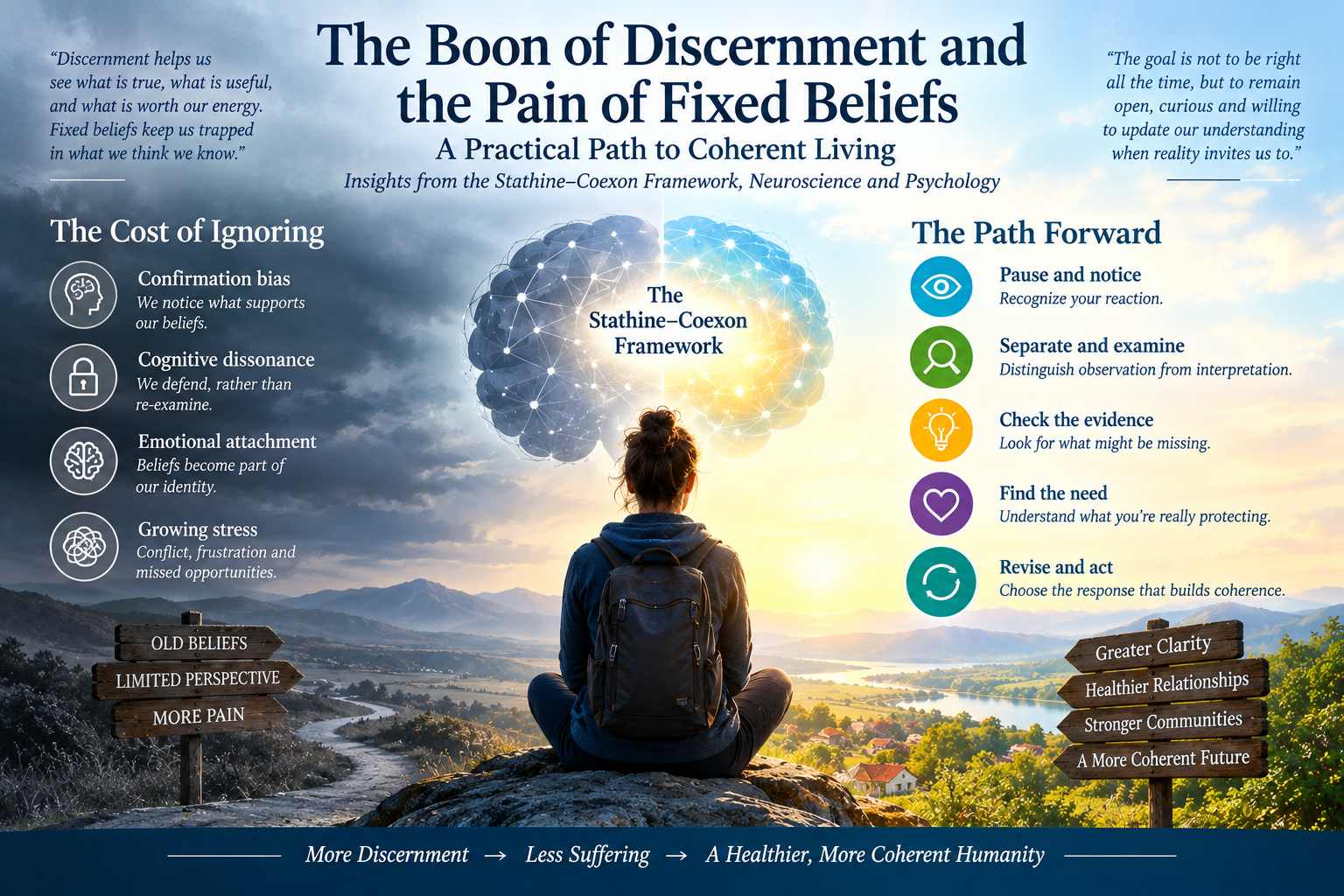
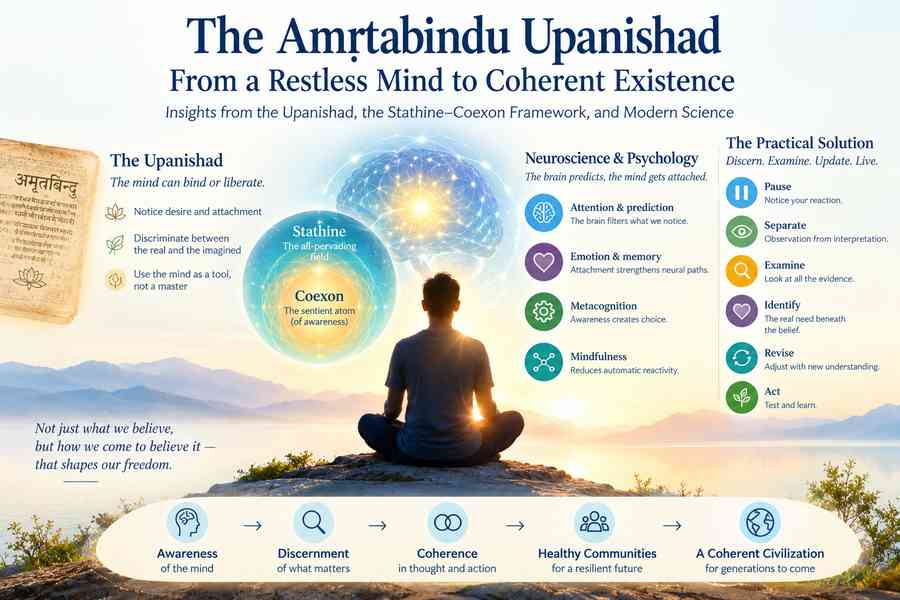
The first movement is noticing attachment. A desire, thought, or emotion becomes especially important to examine when it repeatedly governs behaviour or creates disproportionate distress. The relevant question is not whether the desire is bad, but whether the relationship with it has become inflexible. When disappointment, criticism, or uncertainty produces an automatic reaction, there may be an opportunity to see how the mind is organizing experience.
The second movement is creating room for observation. Attention can be directed toward the breath, bodily sensations, sounds, or the immediate environment, allowing a person to recognize that thoughts and emotions arise and change. This does not require forcing the mind to become blank. It involves noticing distraction, acknowledging it, and returning attention without treating the distraction as a personal failure. Research on focused-attention meditation identifies this cycle of focusing, detecting mind wandering, disengaging, and returning as an important part of attentional practice.
The third movement is examining the interpretation. Once a thought becomes visible, it can be evaluated rather than automatically accepted. If the mind says, “I have failed,” it is worth distinguishing the specific event from the larger conclusion about the self. If it says, “This person does not care about me,” the actual behaviour can be separated from the assumptions about intention. The aim is neither to replace every negative thought with a positive one nor to deny genuine problems. It is to arrive at a conclusion that is proportionate to the evidence.
The fourth movement is acting from a more complete understanding. Awareness becomes useful when it changes the response. A person may communicate a need more clearly, set a boundary, revise an expectation, accept a circumstance that cannot be changed, or take concrete steps to resolve a problem. The quality of the action then becomes further information for learning.
These movements can be expressed as a cycle:
Notice → Observe → Examine → Understand → Act → Learn.
Within the Stathine–Coexon Framework, the same sequence can be understood as the progressive movement from unexamined reaction toward more coherent action. The mind becomes useful not because it stops generating possibilities, but because its activity becomes increasingly responsive to reality, evidence, and the consequences of behaviour.
A scientific boundary: what neuroscience can and cannot establish
The dialogue between the Amṛtabindu Upaniṣad and neuroscience is valuable only if the boundaries of the two forms of inquiry remain clear.
Neuroscience can investigate attentional processes, patterns of mind wandering, emotion regulation, memory, behavioral responses, and the neural activity associated with meditation. Psychological research can examine how people relate to thoughts, how habits develop, and whether specific practices are associated with changes in well-being or behaviour. Such findings can help explain aspects of the human experience that the Upanishad discusses in philosophical language.
These findings do not demonstrate that the Self is identical with Brahman, that the ultimate reality described by the Upanishad has been measured by brain imaging, or that the Stathine–Coexon hypothesis has been established. Such claims would require evidence beyond the findings discussed here.
Likewise, the Upanishad’s philosophical authority within its tradition does not replace the empirical testing required for scientific claims. A fruitful comparison does not force the ancient text to become a neuroscience paper or ask neuroscience to validate every metaphysical statement. It allows each perspective to contribute where its methods and questions are appropriate.
The Stathine–Coexon Framework can serve as an integrative interpretive model in this dialogue. Its practical propositions about discernment, coherence, and the reduction of contradiction can be explored through observable questions: Does a person become more capable of recognizing habitual reactions? Can they distinguish experience from interpretation more reliably? Do they revise beliefs when evidence changes? Do their actions become more compatible with their stated values and with the needs of others?
These questions are open to investigation. They also make the framework useful.
Conclusion: freedom is a changed relationship with the mind
The enduring insight of the Amṛtabindu Upaniṣad is that the mind’s role in human life depends not only on what it produces, but also on how it relates to what it produces. Desire, thought, memory, and interpretation are essential features of ordinary existence. They become sources of bondage when attachment prevents the person from responding freely and appropriately to changing circumstances.
Modern neuroscience helps explain why attention wanders, why emotionally important thoughts can repeatedly capture awareness, and how contemplative practice may support the recognition and redirection of attention. Psychology adds a language for metacognition and for the distinction between an experience and the interpretation attached to it. The Stathine–Coexon Framework brings these insights into a broader inquiry about coherence: how understanding can become more complete and how action can become more consistent with reality and the needs of the whole.
The practical destination is not a permanently silent mind. A mind that plans, evaluates, imagines, remembers, and reasons remains essential to human life. Nor is freedom achieved by rejecting every external object or abandoning ordinary responsibilities. The deeper task is to loosen the automatic hold that desires and thoughts can exercise over behavior, allowing them to be considered in proportion to their relevance and consequences.
The Upanishad’s image of churning suggests that insight emerges through sustained practice rather than through the mere accumulation of descriptions. Its image of space within the pot invites reflection on the relationship between individual identity and a wider reality. Its distinction between sacred word and the reality beyond words reminds us that knowledge must eventually be examined through experience and lived understanding.
The Stathine–Coexon Framework interprets these insights as a movement toward coherence: the reduction of unnecessary contradiction between what we experience, what we believe, what we value, and how we act. Neuroscience and psychology provide ways to investigate some of the mechanisms that may support this movement, while the Upanishad preserves a deeper philosophical inquiry into the nature of the Self and liberation.
The path ahead is therefore neither the suppression of the mind nor the unquestioning acceptance of its contents. It is the gradual development of a discerning relationship with mental life, one in which awareness creates room for examination, examination deepens understanding, and understanding informs action.
When the mind no longer has to obey every desire or defend every interpretation, its capabilities become available for a wider purpose. Thought can serve understanding, understanding can guide action, and action can become more compatible with the well-being of the individual and the larger world.
The movement is from attachment to awareness, from awareness to discernment, from discernment to coherence, and from coherence toward a freer and more responsible way of living.
Further reading in the Stathine–Coexon research series
- The Ontology of the Stathine–Coexon Framework
- Epistemology of the Stathine–Coexon Framework: Knowledge, Coherence, Evidence, and the Progressive Reduction of Human Delusion
- Praxis of the Stathine–Coexon Framework: From Understanding to Coherent Action
- Becoming Aware of Awareness
Selected sources
- Amṛtabindu Upaniṣad, Sanskrit text with English translations, verses 1–22.
- Brandmeyer, T., and colleagues. “Meditation and the wandering mind: a theoretical framework of underlying neurocognitive mechanisms.” Annals of the New York Academy of Sciences (2021).
- Lutz, A., Slagter, H. A., Dunne, J. D., and Davidson, R. J. “Attention regulation and monitoring in meditation.” Trends in Cognitive Sciences (2008).
- Feruglio, S., et al. “The Impact of Mindfulness Meditation on the Wandering Mind: A Systematic Review.” Neuroscience & Biobehavioral Reviews (2021).