
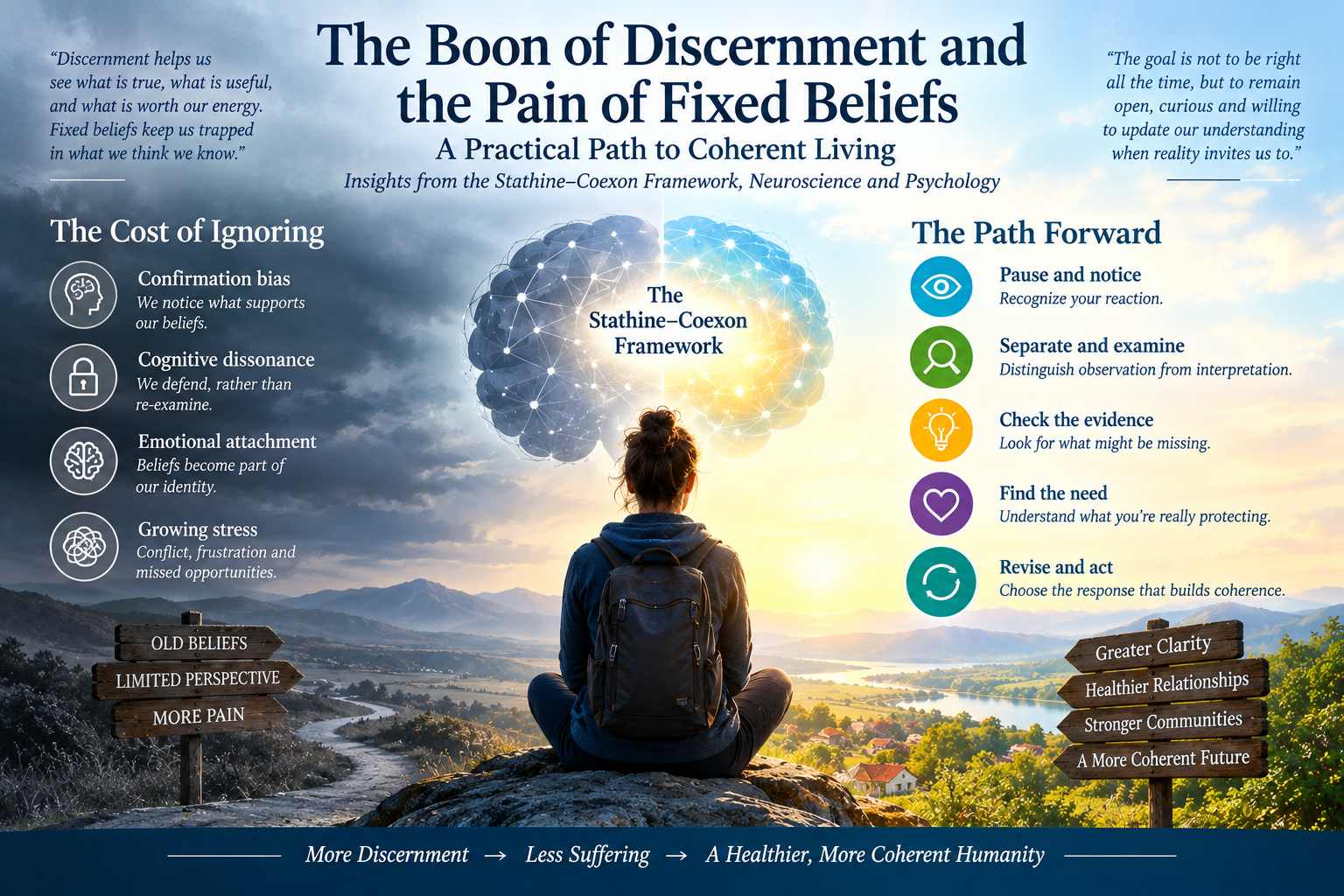
The Boon of Discernment and the Pain of Fixed Beliefs: A Practical Path to Coherent Living. Integrating the Stathine–Coexon Framework with Neuroscience and Psychology
The difference between seeing clearly and needing to be right
Imagine two people receiving the same criticism from someone they respect. The first becomes curious. Perhaps the criticism reveals something worth learning; perhaps it rests on a misunderstanding that can be clarified. The second immediately feels attacked, searches for flaws in the person offering the criticism, recalls past incidents that discredit them, and constructs an explanation for why the criticism should not be taken seriously. By the end of the conversation, the first person has gained an opportunity to understand something new, while the second has spent considerable mental energy protecting an existing position.
The difference is not necessarily intelligence, education, or experience. Both people may be highly intelligent and capable of sophisticated reasoning. What differs is their relationship with what they believe. The first uses a belief as a working understanding of reality; the second has begun to use it as a defence of identity.
This distinction explains why discernment can be a boon while ignoring contrary evidence and clinging to established beliefs can become a source of pain. Discernment allows us to distinguish what deserves attention, what is credible, what matters, and what should guide action. Fixed belief, when detached from evidence and protected against revision, turns yesterday’s understanding into today’s limitation.
The difficulty is that we rarely experience this change consciously. We do not usually announce to ourselves that we have stopped investigating reality and started defending our assumptions. Instead, our justifications often feel perfectly reasonable. We believe that we are being logical, protecting our values, remembering experience, or refusing to be deceived. What we fail to notice is that the very process intended to protect us from error can become the process that prevents us from recognizing it.
The Stathine–Coexon Framework offers a useful way to understand this problem. Its emphasis on truth, coherence, and the progressive reduction of contradiction invites us to ask whether our beliefs help us understand reality more completely or merely help us preserve a familiar interpretation of it. Neurological science and psychology provide complementary explanations of why beliefs become resistant to change and how the relationship between experience, interpretation, emotion, and action can be improved.
The practical objective is not to become a person who doubts everything. Such a person would struggle to make decisions, maintain relationships, or act with confidence. It is to become discerning enough to commit when the evidence warrants commitment, remain open when uncertainty remains, and revise one’s understanding when better explanations emerge.
Why the brain needs beliefs — and why beliefs can become traps
The human brain cannot begin every moment with a completely open investigation of the world. It must use past experience to interpret new information, anticipate what might happen, and prepare appropriate responses. Without this capacity, ordinary life would become impossibly demanding. Recognizing a familiar face, understanding a sentence, crossing a road, or deciding whether a situation is safe all depend on prior learning.
Research on predictive processing examines how the brain uses prior expectations alongside incoming sensory information to interpret the world. These expectations are not inherently errors; they are part of how perception and action become efficient. However, when expectations strongly influence how new evidence is interpreted, the person may fail to recognize that the situation has changed or that the original expectation was mistaken.
Consider someone who has experienced repeated disappointment in relationships. The person may develop a general expectation that others cannot be trusted. Initially, this belief may appear protective. It prepares the individual to notice signs of unreliability and may reduce the chance of being caught unprepared. Yet, once the expectation becomes firmly established, ambiguous behaviour can begin to look suspicious, while reliable behaviour is dismissed as temporary or strategic.
A delayed response becomes evidence of indifference. A forgotten commitment becomes evidence of selfishness. An act of kindness is interpreted as an attempt to gain an advantage. Eventually, the belief begins to organize experience in its own favour.
The person may sincerely feel that life keeps proving that people cannot be trusted, without recognizing that the belief itself influences what gets noticed, how events are interpreted, and which experiences are remembered. The original experience may have been real, but the generalization has become broader than the evidence supports.
This is where the distinction between a useful prior belief and an imprisoning belief becomes essential. A prior belief should help us interpret new information; it should not decide in advance what all new information is allowed to mean.
Psychology offers another important insight through the study of cognitive dissonance. When a belief conflicts with new information, a person’s behaviour, or an important part of their self-image, the inconsistency can produce psychological discomfort. People may respond by changing their belief or behaviour, but they may also reduce the discomfort through justification, selective interpretation, or dismissal of the conflicting evidence.
The problem, therefore, is not simply that the brain forms beliefs. It is that the mind can become motivated to preserve the psychological stability those beliefs provide, even when revision would improve its understanding of reality.
When discernment becomes selective attention
Discernment begins with the ability to distinguish. We distinguish a reliable source from an unreliable one, a meaningful pattern from a coincidence, a genuine need from a passing impulse, and a well-supported conclusion from an attractive assumption. These distinctions protect us from misinformation, manipulation, unnecessary conflict, and poor decisions.
But discernment can quietly turn into selective attention when we apply our critical faculties more rigorously to information we dislike than to information we welcome.
When evidence supports our existing position, we may accept it quickly. When evidence challenges that position, we may demand additional proof, question the source’s motives, search for exceptions, or raise standards of certainty that we never required of the original belief. The individual may believe that they are applying rigorous reasoning, yet the standards of reasoning have changed depending on which conclusion is at stake.
Research on belief formation distinguishes between updating a belief in response to evidence and the processes that determine which evidence is searched for, accepted, interpreted, and integrated. These earlier processes can be influenced by goals and motivations, even when the eventual act of updating appears responsive to evidence.
This distinction is practically important because it means that simply telling someone to be logical may not solve the problem. A person can reason logically from a distorted selection of evidence. They can identify inconsistencies in an opposing argument while remaining unaware of inconsistencies in their own. They can ask difficult questions of others while protecting their own assumptions from equivalent scrutiny.
Discernment must therefore be directed inward as well as outward. The question is not only whether another person’s reasoning is sound, but whether our own method of deciding what counts as sound reasoning remains consistent.
The Stathine–Coexon Framework makes this an issue of coherence. If truth is approached as an understanding that is transparent, sufficiently complete for the question at hand, and compatible with relevant evidence, then discernment must include the capacity to expose the limitations of one’s own interpretation. A belief that survives only because contrary information is excluded has not achieved coherence; it has achieved protection.
The hidden cost of being unable to revise
Why does a person continue defending a belief when doing so creates conflict, damages relationships, or produces repeated disappointment?
One reason is that beliefs often become connected to identity. A person may no longer experience a political, religious, professional, or personal opinion as merely an idea. It may represent family loyalty, moral integrity, competence, status, belonging, or the meaning of years of effort. Revising the belief can therefore feel like admitting that one’s past decisions, relationships, or sense of self were mistaken.
This helps explain why the emotional cost of changing a belief can appear greater than the practical cost of continuing to defend it. A person who has invested years in a particular approach may find it difficult to acknowledge that another method works better. A leader may resist evidence that a strategy is failing because accepting the evidence threatens the image of being a capable leader. A parent may continue imposing an expectation on an adult child because questioning it would require reconsidering assumptions that have shaped the relationship for decades.
The longer a belief has influenced our choices, the more opportunities we may have had to construct reasons for those choices. Changing the belief may then require more than accepting a new fact. It may require acknowledging the consequences of the old understanding and deciding how to act differently now.
Yet this is precisely where discernment becomes most valuable. Its purpose is not to protect us from the discomfort of discovering an error. Its purpose is to prevent the discomfort of correction from becoming a source of prolonged suffering.
Intellectual humility provides one possible bridge between conviction and openness. It is generally understood as an awareness that one’s knowledge and beliefs have limitations, rather than as an absence of confidence or a refusal to make judgments. A review of research on intellectual humility identifies its relevance across education, decision-making, leadership, and interpersonal relationships.
Research also suggests that intellectual humility may help people explore information that challenges their existing views, although it does not guarantee belief revision. In two studies examining false beliefs about vaccines and the 2020 US election, intellectual humility was associated with greater exploration of opposing information, which in turn predicted movement away from inaccurate beliefs. The results were encouraging but mixed, showing that humility is a useful starting point rather than a complete solution.
The implication is that a person needs both the willingness to examine a belief and a practical method for doing so. Good intentions alone are not enough. Nor is the ability to identify other people’s mistakes. What matters is whether we can notice our own uncertainty, investigate it fairly, and change our behaviour when the evidence warrants it.
The Stathine–Coexon perspective: from protecting beliefs to reducing contradiction
The Stathine–Coexon Framework approaches human understanding through the relationship between information, interpretation, truth, and coherence. Its foundational ontology proposes Stathine as a static, non-depleting, borderless field of energy in which all elements interact and exist, and Coexon as a proposed sentient atom capable of organizing information and communicating with the holobiont’s neurological brain. These are hypotheses proposed by the framework. The practical approach to discernment developed here need further to be examined through observable patterns of reasoning, behaviour, and belief revision.
Within the framework, the central question is whether our understanding is becoming more coherent with reality and with the consequences of our actions. A contradiction is not automatically a personal failure. It can be valuable information indicating that our current model is incomplete, that two legitimate needs have not yet been reconciled, or that an assumption once useful has become unsuitable.
Suppose a manager believes that effective leadership requires maintaining strict control. The manager’s experience may support the belief: clear instructions can reduce confusion, and close supervision can be necessary in some circumstances. But employees begin withholding information, avoiding initiative, and concealing mistakes. The manager interprets this as proof that employees require even tighter control.
The belief now creates some of the conditions that appear to confirm it. By reducing autonomy, the manager discourages initiative; by discouraging initiative, the manager sees less evidence of independent judgment; and by interpreting the resulting dependence as proof of incapacity, the manager reinforces the original belief.
The contradiction becomes visible when the manager examines the whole system rather than only the behaviour of individual employees. Perhaps the team lacks experience, perhaps expectations are unclear, or perhaps excessive supervision is preventing people from developing competence. The original belief may still apply to particular situations, but it cannot adequately explain the entire pattern.
A coherent response does not require abandoning leadership or replacing control with unlimited freedom. It requires distinguishing circumstances in which direction is necessary from those in which autonomy produces better results. The manager becomes more discerning precisely by becoming less attached to a single explanation.
This illustrates the framework’s principle of progressive reduction of contradiction. Instead of forcing every observation to fit an established belief, the individual allows the belief to evolve until it accounts more adequately for the available evidence and supports more constructive action.
The same process applies to personal relationships, parenting, education, health decisions, business strategy, and public policy. When repeated conflict or disappointment occurs, the most useful question may not be, “Who is wrong?” but, “What are we assuming that prevents us from understanding the situation more completely?”
Sometimes the answer will reveal another person’s mistake. Sometimes it will reveal our own. Often it will expose a mismatch between expectations, circumstances, and capabilities that neither party has fully understood. Discernment improves when all three possibilities remain open.
A practical method: pause, separate, examine, update, and act
The practical solution must work in the moment when a belief is challenged, because that is when the emotional impulse to defend it may be strongest. It should not require a person to become a professional psychologist or suspend judgment indefinitely. It should introduce a small but meaningful space between the experience of contradiction and the response to it.
First, pause long enough to recognize the reaction. When disagreement produces irritation, embarrassment, fear, or an urgent need to reply, the emotional response is information about the importance of the issue to us. It is not proof that our belief is wrong, nor is it proof that the other person is wrong. A short pause, a slower breath, or a decision to revisit the matter later can help prevent the first impulse from becoming the final judgment.
This pause is not a claim that emotion must be eliminated before reasoning becomes possible. Emotion often identifies what matters and helps prioritize action. The purpose is to prevent the intensity of a feeling from being mistaken for the certainty of a conclusion.
Second, separate what happened from what you believe it means. Imagine that a friend has not returned a call. The observation is that the call has not been returned. “My friend does not respect me” is an interpretation. “People always take advantage of me” is a generalization. “I should stop trusting people” is a proposed rule for future behaviour. Each step adds meaning that may or may not be justified by the original observation.
Writing these layers separately can expose how quickly the mind moves from an event to a judgment about another person or the world. It also creates room for alternative explanations: the friend may be occupied, distressed, forgetful, uncertain how to respond, or genuinely neglectful. Further evidence is needed to distinguish among these possibilities.
Third, examine the evidence in both directions. Instead of asking only what supports a belief, ask what would count against it. What evidence would make you reconsider? Would you apply the same standard if the belief belonged to someone you disagreed with? Are you demanding stronger evidence from the opposing view than from your preferred one?
These questions turn discernment into a consistent method rather than a weapon used selectively against other people. They also make beliefs more testable. If no imaginable evidence could change a conclusion, it is worth asking whether the conclusion is functioning as an unquestionable commitment rather than as an explanation of reality.
Fourth, distinguish the value you want to preserve from the belief you use to protect it. A person who refuses to trust anyone may be trying to preserve safety. A parent who controls every decision may be trying to protect a child. A leader who rejects criticism may be trying to preserve competence or responsibility. These underlying needs may be legitimate even when the chosen strategy is counterproductive.
Recognizing the need allows the strategy to change without requiring the person to abandon what matters. Safety can be pursued through boundaries and gradual trust rather than universal suspicion. Care can be expressed through guidance that develops independence rather than through permanent control. Professional competence can be strengthened by responding to evidence rather than suppressing criticism.
Fifth, revise the belief in proportion to the evidence. Not every contradiction requires a complete reversal. Sometimes a belief needs a narrower scope, a lower level of confidence, or an additional condition. “Nobody can be trusted” might become “Trust should develop through consistent behaviour, and some people have shown that they are not reliable.” This revised belief is neither naïve nor cynical. It preserves caution while allowing reality to be more varied than the original generalization.
A useful habit is to describe confidence in degrees rather than treating every belief as absolutely true or false. Some conclusions are strongly supported, others are plausible but incomplete, and still others remain uncertain. Matching confidence to evidence makes it easier to update without feeling that every revision is a humiliating reversal.
Finally, test the revised understanding through action and observe the consequences. If a manager suspects that excessive supervision is reducing initiative, the manager can create a limited opportunity for employees to make decisions independently and observe what happens. If someone believes that every disagreement damages a relationship, they can try a respectful conversation in which differences are acknowledged without turning them into personal attacks.
Action provides feedback that abstract argument cannot always supply. The purpose is not to prove a new belief correct at any cost, but to discover whether it explains the situation better and supports a more constructive response. When the outcome contradicts the revised belief, the learning process begins again.
Together, these steps establish a practical cycle:
Pause → Separate observation from interpretation → Examine evidence → Identify the underlying need → Revise confidence or belief → Test through action → Learn from the result.
The cycle is deliberately modest. It does not promise perfect judgment. It offers a repeatable way to prevent a belief from becoming immune to the very experiences that should inform it.
Why the method works with human psychology
This approach is consistent with several established psychological principles, although the complete sequence is a practical synthesis rather than a single clinically validated protocol.
Separating observations from interpretations reduces the chance that an immediate explanation will be treated as an unquestionable fact. Examining evidence on both sides helps counter selective search and motivated evaluation. Identifying the underlying need can reduce the perceived threat involved in changing a strategy. Testing revised beliefs through action provides opportunities to learn from outcomes rather than relying exclusively on abstract argument.
Metacognition — the ability to reflect on one’s own thinking — provides a broader foundation for these practices. Instead of attending only to the content of a belief, a person also notices how the belief is being formed, how confidence is being assigned, and how emotional or motivational factors may influence the process.
A systematic review published in 2025 found a consistent association between changes in metacognitive beliefs and improvement across different psychological difficulties and treatments, while also noting that many studies were not sufficiently rigorous to establish causality definitively. The finding supports the relevance of metacognition without implying that every form of self-reflection is automatically beneficial.
Reflection is most useful when it changes how a person responds to experience. Repeatedly analysing a conflict without acquiring new information or considering a different action can become rumination rather than discernment. The difference lies partly in whether thinking opens possibilities or merely rehearses the same interpretation.
For some people, especially when beliefs are entangled with severe anxiety, obsessive rumination, trauma, or persistent relationship difficulties, changing these patterns may require structured psychological support. A practical framework can support self-awareness, but it is not a substitute for professional care when distress is substantial or enduring.
Relationships: where fixed beliefs become visible
Our beliefs are often easiest to recognize through the pain they create in relationships. A person may believe that a partner should understand their needs without being told, that a child should make the choices the parent considers best, or that a colleague who disagrees is demonstrating disrespect. When the other person behaves differently, the event is interpreted as a failure of character rather than as an opportunity to investigate differing expectations, information, or needs.
The resulting conflict can become self-reinforcing. One person feels misunderstood and withdraws; the other interprets the withdrawal as indifference and responds with criticism; the first experiences the criticism as proof that speaking openly is unsafe. Each person collects evidence for a belief that the interaction itself is helping to sustain.
Discernment changes the questions that guide the relationship. Instead of assuming that a person’s action reveals their entire character, we ask what the action actually demonstrates, what remains unknown, and whether the pattern persists across circumstances. We distinguish a boundary from a punishment, an explanation from an excuse, and a disagreement from a rejection of the person.
This does not mean tolerating harmful behaviour or remaining in unsafe relationships. Openness to revising one’s interpretation must coexist with clear boundaries and attention to evidence. If someone repeatedly violates an explicit boundary, the coherent response may be to reduce contact rather than continue searching for a more generous explanation. Discernment requires neither automatic suspicion nor unlimited forgiveness; it requires proportionate judgment.
The same principle can transform disagreement. Two people need not reach identical conclusions to understand each other better. They can clarify what they agree upon, identify the point where their interpretations diverge, and decide whether the difference can be resolved through further evidence, negotiated expectations, or respectful coexistence.
In the Stathine–Coexon perspective, coherence is not uniformity. It is the capacity for different needs and perspectives to exist in a relationship that remains responsive to reality. Sometimes coherence produces agreement; sometimes it produces a clearer boundary and a safer distance.
From individual discernment to collective intelligence
The consequences of fixed beliefs extend beyond the individual. Organizations may continue investing in failing strategies because leaders have tied their reputations to them. Institutions may dismiss emerging evidence because acknowledging it threatens established procedures or interests. Societies may become polarized when groups interpret every new event through narratives that divide people into permanent allies and enemies.
In these circumstances, the problem is not merely that individuals hold inaccurate beliefs. It is that institutions can reward the defence of those beliefs. Employees who reveal problems may be penalized, leaders may surround themselves with people who agree with them, and public debate may reward confidence and outrage more than careful correction.
A culture of discernment therefore requires more than asking individuals to become humble. It requires environments in which evidence can be reported safely, mistakes can be acknowledged without disproportionate humiliation, and decisions can be revised when circumstances change. Accountability remains necessary, but accountability should improve learning rather than make concealment the safest response to error.
This is particularly important as artificial intelligence becomes more influential in decision-making. AI systems can help compare evidence, identify inconsistencies, generate alternative explanations, and reveal assumptions in an argument. Yet an AI system can also reproduce biased data, present incorrect claims confidently, or reinforce the user’s existing preferences. Its output should be treated as material for examination rather than as a substitute for discernment.
The Stathine–Coexon Framework’s movement from information to understanding and coherence offers a useful way to evaluate both human and artificial intelligence. The question is not merely whether a system can produce a persuasive answer, but whether it helps improve the relationship between evidence, interpretation, action, and consequences.
A mature partnership between human judgment and AI would allow the system to challenge the user’s assumptions as well as assist with the user’s goals. It would make uncertainty visible, distinguish evidence from inference, offer plausible alternatives, and encourage verification where errors carry significant consequences. The human participant would remain responsible for evaluating the evidence and deciding what action is appropriate.
The broader aspiration is intelligence that can learn without becoming trapped by its previous success. Whether in a person, a team, an institution, or a machine, the capacity to revise an inadequate model is a crucial component of effective adaptation.
The freedom to be wrong — and to become less wrong
One of the most important changes in a discerning life is the gradual separation of self-worth from the need to be right. If admitting an error means losing dignity, people will find reasons to avoid admitting errors. If changing one’s mind can be understood as evidence of learning, revision becomes less threatening.
A person can be wrong about a decision without being worthless. A leader can revise a strategy without losing the capacity to lead. A parent can acknowledge that an expectation was mistaken without abandoning the desire to care for a child. A professional can learn that a long-standing method is ineffective without discarding the experience gained through years of practice.
This distinction is not merely comforting. It creates practical room for adaptation. When people no longer have to defend every past conclusion to preserve their identity, they can examine new information with greater freedom. The past becomes a source of learning rather than a courtroom in which every earlier decision must be justified.
Within the Stathine–Coexon Framework, this movement can be understood as progressive reduction of contradiction. The aim is not to achieve a state in which no error is possible. It is to reduce the need to preserve errors once they become visible. Truth becomes a continuing relationship with reality rather than a possession that must be defended against every challenge.
Discernment, then, is not the ability to make a final judgment and never revisit it. It is the capacity to make the best judgment available, understand its limits, act responsibly, and remain willing to learn. Its strength lies in the balance between commitment and openness: enough confidence to act, enough humility to reconsider, and enough clarity to recognize when a belief has stopped serving understanding.
The practical solution to fixed beliefs is therefore not to remove conviction from human life. It is to make conviction accountable to evidence, to keep the underlying need separate from the strategy chosen to meet it, and to allow action and its consequences to inform the next cycle of understanding.
The progression is simple to express, though it takes practice to embody:
Experience → Discernment → Awareness of assumptions → Examination → Revision → Coherence → Constructive action → New learning.
When this cycle becomes part of everyday life, discernment becomes a boon not because it guarantees that we will always be right, but because it helps us recognize when we are wrong and respond without unnecessary suffering. The pain of fixed beliefs arises when the mind treats revision as a threat. Freedom begins when revision becomes a natural part of understanding.
The ultimate measure of discernment is not how confidently we defend what we believe. It is whether our beliefs help us see more clearly, relate more constructively, act more responsibly, and remain responsive to the reality we share.
Further reading in the Stathine–Coexon research series
- Epistemology of the Stathine–Coexon Framework: Knowledge, Coherence, Evidence, and the Progressive Reduction of Human Delusion
- The Principle of Truth Compression
- Praxis of the Stathine–Coexon Framework: From Understanding to Coherent Action
- Becoming Aware of Awareness
The Stathine–Coexon Framework is a proposed integrative philosophical framework. Its ontological propositions, including Coexon, are all proposals which are being tested by many people. The practical methods discussed here draw on psychological concepts and research, but the combined framework itself is evolving as more and more people validate it.