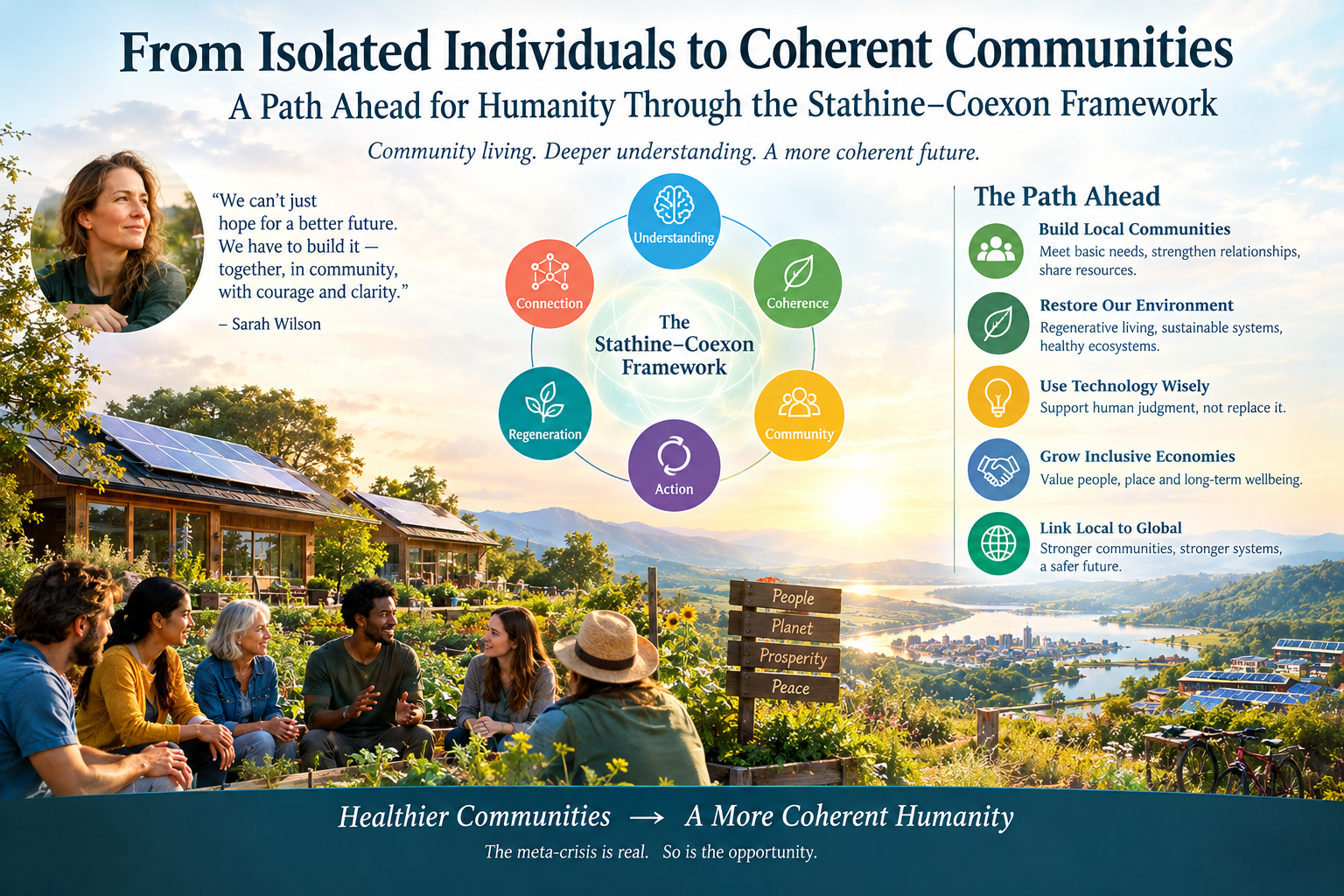
From Isolated Individuals to Coherent Communities: A Path Ahead for Humanity Through the Stathine–Coexon Framework
Integrating Sarah Wilson’s reflections on living through the meta-crisis with a framework for community, coherence, and civilizational renewal
The crisis beneath the crises
Imagine a society that has never been more connected technologically, yet in which many people feel increasingly alone. Food travels across continents while communities struggle to secure healthy local food systems. Digital networks transmit information instantly, but public discourse often deepens distrust rather than understanding. Economies generate unprecedented wealth and extraordinary technological capabilities, yet ecological degradation, inequality, political polarization, and anxiety about the future persist. Each problem appears to demand its own solution, and humanity responds by building specialized institutions, technologies, policies, and markets. Nevertheless, the problems continue to interact, frequently reinforcing one another.
This is the difficulty commonly described as the meta-crisis: not simply a collection of separate emergencies, but a convergence of crises whose deeper causes may lie in the ways humanity understands reality, organizes collective life, distributes power, and defines progress. Environmental damage, social fragmentation, economic insecurity, institutional distrust, and technological disruption cannot always be resolved independently because the conditions producing one crisis may intensify another.
The challenge, therefore, is not only to repair the systems that are failing. It is to understand why our existing arrangements repeatedly generate outcomes that contradict our collective interests.
Sarah Wilson’s reflections on living through a world in crisis offer an important human entry point into this question. Rather than relying on comforting promises that everything will return to normal, her approach invites people to confront uncertainty, acknowledge the possibility of profound disruption, and discover how to live meaningfully without waiting for the world to become predictable again. Her discussion of community, care, nature, and the creation of islands of sanity points toward a crucial possibility: even when humanity cannot immediately transform the entire global system, people can begin building ways of living that embody a healthier relationship with one another and the living world.
The Stathine–Coexon Framework offers a complementary perspective. It asks whether many of humanity’s difficulties arise from persistent contradictions between what people understand, what they value, how they behave, and the consequences their actions produce. From this perspective, the path forward is not simply to make existing systems more efficient. It is to improve the coherence between individual understanding, community relationships, institutional arrangements, economic activity, and ecological reality.
Community living becomes significant when it is understood in this broader sense. It is not a retreat from civilization, nor does it require everyone to abandon cities, modern technology, markets, or individual aspirations. It is an opportunity to reorganize the relationships through which human beings meet their needs, develop their capabilities, and contribute to a larger whole. The question is how to turn this possibility into a practical path for humanity.
Why the isolated individual cannot solve a collective crisis alone
Modern societies have achieved remarkable progress by enabling individuals and specialized organizations to pursue particular goals. Scientific specialization has expanded knowledge, markets have coordinated exchanges across vast distances, and technological systems have made previously impossible activities routine. These achievements should not be dismissed. The difficulty begins when specialization becomes separation, and when the success of one part of a system is treated as proof of the health of the whole.
A company may increase its profitability while transferring environmental costs to society. A household may obtain inexpensive goods without seeing the ecological and social consequences of their production. A government may improve a short-term economic indicator while weakening the trust and resilience on which future prosperity depends. Each actor may behave rationally within a limited field of understanding, yet the combined outcome can be destructive.
This is a problem of fragmented intelligence. Knowledge exists, but it is distributed across institutions that may have limited incentives or capacity to integrate it. People recognize the consequences of their own decisions incompletely, while the costs of those decisions are frequently experienced by others, by future generations, or by the ecosystems on which everyone depends.
The Stathine–Coexon Framework treats coherence as a way to examine this gap between local success and whole-system consequences. Coherence does not mean that everyone must think alike or that every conflict can be eliminated. It means developing sufficient understanding of the relationships among different needs, actions, and consequences to make decisions that are more compatible with reality and with the continued flourishing of the larger system.
A community provides a human-scale environment in which these relationships become more visible. The person growing food may also know the people who eat it. The individual caring for an older neighbour may experience the social value of care directly. Residents may observe the consequences of waste, transport, energy consumption, or land use within the same place where they live. Interdependence, which can remain abstract in a global economy, becomes tangible through daily relationships.
Such proximity does not automatically create harmony. Communities can reproduce exclusion, prejudice, hierarchy, and conflict. Familiarity can become surveillance, collective responsibility can become coercion, and local loyalties can turn into hostility toward outsiders. The value of community living therefore depends not on closeness alone, but on the quality of the relationships and institutions that make cooperation possible.
A coherent community is not one without disagreement. It is one capable of recognizing disagreement, examining the assumptions beneath it, protecting individual dignity, and finding arrangements that allow different people and needs to coexist constructively.
Community as a living system
The idea of community becomes more powerful when we stop seeing it merely as a collection of households and begin understanding it as a living system of relationships.
A community depends on food, water, energy, shelter, health, education, care, economic activity, culture, trust, and the natural systems that sustain them. These are not independent services that happen to occupy the same geographical area. They interact continuously. Reliable access to food affects health; health affects people’s ability to learn and work; education affects economic opportunity; economic security influences family stability; and trust influences whether people cooperate when difficulties arise.
Research on regenerative community development makes a related argument. Regenerative approaches seek not merely to reduce harm but to strengthen the capacity of social and ecological systems to sustain and renew life. A community-scale regenerative framework developed by Leah V. Gibbons, for example, connects social, cultural, ecological, and other dimensions of community development rather than treating sustainability as a narrow technical problem.
The Regenerative Lens, developed by an interdisciplinary group of researchers, similarly emphasizes ecological understanding, mutualism, diversity, the agency of human and non-human participants, and continuous reflection. Its central orientation is toward systems in which the conditions for flourishing reinforce one another rather than being depleted to support isolated gains.
These perspectives converge with an important implication of the Stathine–Coexon Framework: a healthy system should be assessed not only by what it produces, but also by whether its functioning preserves and strengthens the relationships on which its continued existence depends.
Consider a community food system. Its success cannot be measured only by the quantity of food sold or the income generated. It also matters whether soil quality improves, farmers retain viable livelihoods, nutritious food remains accessible, waste is reduced, and residents develop a more informed relationship with the sources of their nourishment. The relevant outcome is not simply production; it is the coherence of the relationships that sustain production and human well-being over time.
The same principle applies to education, healthcare, housing, energy, and local enterprise. A school is part of a community’s capacity to understand and respond to reality. Healthcare is connected to food, living conditions, social support, and preventive knowledge. Housing is linked to energy use, mobility, safety, affordability, and the availability of shared spaces. Enterprise can strengthen a community when it adds value to these relationships rather than extracting value while leaving the consequences to others.
Community living thus becomes a way to make the interdependence of human life visible and actionable. It allows people to move from asking, “How can I secure my share?” toward the more encompassing question, “What conditions enable all of us, including future generations, to live well?”
From the Stathine–Coexon Framework to a culture of coherence
The Stathine–Coexon Framework distinguishes between its foundational definitions, its hypotheses about existence and sentience, and the practical implications that can be explored in human life. Its concept of Stathine describes a proposed static, non-depleting, borderless field of energy in which all elements interact and exist. Its concept of Coexon proposes a sentient atom capable of organizing information and communicating with the holobiont’s neurological brain. These are framework propositions, not established scientific findings. The practical argument for community coherence does not depend on treating these propositions as empirically proven; it can be explored through observable human relationships, institutional outcomes, and ecological consequences.
Within this framework, the human being is understood as more than an isolated biological individual. The person develops through relationships with other people, the body, the surrounding environment, and the systems of knowledge and meaning through which experience is interpreted. The framework’s proposed Coexon–brain relationship offers an ontological hypothesis about the relationship between sentience and biological communication, while its practical vocabulary of coherence can be used to examine how understanding becomes action.
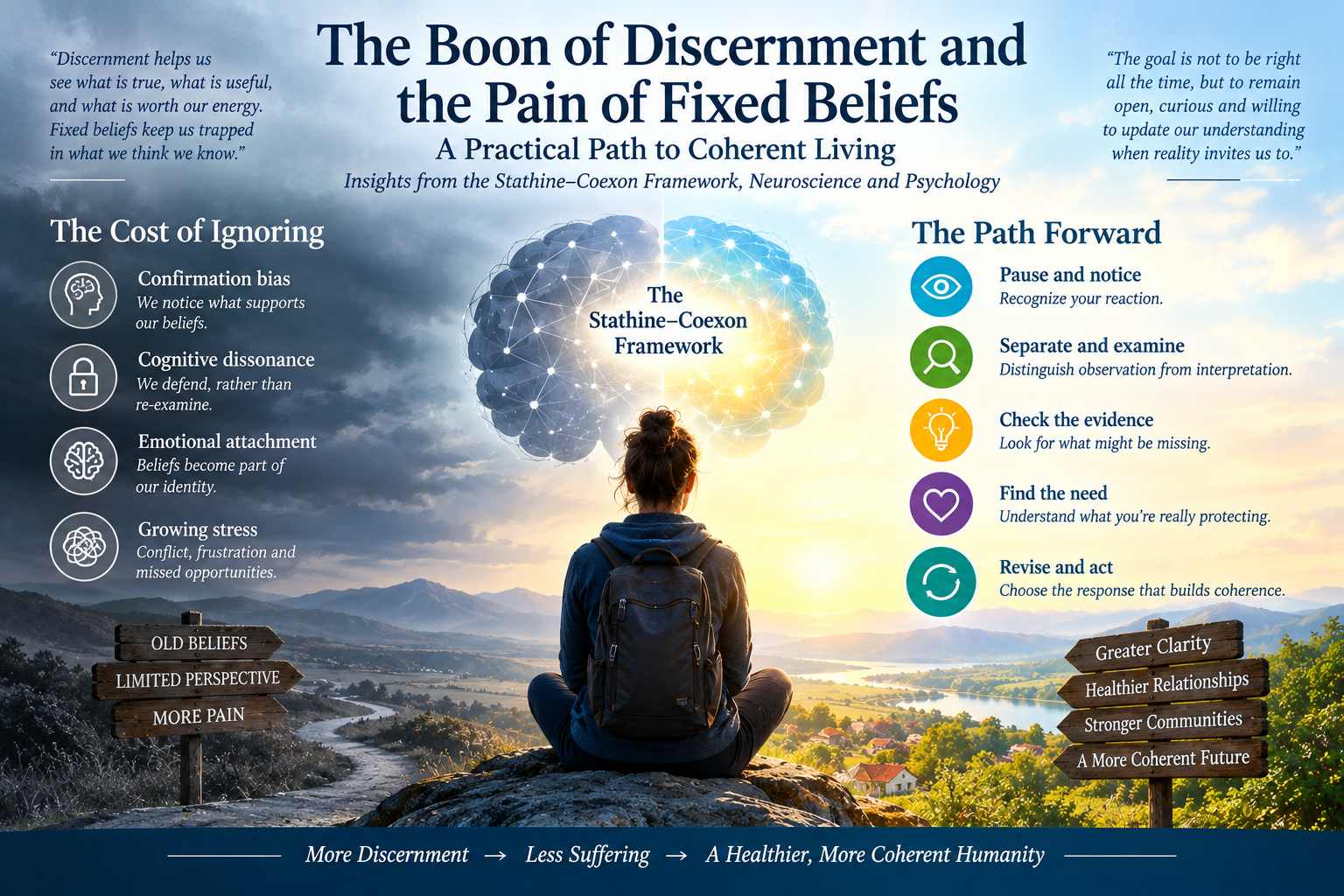
One of the most useful concepts here is the progressive reduction of contradiction. A contradiction arises when our beliefs, needs, actions, and consequences cannot be reconciled without further understanding or change. A person may value health while participating in habits that undermine it; a business may claim to value sustainability while depending on practices that degrade its ecological foundations; a community may celebrate equality while excluding people who lack wealth or social influence.
These contradictions do not disappear simply because they are exposed. People may defend them because changing a familiar practice threatens their identity, income, status, or sense of security. Progress requires conditions in which contradictions can be examined without immediately turning the process into a contest between winners and losers.
Community can help create those conditions. When people meet repeatedly, share practical responsibilities, and observe the consequences of their decisions, abstract disagreements can become opportunities for joint learning. A dispute over water use, for example, can reveal competing assumptions about ownership, fairness, ecological limits, and future need. Rather than treating the dispute as evidence that one side must defeat the other, the community can use it to develop a more complete understanding of the system on which all parties depend.
This is not an argument that truth is whatever a community agrees upon. A community can collectively believe something false. Reality, evidence, and the consequences of action must remain central. The purpose of shared inquiry is to improve the relationship between collective understanding and the world that understanding seeks to navigate.
In this sense, coherence is not conformity. Diversity of experience and perspective can help reveal what a homogeneous group overlooks. The task is to bring differences into a relationship where they can contribute to a more complete understanding, rather than allowing them to harden into permanent divisions.
The path ahead: from local resilience to civilizational transformation
The future need not depend on humanity discovering one perfect model of community living. Different regions have different climates, cultures, resources, histories, and institutional arrangements. A densely populated city, a rural settlement, an Indigenous community, and an intentional ecovillage cannot all be organized in the same way. What can travel across these contexts are the principles of learning, reciprocity, ecological responsibility, inclusion, and continuous adaptation.
The first step is to make essential interdependencies visible. Communities need a shared understanding of where their food, water, energy, materials, income, and care come from, as well as where their waste and risks go. This need not begin with an elaborate digital platform. A clear local map of resources, vulnerabilities, capabilities, and unmet needs can reveal opportunities for cooperation that are invisible when every household or organization works independently.
The second step is to build practical cooperation around needs that people already recognize. Shared food-growing initiatives, community repair services, local energy projects, cooperative purchasing, care networks, skill-sharing, and common spaces can strengthen relationships while solving tangible problems. These initiatives are most useful when they reduce real burdens and expand people’s agency, rather than requiring participation as a matter of ideological loyalty.
The third step is to make community enterprise part of the solution. Community living does not mean abolishing enterprise or assuming that every service can be provided voluntarily. It means creating economic arrangements that reward genuine value addition and account more honestly for social and ecological consequences. Local businesses, cooperatives, public institutions, and larger enterprises can contribute when their incentives support the health of the systems on which they depend.
This is where the Stathine–Coexon Framework’s distinction between individual gain and whole-system coherence becomes economically significant. An enterprise should be assessed not only by the value it captures, but also by the value it creates, the capabilities it develops, the dependencies it strengthens or weakens, and the costs it transfers to others. Such an approach does not remove the need for markets, accounting, or financial discipline. It asks that they become more complete.
The fourth step is to develop community learning as a permanent capability. Every initiative will encounter failure, disagreement, unintended consequences, and changing circumstances. A community that hides mistakes will repeat them; one that treats every mistake as a reason to assign blame will discourage experimentation. A learning community instead asks what its experience reveals, which assumptions need revision, and what should change in the next cycle of action.
This approach reflects the framework’s emphasis on truth, understanding, and the progressive reduction of contradiction. Its practical test is whether new learning changes decisions and improves outcomes. A community does not become coherent by declaring itself coherent, but by demonstrating that it can recognize reality, revise its understanding, and act more constructively over time.
The fifth step is to protect inclusion and individual freedom. Community resilience must not be built at the expense of those with less power. Women, children, older people, people with disabilities, newcomers, and economically disadvantaged residents must have meaningful opportunities to influence decisions that affect them. Privacy, dissent, personal boundaries, and the freedom to leave a community are essential safeguards. Cooperation becomes sustainable when people experience it as a source of greater capability, not as the loss of their autonomy.
Finally, local communities need connections to wider networks. A neighbourhood cannot solve climate change alone, nor can it independently manage every healthcare, financial, technological, or infrastructure dependency. Local resilience should therefore complement regional coordination, national public institutions, and international cooperation. The goal is not to retreat from the world into self-sufficient enclaves, but to build a nested system in which capable local communities contribute to and benefit from larger networks.
Research on community self-organization supports the importance of this combination. A study of six community cases in Brazil identified social capital, external partnerships, opportunities for social interaction, collective agency, and economic opportunities or rights as interconnected factors in overcoming local crises. The findings suggest that self-organization is strengthened not by isolation, but by relationships and feedback that enable communities to mobilize, learn, and sustain action.
The role of technology and artificial intelligence
Community living should not be romanticized as a return to a pre-technological past. Modern medicine, communications, scientific knowledge, renewable energy, and carefully designed digital systems can all strengthen community capability. The central question is whether technology serves the development of human understanding and collective agency, or whether people become increasingly dependent on systems they cannot question or influence.
Artificial intelligence could help communities understand complex relationships that are difficult to assess through ordinary observation. It might help map local energy demand, forecast water stress, coordinate care, identify food waste, compare policy options, translate across languages, or make relevant public information more accessible. Properly governed, these tools could help residents see the connections among decisions that are usually considered separately.
But a technically sophisticated system can still optimize the wrong objective. An algorithm might minimize costs while excluding people who are difficult to serve, maximize engagement while increasing social conflict, or improve local efficiency while shifting ecological costs elsewhere. Data cannot determine community values by itself, and a prediction is not the same as an understanding of what ought to be done.
The Stathine–Coexon Framework’s progression from information to understanding, coherence, and action offers a useful conceptual discipline here. AI should help people examine evidence, identify assumptions, understand trade-offs, and evaluate consequences. It should not silently replace public judgment or treat a computational recommendation as the final authority on human needs.
This points toward a partnership between artificial intelligence and natural intelligence. AI can expand analytical capacity, while people contribute lived experience, moral judgment, contextual knowledge, and responsibility for consequences. Community members must remain capable of questioning the system, correcting its assumptions, and deciding whether its recommendations reflect their needs.
The same principle applies to the wider meta-crisis. Technology alone cannot resolve contradictions embedded in social priorities and institutional incentives. Its value depends on the purposes for which it is designed, the people who control it, and the relationships it strengthens or weakens.
From islands of sanity to a coherent civilization
Sarah Wilson’s image of creating islands of sanity is powerful because it recognizes that people need places and relationships in which they can remain capable of care, judgment, and constructive action even amid wider uncertainty. Such islands are not merely refuges from the world. At their best, they become places where new ways of living can be practised, tested, and shared.
The Stathine–Coexon Framework extends this idea toward a broader civilizational possibility: the emergence of a coherence-oriented society in which institutions are evaluated by their contribution to the health of the whole. In such a society, progress would not be measured exclusively by production, consumption, technological power, or the accumulation of information. It would also be measured by whether people understand their interdependence, whether ecological systems are being renewed, whether institutions learn from evidence, and whether the benefits of collective life expand human capability without transferring hidden costs to others.
A coherent civilization would still contain competition, disagreement, ambition, and change. Its defining feature would be the capacity to place these forces within a more complete understanding of their consequences. Competition could encourage innovation without legitimizing the destruction of shared foundations. Individual achievement could flourish without making social contribution invisible. Technological advancement could proceed alongside ecological responsibility rather than treating the living world as an unlimited source of inputs and an unlimited destination for waste.
This transformation cannot be imposed by a single authority or achieved through a single blueprint. It must emerge through a combination of personal development, community experimentation, institutional reform, scientific learning, and coordinated public action. Some initiatives will fail. Others will reveal possibilities that can be adapted elsewhere. The important question is whether humanity can build systems that learn faster than their mistakes accumulate and that spread the benefits of successful learning beyond the places where it begins.
Community living, in this account, is not the final destination. It is one of the environments in which humanity can rediscover how to cooperate without suppressing difference, how to create value without exhausting its foundations, and how to use knowledge without confusing information with wisdom.
Conclusion: the path from crisis to coherence
The meta-crisis confronts humanity with a difficult possibility: many of the systems developed to secure our future may now be undermining the conditions required for that future. The response cannot be limited to repairing individual failures while leaving their relationships untouched. It requires a change in how we understand progress, organize collective life, and evaluate the consequences of our choices.
Sarah Wilson’s reflections on confronting uncertainty and finding meaning through community offer a human starting point. The Stathine–Coexon Framework provides a complementary conceptual lens through which community can be understood as a setting for progressively aligning knowledge, needs, action, and consequences. Regenerative research reinforces the practical importance of mutualism, diversity, ecological responsibility, and continuous learning.
The path ahead is neither an escape into isolated self-sufficiency nor a promise that technology or centralized planning will solve everything. It is the gradual development of communities that can meet essential needs, regenerate their environments, sustain meaningful relationships, learn from contradiction, and cooperate across differences. These communities must remain open to the wider world, connected to capable institutions, and committed to protecting individual dignity.
Humanity does not need every person to adopt one ideology or live in one prescribed way. It needs more places where people can experience the practical benefits of cooperation, where evidence can change minds, where enterprise creates value without destroying its foundations, and where the well-being of the whole is not treated as separate from the well-being of its parts.
The movement can begin with a local question: are the ways we live together strengthening or weakening the conditions on which we all depend? As communities learn to answer that question honestly, they can turn isolated acts of care into durable institutions, local experiments into shared knowledge, and shared knowledge into more coherent systems.
The larger aspiration is a civilization in which human intelligence is expressed not merely through what humanity can invent or accumulate, but through its growing capacity to understand interdependence and live accordingly.
The path ahead is from isolated resilience to connected resilience, from connected resilience to regenerative communities, and from regenerative communities toward a coherent civilization. The meta-crisis may be a warning about the contradictions in our present arrangements, but it can also become an invitation to build relationships and institutions that make a different future possible.
Further reading in the Stathine–Coexon research series
- The Stathine–Coexon Framework as an Integrative Meta-Framework for Human Understanding
- Evaluating the Framework Across Five Dimensions: Epistemology, Ontology, Axiology, Praxis, and Telos
- Praxis of the Stathine–Coexon Framework: From Understanding to Coherent Action
- From Civilizational Coordination to Coherent Civilization
- From AI to NI