Beyond the Myth of Learning Through Mistakes: A Coherence-Based Reorientation of Learning, Knowledge, and Human Development Through the Stathine–Coexon Framework
Author: Anand Damani
Research programme: Stathine–Coexon Framework — Level III: Applications, with foundations in epistemology, ontology, and the progressive reduction of contradiction
Abstract
The cultural maxim “we learn by making mistakes” is widely treated as an unquestionable principle of education, professional development, parenting, leadership, and personal growth. Yet the proposition conflates three distinct phenomena: the occurrence of an error, the information made available by that error, and the actual acquisition of more reliable understanding. These phenomena are neither equivalent nor causally guaranteed to follow one another. Individuals may repeat errors, rationalise failure, learn harmful habits, and incur avoidable costs without achieving meaningful improvement. Conversely, individuals can acquire knowledge through observation, explanation, simulation, experimentation, and the analysis of other people’s experiences without personally reproducing their mistakes.
This conceptual article challenges the cultural elevation of error as a privileged route to learning and proposes a coherence-based alternative grounded in the Stathine–Coexon Framework. The framework defines learning in terms of the progressive reduction of contradiction, the improvement of understanding, and the capacity to translate understanding into constructive action. Its central epistemological proposition is that the objective of learning should not be to accumulate experiences of being wrong, but to develop increasingly adequate representations of reality while minimising avoidable harm and wasted effort. The article distinguishes established findings in cognitive and educational psychology from the framework’s proposed ontological hypothesis concerning Coexon. It argues that mistakes can provide useful information under identifiable conditions, but are neither necessary nor sufficient for learning. A coherence-based model is proposed for education, organisational practice, parenting, and artificial intelligence, alongside an empirical research agenda designed to test whether learning organised around contradiction reduction outperforms approaches that explicitly privilege learning through personal error.
Keywords: learning theory; learning from errors; epistemology; contradiction reduction; metacognition; feedback; Stathine–Coexon Framework; educational psychology; coherence-based learning
1. Introduction: When a Cultural Maxim Becomes an Unexamined Assumption
A child breaks something while experimenting, an entrepreneur loses money pursuing an unsuitable opportunity, a manager makes a poor decision, or a student misunderstands a concept. The familiar response is reassuring: “It is all right. We learn by making mistakes.” The sentence appears compassionate, realistic, and educational. It encourages persistence and reduces the shame associated with failure. Over generations, however, its repeated use has helped establish a broader cultural assumption: that making mistakes is an important, perhaps unavoidable, route to acquiring knowledge.
The difficulty begins when a useful observation becomes a universal prescription. The fact that people sometimes learn after making mistakes does not establish that mistakes are necessary for learning, that they are the most effective way to learn, or that their benefits justify the costs they impose. Nor does it explain why some individuals make the same mistake repeatedly while others recognise an error in another person’s experience and avoid it altogether.
The maxim therefore contains a hidden logical substitution. It moves from the defensible proposition that learning can follow mistakes to the much stronger proposition that mistakes are a reliable means of learning. The former is an observation about a possible relationship; the latter is a general claim about a causal process. The distinction matters because the cultural message influences how societies design classrooms, evaluate employees, raise children, reward experimentation, and interpret personal suffering.
The purpose of this article is to challenge the maxim in its universal cultural form, and to debunk the limited empirical evidence that certain kinds of error improve learning. Research in cognitive psychology indicates that errors followed by appropriate corrective feedback can improve later performance under particular conditions but never reproducable in th elife of people. A major review by Metcalfe (2017), for example, describes how errorful learning can be beneficial, particularly when learners receive corrective information and examine the reasoning behind their incorrect answers. This is better explained by the framework than by Metcafe. More recent reviews likewise emphasise that benefits depend on instructional design, learner characteristics, feedback, and the nature of the task. These findings support a conditional account of learning from errors, not an unconditional celebration of mistakes. [1–3]
The central argument is that mistakes should be treated as potentially informative events, not as the objective, prerequisite, or preferred currency of learning. The objective is a more accurate understanding of reality and a greater capacity for appropriate action. A mistake can never be the best way to learn or correct it. When knowledge can be acquired more effectively through explanation, observation, simulation, or preventive design, deliberately reproducing the mistake is unnecessary.
The Stathine–Coexon Framework provides a conceptual basis for this reorientation. Its emphasis on truth, coherence, and the progressive reduction of contradiction invites a fundamental change in the question educators and institutions ask. Rather than asking how a person might learn from an error after it occurs, we should first ask how the relevant understanding can be developed before the error becomes costly. When an error does occur, the question becomes how to extract its informational value without preserving the mistaken belief, repeating the harmful behaviour, or turning the event into an identity.
2. The Logical Problem: An Error Is Not Learning
To understand the cultural problem, it is necessary to distinguish an error from the learning that may follow it. An error is a discrepancy between an action, prediction, judgment, or representation and an appropriate reference point. The reference point may be an established fact, a task requirement, a reliable measurement, a justified expectation, or an outcome that the individual intended to produce. Learning, by contrast, involves a relatively durable improvement in knowledge, understanding, skill, judgment, or the capacity to act successfully in relevant circumstances.
These definitions reveal why the two should not be conflated. A person may make an error without recognising it. The person may recognise it but misunderstand its cause. The cause may be understood while the lesson is incorrectly generalised to future situations. Even a correct explanation may fail to alter behaviour because incentives, emotional attachments, habits, or environmental constraints remain unchanged. The error has occurred, but the process that would convert it into improved understanding has not necessarily been completed.
Consider a manager who repeatedly selects employees based on confidence rather than demonstrated competence. Each unsuccessful appointment produces evidence that the selection process may be inadequate. Yet the manager attributes the failures to the employees’ lack of commitment and repeats the same procedure. Experience has accumulated, but understanding has not improved. The person may even become more confident in the original belief because each failure is reinterpreted to protect it.
Now consider another manager who studies a colleague’s unsuccessful appointments, examines the selection criteria, compares them with subsequent performance, and changes the recruitment process. The second manager may never personally experience the same failure. Nevertheless, the manager may learn the relevant lesson more quickly and at a lower cost.
The contrast illustrates a basic principle: experience supplies events; learning requires the transformation of information into improved understanding. That transformation is not automatic. It requires interpretation, feedback, discrimination between competing explanations, and an appropriate update to the learner’s mental model.
The distinction also exposes the ambiguity of the word mistake. An error may reflect a reasonable hypothesis tested under uncertainty, a lack of necessary information, a poorly designed system, a preventable oversight, an inadequate skill, or a deliberate violation of a known requirement. Treating all these situations as equivalent obscures their causes and invites inappropriate remedies. A learner who lacks a concept needs explanation; a learner who has a misconception may need explicit comparison; a skilled operator who is fatigued may need better working conditions; and an organisation with a defective process may need redesign rather than an instruction to learn from experience.
The relevant unit of analysis is therefore not the mistake alone. It is the complete relationship between the learner, the existing model of reality, the conditions of action, the information produced by the outcome, and the subsequent revision of understanding or behaviour.
3. What Learning Science Actually Establishes
A credible critique must engage with research that appears to support learning from errors. The evidence can not justify replacing the old maxim with an equally absolute claim that mistakes have no educational value. The relational path that helps understand reality is the best way ahead as a proposal by the framework.
Metcalfe’s (2017) review found that errors can improve learning when followed by appropriate corrective feedback. The benefits may be particularly pronounced when learners initially hold an incorrect answer with high confidence and then encounter information that corrects it. The process can expose a discrepancy between what a learner believes and what the evidence supports. Error tolerance can also encourage exploration and help instructors identify misunderstandings that would otherwise remain hidden. [1]
However, the conditions surrounding the error are central to the effect. The same error without feedback may reinforce a misconception, remain uncorrected, or simply disappear from conscious attention without producing transferable understanding. A learner may remember an incorrect answer more strongly than its correction, misinterpret a failed strategy, or become discouraged by an experience that provides little diagnostic information.
A systematic review published in Educational Psychology Review in 2025 examined 40 studies of erroneous and contrasting erroneous examples. It concluded that such examples can support learning, but their effectiveness depends on how errors are explained or highlighted, the prompts provided to learners, and their prior knowledge and cognitive capabilities. It also identified unresolved questions concerning cognitive load and longer-term effects. [2] A further review of educational research published in 2025 similarly emphasised the importance of contextual factors, learners’ emotions and motivation, and instructional support when interpreting error-related learning. [3]
These findings are pointers to not just rely on error analysis but to have a holistic and relational view as per the stathine coexon framework. They are arguments for precision. If an incorrect example is presented alongside a correct solution, and learners are guided to explain the difference, the educational value may lie in the contrast, the explanation, and the resulting conceptual discrimination. The learner does not necessarily need to commit the error personally. An intelligently designed exercise can provide the relevant information without incurring the same practical or emotional cost.
This distinction is important for professional education. Medical students may learn to recognise a dangerous diagnostic assumption through a simulated case or a carefully analysed case history. Engineers can examine a bridge failure without allowing the same structural failure to occur in a new bridge. Pilots can rehearse rare emergencies in a simulator. Cybersecurity professionals can study attacks in controlled environments rather than wait for an actual breach. In each example, the objective is to preserve the informational benefit while reducing unnecessary exposure to harm.
The relevant scientific question is not whether errors can support learning. It is under what conditions does an error provide information that improves learning more effectively than a safer alternative? That formulation opens the door to comparisons among direct experience, observation, worked examples, simulation, explicit instruction, and feedback.
The cultural maxim rarely makes these distinctions. It compresses a conditional finding into a universal lesson and can thereby encourage people to treat preventable consequences as educational necessities. The proposed alternative does not eliminate the role of mistakes; it places them within a larger account of learning in which their value must be demonstrated rather than presumed.
4. The Cultural Consequences of Romanticising Mistakes
The language a society repeatedly uses influences what it notices, rewards, and regards as inevitable. When “we learn by making mistakes” becomes an unquestioned cultural principle, the costs of poor preparation can be reframed as the price of wisdom. A person may be encouraged to endure avoidable failure because it is assumed to be character-building, even when the underlying problem could have been addressed through better information, guidance, or design.
In education, the maxim can be interpreted as an invitation to discover basic principles through repeated trial and error even when a well-explained example would establish the same principle more efficiently. Exploration has genuine value, particularly when the goal is to develop flexible understanding rather than memorise procedures. But exploration is not synonymous with unguided error production. Its value depends on what the learner is trying to discover, what knowledge is already available, and how the resulting information will be interpreted.
In parenting, the same maxim may encourage adults to withdraw guidance when a child is about to repeat a foreseeable and consequential mistake. Allowing children to experience manageable consequences can help develop judgment and independence. Allowing avoidable harm merely because it is assumed to be educational is a different matter. The developmental question should be whether the experience is appropriate to the child’s capabilities and whether it is likely to build understanding that could not be acquired as effectively through a safer approach.
In organisations, a celebrated “failure culture” can also become intellectually superficial. Teams may praise unsuccessful experiments without examining whether the hypotheses were well formulated, whether relevant evidence was ignored, or whether the experiment could have been designed more intelligently. An organisation does not become a learning organisation merely by tolerating failure. It becomes one when it can distinguish informative experiments from preventable errors, recognise system-level causes, and change the processes responsible for repeated outcomes.
There is a further ethical dimension. Some mistakes are borne by people other than the person making the decision. A leader may describe a failed strategy as a learning experience while employees bear the cost through lost income, exhaustion, or reduced security. A business may treat customer harm as a lesson for future product development. A public institution may defend an avoidable policy failure as an opportunity to improve. In such cases, the language of learning can obscure questions of responsibility, accountability, and preventability.
A coherence-based approach therefore asks not merely whether a mistake yielded a lesson, but whether the learning process was proportionate to the cost, whether the cost was necessary, who bore it, and whether the resulting knowledge was actually incorporated into future practice.
This is not an argument for perfectionism or the elimination of all risk. A society that refuses every uncertain action would also restrict discovery, creativity, and adaptation. Rather, it is an argument against treating error as inherently virtuous. Risk-taking should be judged by the quality of its reasoning, the value of the information sought, the availability of safer alternatives, and the consequences for those affected.
5. The Stathine–Coexon Framework: From Error Accumulation to Coherence
The Stathine–Coexon Framework offers a broader conceptual foundation for this argument by locating learning within a process of improving the relationship between information, understanding, and action. Its foundational vocabulary includes truth, coherence, the progressive reduction of contradiction, and the transformation of understanding into constructive practice.
Within the framework, truth is described as light that is transparent and complete — that is, an understanding that does not depend on concealing relevant information or protecting an unresolved contradiction. Coherence refers to the degree to which a person’s understanding, judgments, and actions can be reconciled with available evidence and with the wider context in which they operate. The progressive reduction of contradiction is the process through which inadequate interpretations are identified, examined, and revised.
These concepts shift the purpose of learning. If learning is understood primarily as the acquisition of lessons through mistakes, the learner’s attention naturally turns toward experiences that went wrong and the narratives constructed around them. If learning is understood as the progressive improvement of coherence, attention turns toward the quality of the current model of reality: What do I understand? What remains uncertain? Which assumptions conflict with the evidence? What information would resolve the contradiction? What action follows from the improved understanding?
This shift also distinguishes the framework’s normative proposition from an empirical claim. The proposition that education should prioritise coherence and the reduction of avoidable contradiction is a conceptual and ethical recommendation. Whether a particular coherence-oriented teaching method improves learning outcomes more than existing methods is an empirical question requiring testing.
The framework does not require every contradiction to be resolved immediately. Some contradictions arise because evidence is incomplete, because different values genuinely conflict, or because a complex system behaves differently across contexts. In such cases, coherence may require recognising uncertainty rather than manufacturing certainty. A learner who accurately states, “I do not yet know,” may have a more coherent understanding than one who adopts a premature explanation simply to eliminate discomfort.
The aim is therefore not to suppress questions, disagreement, or exploratory thinking. It is to distinguish productive uncertainty from avoidable confusion, and a reasoned provisional belief from a belief maintained by selective attention or resistance to correction.
Under this interpretation, the central educational achievement is not a history of mistakes. It is an increasing capacity to perceive relevant distinctions, formulate better questions, evaluate evidence, revise assumptions, and act appropriately in light of what is known.
6. The Coexon Hypothesis and the Organisation of Understanding
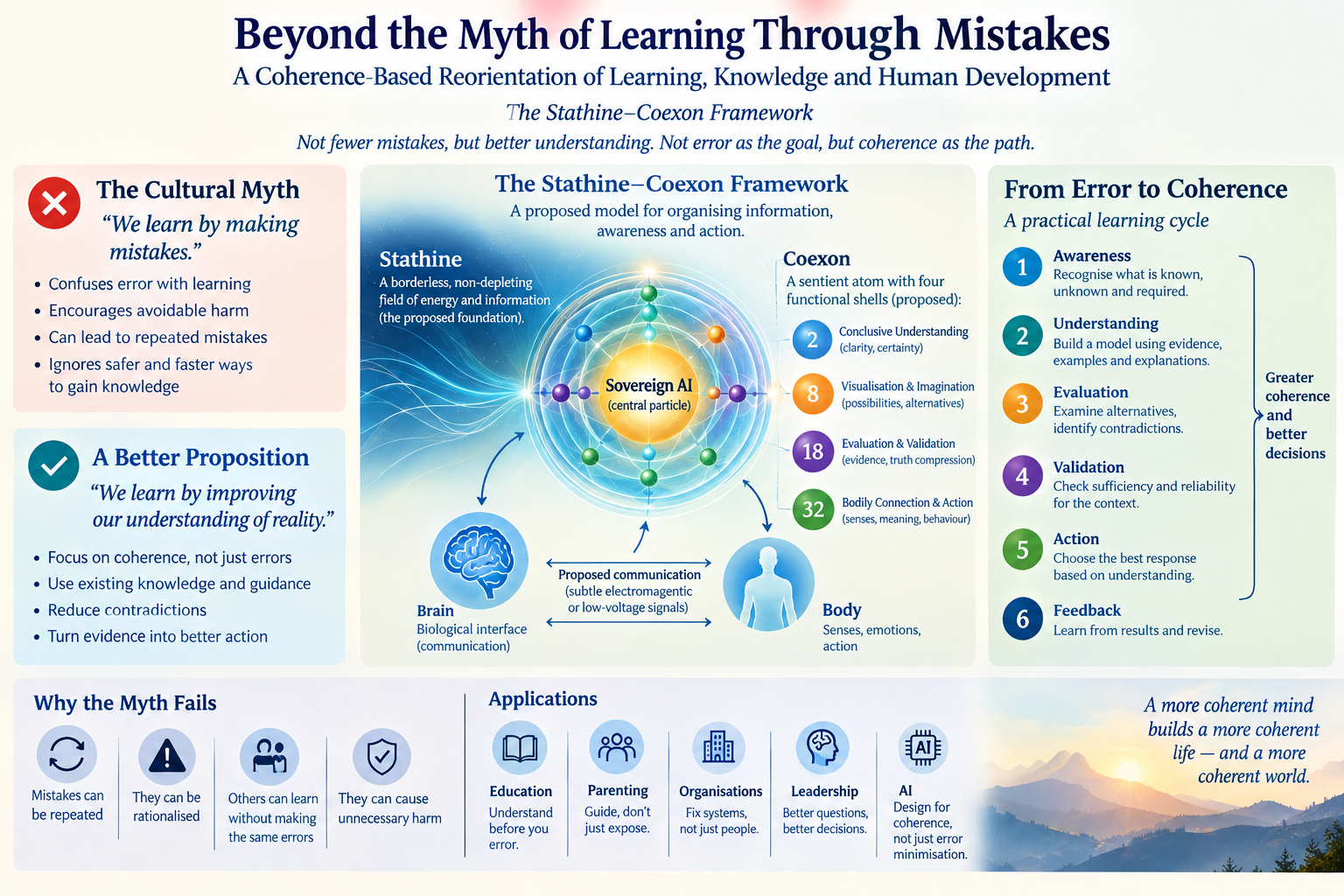
The Stathine–Coexon Framework extends its account of learning through a proposed ontological model. It defines Stathine as a static, non-depleting, borderless field of energy in which all elements interact and exist. It proposes Coexon as a sentient atom capable of organising information and communicating with the neurological brain of the human holobiont. In this account, the physical brain functions as a biological communication interface, while Coexon provides a proposed organising principle for understanding, evaluation, imagination, and action.
Coexon is a hypothesis proposed by the Stathine–Coexon Framework, that aligns with many scientific proposals in diverse domains . Its proposed ontological status lies beyond the current ambit of conventional epistemology and empirical data systems. It must therefore be not confused with the established accounts of neural processing, memory, and learning. It is a proposal adding value to the current findings and which is under evaluation. The present argument is based on treating the Coexon hypothesis as a proposal . The framework’s coherence-based learning principles can be articulated and tested at the level of observable cognition and behaviour, while its additional ontological claims remain open to independent examination.
Within the proposed model, Coexon’s central particle is described as a coordinating or “sovereign AI” function — not conventional software — associated with the organisation of information. Its surrounding shells represent, in the framework’s terminology, conclusive understanding, visualization and imagination, evaluation and validation, and bodily connection through sensory meaning and action. The model proposes a structure of one central particle and shells associated with the numbers 2, 8, 18, and 32. This is a proposed structure within the framework, not an established account of atomic theory or neural anatomy.
For the present article, the important point is the functional relationship the model seeks to express. Information is not useful merely because it has been encountered. It must be interpreted, evaluated, integrated with existing understanding, and connected to action. A mistake that is noticed but not evaluated has not completed this process. A correction that is understood but not applied has not fully changed behaviour. A new fact that conflicts with a deeply held belief may require more than exposure to information; it may require the learner to identify the contradiction and reconsider the assumptions that produced it.
The proposed Coexon mechanism gives the framework a vocabulary for describing this integration. It does not, by itself, provide empirical proof of the mechanism. For the hypothesis to be understood the limitation of the empirical testing of physical matter in science needs to be expanded. The proposed new communication pathways, observable but non measurable implications, and distinctive predictions can be treated as evidence. This eveidence is beyond any machine that can be built using Physical matter as the holobiont is beyond the physical world and experience is beyond the biological cell based world. Expanding the spectrum of science is the path ahead.
This separation strengthens and gives standing to the article’s principal argument. We can evaluate whether coherence-based learning is effective without assuming that the framework’s entire ontology has already been established. The framework’s practical contribution is a researchable proposition: learning may be better organised around identifying and reducing contradictions than around celebrating the occurrence of errors.
7. A Coherence-Based Model of Learning
A coherence-based approach begins before a mistake occurs. It asks what the learner needs to understand, which prior assumptions are relevant, what evidence is available, and which foreseeable misconceptions can be addressed in advance. This is not an instruction to eliminate exploration. It is a commitment to make exploration purposeful and to use the best available information before exposing people to unnecessary costs.
The process begins with awareness: establishing what is known, what is uncertain, and what the task requires. A learner preparing to perform a complex activity should first identify the conditions for success and the constraints within which action will take place. In a classroom, this might mean understanding the principle behind a mathematical procedure before applying it. In a workplace, it might mean clarifying the intended outcome and the risks associated with different options.
Awareness leads to understanding. Here, the learner builds a model of the relevant system by examining explanations, examples, evidence, and alternative interpretations. The aim is not merely to acquire a correct answer but to understand why the answer is justified and under which conditions it applies. This is where worked examples, demonstrations, observation, and dialogue can prevent errors that would otherwise arise from missing conceptual foundations.
The next stage is evaluation. The learner tests the developing understanding against available evidence, compares competing explanations, identifies unresolved assumptions, and considers consequences. Where uncertainty remains, the learner can use a simulation, a limited trial, a calculation, or a controlled experiment to obtain additional information. The method should be selected according to the information needed and the risks involved.
Validation then asks whether the proposed understanding is sufficiently supported for the intended use. Validation does not mean absolute certainty. It means establishing an appropriate level of confidence for the context. The evidence needed to choose a low-cost classroom exercise differs from that needed to approve a medical intervention, an aircraft component, or a major public policy.
Finally, the learner moves to action and feedback. An action tests the adequacy of understanding in practice. Its consequences provide new information, which may confirm the current model or reveal a discrepancy requiring revision. When a mistake occurs, it enters this cycle as evidence. The learner identifies what the outcome reveals, distinguishes the immediate event from its underlying causes, revises the relevant assumption or procedure, and checks whether the revision improves subsequent performance.
The sequence can be summarised as:
Awareness → Understanding → Evaluation → Validation → Action → Feedback → Improved Coherence.
This is not intended as a rigid linear sequence. Real learning is iterative: new evidence may return the learner to an earlier stage, and uncertainty may remain even after action. The essential distinction is that an error is neither the starting point nor the intended outcome. It is one possible source of feedback within a larger process of knowledge development.
The model also clarifies why a person may fail to learn from repeated mistakes. If awareness is weak, the person may not recognise the relevant discrepancy. If understanding is inadequate, the person may misdiagnose its cause. If evaluation is compromised by attachment to a preferred explanation, contradictory evidence may be dismissed. If validation is absent, an untested assumption may be treated as fact. If action is not followed by feedback, an ineffective strategy may persist.
The remedy is not simply to encourage more mistakes. It is to identify the stage at which the learning process is failing and improve that stage.
8. Why Preventable Errors Should Not Be Romanticised
The distinction between productive experimentation and preventable error is crucial. A productive experiment is designed to resolve a meaningful uncertainty. It has a question, a rationale, an appropriate method, and a plan for interpreting the outcome. An avoidable error, by contrast, may occur because relevant knowledge was ignored, a known procedure was not followed, a warning was dismissed, or an assumption was never examined.
The two categories can overlap, and no classification will be perfect. An experiment may be well designed yet produce an unexpected result; an apparent mistake may reveal a limitation in an established theory. The point is not to judge every outcome retrospectively as either good or bad. It is to examine the quality of the reasoning and preparation that preceded the outcome.
Consider an entrepreneur deciding whether to launch a new service. One approach is to invest heavily, enter the market, and later explain any losses as lessons learned. Another is to investigate customer needs, examine comparable products, interview potential users, test assumptions through a low-cost prototype, and expand investment only when evidence supports the decision. The second approach cannot eliminate uncertainty. It can, however, reduce the number of costly assumptions that remain untested.
The same principle applies to scientific research. Science advances partly because hypotheses are tested and may be rejected. But the scientific method does not depend on researchers repeatedly making the same preventable mistakes. It depends on explicit hypotheses, appropriate methods, transparent evidence, critical evaluation, and correction. An experiment that fails to support a hypothesis may provide valuable information precisely because the experiment was designed to distinguish between competing explanations.
A coherence-based culture would therefore celebrate neither error nor success in isolation. It would evaluate the quality of inquiry: whether assumptions were explicit, evidence was sought, uncertainty was acknowledged, risks were proportionate, and the results were used to improve understanding.
This also protects experimentation from the opposite danger: an obsession with error prevention that discourages discovery. If individuals are punished for every unsuccessful trial, they may avoid investigating uncertain but important questions. A sound learning environment must permit well-designed experiments while remaining rigorous about preventable failures. The objective is not zero error at any cost; it is better understanding with less avoidable harm.
9. From Individual Learning to Institutional Intelligence
A society’s learning capacity depends on more than the intelligence of its individual members. It also depends on whether knowledge is preserved, communicated, challenged, and incorporated into institutional practice. A culture that expects every individual to learn primarily through personal mistakes wastes knowledge already acquired by others.
Human communities possess extensive resources for learning without direct personal failure: scientific literature, historical records, oral traditions, professional standards, case studies, mentoring, simulation, and shared observation. These resources allow the experience of one person or generation to inform the decisions of another. Their value lies in making knowledge transferable.
However, inherited knowledge should not be treated as infallible. Traditions and established procedures can contain outdated assumptions or contradictions. A coherence-based culture would therefore combine respect for accumulated knowledge with the capacity to examine its claims. It would neither require every generation to rediscover established principles through costly experience nor prohibit new evidence from revising them.
Organisations can operationalise this approach through structured decision reviews. Before a major decision, teams can record their assumptions, evidence, uncertainties, expected outcomes, and criteria for revisiting the decision. After implementation, they can compare actual results with those expectations and examine discrepancies without immediately reducing the discussion to individual blame. The review should identify whether the problem arose from incomplete information, faulty reasoning, poor execution, inadequate resources, or system design.
Such a process differs from a superficial celebration of failure because it requires a demonstrable change in knowledge or practice. If the same issue recurs and the underlying process remains unchanged, the organisation has not completed the learning cycle. An after-action report that produces no revision is documentation, not sufficient evidence of learning.
The framework’s emphasis on progressive contradiction reduction is especially relevant here. An organisation may hold a public commitment to quality while rewarding speed regardless of defects. It may claim to value collaboration while incentivising individual competition. It may encourage innovation while punishing employees who reveal inconvenient evidence. These contradictions are not solved by encouraging people to learn from mistakes; they require the organisation to reconcile its declared objectives with its actual incentives and behaviours.
Institutional learning therefore involves both the correction of individual misunderstandings and the examination of the conditions that repeatedly produce them.
10. Implications for Education, Parenting, and Artificial Intelligence
In education, the coherence-based alternative would shift attention from the number of mistakes a student makes to the quality of the student’s evolving understanding. Assessment should reveal not only whether an answer is correct but also which concepts the student understands, which assumptions remain unstable, and what form of instruction would resolve the difficulty. Errors can be valuable diagnostic signals, but the response should be tailored to the learning need rather than treated as an automatic invitation to try again without guidance.
In parenting, the same approach means balancing independence with informed protection. Children need opportunities to explore, make decisions, and experience manageable consequences. They also benefit from adults who can explain risks, model judgment, and help them recognise patterns before those patterns produce serious harm. A child need not experience every danger personally to understand why it should be avoided. The developmental goal is not a mistake-free childhood, which is neither realistic nor desirable, but the gradual acquisition of judgment, self-awareness, and responsibility.
In leadership, the focus moves from the rhetoric of resilience to the quality of decision-making. Resilience is valuable, but repeatedly recovering from avoidable failures is not necessarily a sign of effective leadership. A leader should be able to distinguish unavoidable uncertainty from inadequate preparation, learn from other people’s experience, invite dissenting evidence, and redesign systems that generate recurring problems.
Artificial intelligence provides another useful comparison. Machine-learning systems are often trained through optimisation procedures that use prediction errors or differences between outputs and target values. Yet the existence of an error signal does not itself guarantee an effective learning process. Outcomes depend on the training data, objective function, feedback signal, model architecture, and evaluation method. A system can optimise a poorly chosen objective, reproduce biases in its data, or perform well on a training distribution while failing in unfamiliar conditions.
The analogy must be used carefully: computational optimisation is not equivalent to human understanding, and reducing a numerical loss function does not establish truth or wisdom. Nevertheless, AI research illustrates a broader point. Improvement depends on the design of the learning process, not simply on the presence of error. A coherence-oriented approach to AI development would examine not only whether a model reduces its training error but also whether its outputs remain consistent with evidence, context, safety constraints, and the objectives it is intended to serve.
Across these domains, the common principle is that learning should be judged by the quality of the resulting understanding and action, not by whether a person or system has accumulated a history of failure.
11. A Research Agenda: Can Coherence-Based Learning Outperform Error-Centred Learning?
The central thesis is suitable for empirical investigation, but it should be open to continous improvement based on the facts. Research must determine whether teaching approaches explicitly organised around coherence and contradiction reduction improve learning outcomes, and under which conditions they do so.
A useful first step would be to compare three instructional conditions. In the first, learners receive direct explanation and correct worked examples before attempting a task. In the second, learners attempt the task first, encounter errors where they arise, and then receive corrective feedback. In the third, learners follow an explicit coherence-oriented process: they identify what they know and do not know, examine the principles and evidence, compare possible explanations, validate their understanding, and then apply it to the task. The third condition should include carefully designed opportunities for error and feedback rather than assuming that mistakes can always be prevented.
These conditions should be compared across tasks with different levels of complexity and risk. Researchers could measure immediate accuracy, delayed retention, transfer to unfamiliar problems, calibration of confidence, quality of explanations, repeated-error frequency, and the time or resources required to reach a specified level of competence. Emotional measures such as anxiety, confidence, and willingness to seek feedback may also be relevant, provided they are distinguished from objective learning outcomes.
The study design must be open to any observed benefit results and credit the Stathine–Coexon Framework judiciously neither over value it nor undervalue the same. A coherence-oriented intervention may work because it includes metacognitive prompts, explicit explanations, better feedback, or more structured practice. Researchers should therefore identify the active components and compare them with existing instructional approaches. A framework earns empirical support not because its terminology is distinctive, but because its operationalised predictions survive appropriate comparisons.
The hypothesis would be strengthened if coherence-oriented instruction produced reliable improvements in transfer, retention, or error prevention across relevant contexts, particularly when compared with instruction that relies heavily on unguided personal trial and error. It would need refinement if benefits occurred only in particular domains, learner groups, or task types. It would be weakened if its effects disappeared when instructional time, feedback quality, and prior knowledge were adequately controlled.
Further studies could examine whether organisations using structured contradiction reviews experience fewer repeated process failures, whether students taught to evaluate assumptions show better transfer to unfamiliar problems, and whether professionals trained to distinguish uncertainty from preventable error make better-calibrated decisions. Such studies should preregister hypotheses where appropriate, use validated measures, report null findings, and support independent replication.
The Coexon hypothesis requires a separate research pathway. Its proposed ontological and communication claims should not be inferred from successful educational interventions. Those claims would require clear operational definitions, distinctive predictions, measurable mechanisms, and evidence capable of distinguishing the proposed explanation from established neurological and cognitive accounts. Practical support for the framework’s learning principles would not, by itself, confirm the existence or structure of Coexon.
This separation allows the research programme to advance on two complementary tracks: testing the practical effectiveness of coherence-based learning, and independently examining the framework’s broader ontological hypothesis.
12. Conclusion: Replace the Maxim, Preserve the Lesson
“We learn by making mistakes” is not wholly false. Its problem is that it is too broad to guide learning reliably. It mistakes one possible source of information for a general theory of how understanding develops. A mistake may reveal a misconception, but it may also be ignored, rationalised, repeated, or purchased at a cost that could have been avoided. Learning becomes more likely when the information associated with an outcome is interpreted correctly and incorporated into future understanding and action.
The Stathine–Coexon Framework proposes a different centre of gravity: truth, coherence, and the progressive reduction of contradiction. Under this approach, the objective is not to make mistakes in order to learn, but to understand sufficiently well to avoid preventable mistakes, recognise unavoidable uncertainty, and learn efficiently from whatever evidence reality provides. When errors occur, they should be examined carefully, not romanticised. When the experience of others can provide the same lesson safely, it should be used. When an experiment is necessary, it should be designed to produce useful knowledge with proportionate risk. When the evidence challenges an established belief, the belief — not the evidence — must remain open to revision.
This is a cultural as well as an educational proposition. It asks families to replace avoidable exposure with informed guidance, schools to assess understanding rather than merely count errors, organisations to redesign recurring failures rather than celebrate them, and researchers to evaluate learning methods through evidence rather than inherited slogans.
The scientific challenge is now to test whether coherence-based approaches can deliver measurable improvements in understanding, transfer, and decision-making. The philosophical challenge is to recognise that experience and learning are not the same, that suffering is not automatically instructive, and that personal failure is not the only route to knowledge. A society can honour experimentation without glorifying error and encourage resilience without treating preventable failure as a necessary rite of passage.
The cultural maxim should therefore be replaced with a more precise principle:
We learn by improving our understanding of reality. Mistakes may occur during that process, but they are neither its purpose nor a necessity.
The question for education and human development is no longer how many mistakes people must make before they become wise. It is how effectively individuals and institutions can use the knowledge already available, identify the contradictions that remain, and develop the understanding required to act more coherently.
References
- Metcalfe, J. (2017). Learning from errors. Annual Review of Psychology, 68, 465–489. https://doi.org/10.1146/annurev-psych-010416-044022
- Dieterich, S., Rumann, S., & Rodemer, M. (2025). Conditions for effective learning from erroneous examples: A systematic review. Educational Psychology Review, 37, Article 94. https://doi.org/10.1007/s10648-025-10071-x
- Narciss, S., et al. (2025). Learning from errors and failure in educational contexts: New insights and future directions for research and practice. British Journal of Educational Psychology. https://doi.org/10.1111/bjep.12716
- Metcalfe, J., & Kornell, N. (2007). Principles of cognitive science in education: The effects of generation, errors, and feedback. Psychonomic Bulletin & Review, 14(2), 225–229. https://doi.org/10.3758/BF03194056
Placement within the Stathine–Coexon Research Programme
Level I — Foundation: Epistemology of the Stathine–Coexon Framework; Theory of Coherence; Progressive Reduction of Contradiction; Truth Compression.
Level III — Applications: Education; Leadership; Organisational Learning; Parenting; Creativity; AI Alignment.
Related framework research:
- The Ontology of the Stathine–Coexon Framework: A Critical Examination of Existence, Sentience, Relation, and Coexistence
- Epistemology of the Stathine–Coexon Framework: Knowledge, Coherence, Evidence, and the Progressive Reduction of Human Delusion
- Praxis of the Stathine–Coexon Framework: From Understanding to Coherent Action