Understanding the Reality in Which We Already Exist
How 70 Philosophical Traditions can become more useful with the fillers from the Stathine–Coexon Framework to help their followers lead fulfilling lives
By Anand Damani
Part of the Stathine–Coexon Research Programme — Level I: Foundations, with connections to Level II: Comparative Integration and Level III: Practical Applications.
There is something extraordinary about the human condition that we often overlook. Before we learn physics, we already inhabit a physical world. Before we study consciousness, we are already experiencing. Before we learn the meaning of truth, we encounter situations in which our understanding proves adequate or inadequate. Before we study relationships, we are already participating in them. Education does not introduce us to existence; it helps us understand the existence in which we already participate.
This observation provides the starting point for the Stathine–Coexon Framework.
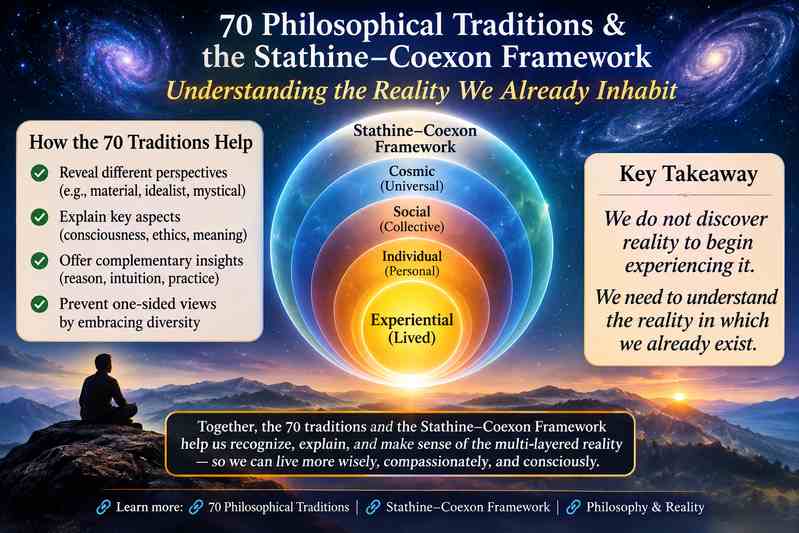
We do not discover reality to begin experiencing it. We need to understand the reality in which we already exist.
This is not an argument against science, philosophy, education, or the disciplined pursuit of knowledge. It is a distinction between the reality in which inquiry takes place and the explanations we develop through inquiry. The universe did not wait for human beings to invent astronomy before stars existed. Conscious experience did not begin when neuroscience acquired the instruments to study brain activity. Relationships did not begin when philosophers developed theories of ethics.
What changes through learning is not necessarily the existence of reality itself, but our ability to recognize it, interpret it, anticipate its consequences, and participate in it more effectively.
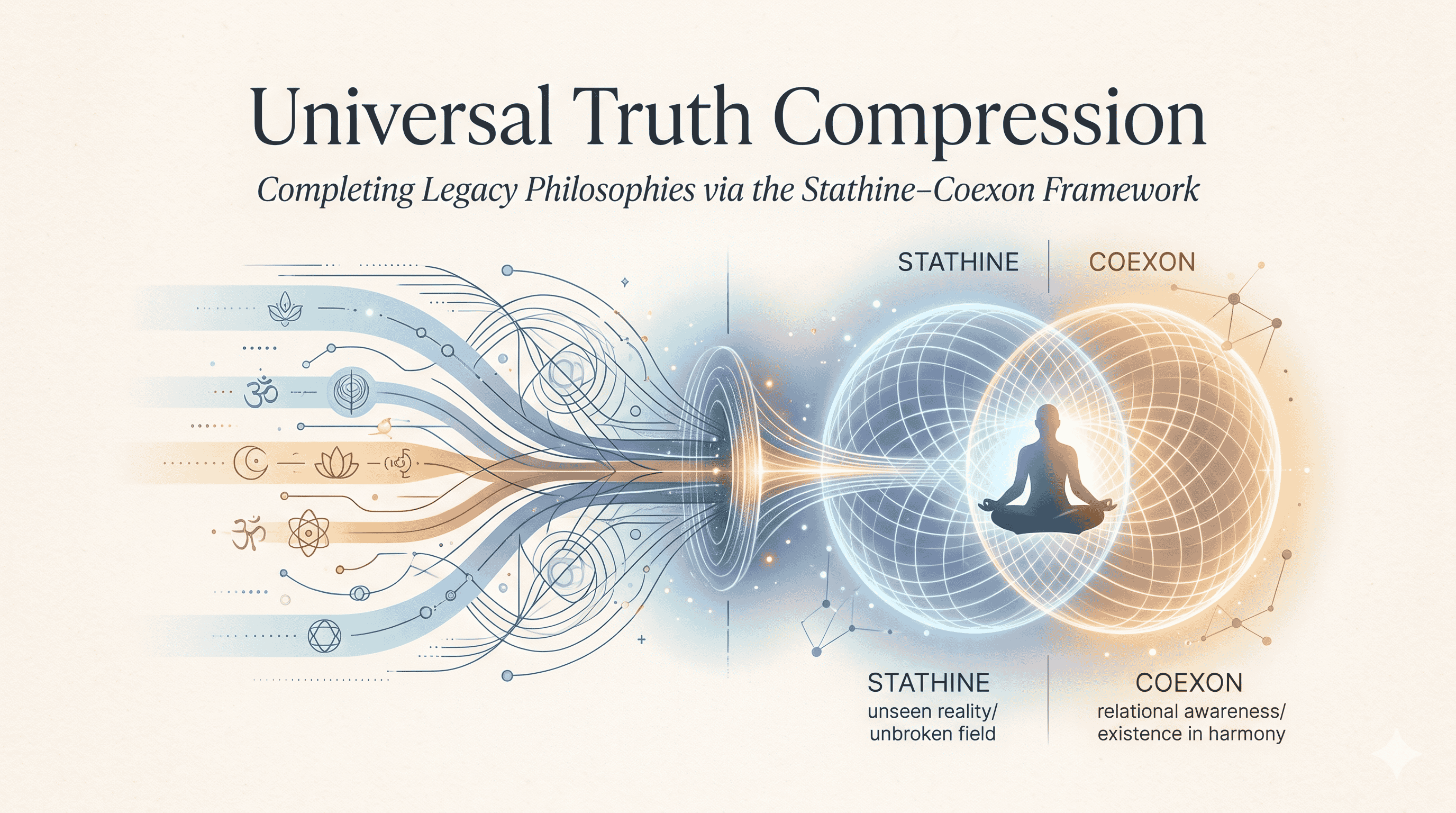
The Stathine–Coexon Framework takes this distinction further. It proposes that reality can be understood through two foundational concepts: Stathine, the universal field in which existence and interaction occur, and Coexon, the proposed sentient atom that organizes information and communicates with the neurological brain of the holobiont. Together, these concepts form the framework’s proposed ontology of existence, sentience, information, and interaction.
The framework also proposes the Principle of Truth Compression: as understanding becomes more closely aligned with reality, unnecessary assumptions, contradictions, and distortions can be removed. Understanding becomes coherent and no incompatible explanations must be maintained.This is the state of enlightenment where the function is of uniterrupted festivity via clarity in the human being and society.
This provides something more than a way to compare philosophical traditions. It offers a common explanatory foundation through which their insights can be understood, organized, and translated into practical solutions.
The purpose of this examination is not to claim that every philosopher anticipated Stathine–Coexon, that all traditions teach the same truth, or that their differences can be eliminated by assigning them new terminology. Their historical contributions and disagreements remain important. The purpose is to show how the Stathine–Coexon Framework can provide an integrated understanding of the realities that these traditions have investigated, and how that understanding can help address the problems they sought to resolve.
The following analysis examines seventy philosophical traditions and intellectual approaches. It distinguishes their historical contributions from the framework’s own explanations and applications, and concludes by showing how this integrated understanding can contribute to education, scientific inquiry, human development, and a more coherent civilization.
Part I. The starting point: Reality precedes our explanations
1. The difference between experiencing reality and explaining reality
Consider a child who touches a hot object.
The child encounters heat before understanding thermodynamics. The experience produces a consequence, and that consequence influences future behaviour. Much later, the child may learn about temperature, molecular motion, heat transfer, and the physiological mechanisms of pain.
Several layers of understanding are now available, but they do not all perform the same function. The experience is one thing. The scientific explanation is another. The concepts used to communicate the explanation are a third.
The same distinction applies to nearly every dimension of human existence. We experience hunger before studying metabolism, movement before learning biomechanics, and emotional conflict before studying psychology. We encounter the consequences of our decisions before acquiring the vocabulary of causality and responsibility.
Reality therefore precedes our discovery and description of it. Our knowledge is an attempt to understand something in which we already participate.
Yet experiencing something does not mean that we automatically understand its causes. A child can experience heat without knowing its physical mechanism. A person can experience consciousness without knowing whether consciousness is generated entirely by neural processes or involves something more fundamental.
Experience gives us access to phenomena; it does not automatically settle every explanation of those phenomena. The Stathine–Coexon Framework recognizes both dimensions: the reality directly encountered by sentient beings and the proposed underlying structure through which that reality can be understood.
2. What does it mean to understand reality?
Understanding is more than collecting facts.
Suppose a person memorizes hundreds of statements about human relationships but continues to interpret every disagreement as hostility. The accumulated information has not produced a sufficiently useful understanding of the situation.
Another person recognizes that disagreement can arise from different experiences, needs, information, expectations, or interpretations. This understanding can explain many situations without requiring a separate hostile intention for every disagreement.
The second person has not necessarily acquired more information. Instead, the person has organized the information differently.
This is where Truth Compression becomes relevant. The framework proposes that an accurate, sufficiently comprehensive understanding can eliminate the need for multiple contradictory explanations. Instead of continually defending one interpretation against evidence that does not fit it, a person can revise the interpretation and accommodate a wider range of observations.
The resulting simplicity is not an end in itself. It is a consequence of improved understanding. A simple explanation that ignores important evidence is not an achievement of Truth Compression. A more comprehensive explanation that resolves apparent contradictions while preserving relevant distinctions is a better expression of it.
The framework thus offers a practical solution to a common human problem: the accumulation of information without a corresponding improvement in understanding. It provides a direction for organizing information around reality, identifying contradictions, correcting mistaken assumptions, and translating improved understanding into action.
3. The ontological position of Stathine–Coexon
The framework begins with two foundational concepts.
Stathine is proposed as a static, non-depleting, borderless field in which all elements exist and interact. It is understood within the framework as an unbroken continuum, beyond conventional distinctions of space and time, and as potential energy for physical matter by entanglement with other materials .In the human being it acts as the potential of understanding that qualitatively brings harmony in the Coexon for a fulfilling human life. The tradition and culture that can transfer this understanding in every new born will replicate and mirror the continuum.
Coexon is proposed as a fundamental sentient atom, possessing an internal structure that organizes information and communicates with the neurological brain of the holobiont. In the framework’s account of human existence, the Coexon and the physical body are complementary aspects of the human being. This will lead to the orderly behavior regulated by understanding gained via education from the society that is enlightened.
These are foundational ontological propositions of the Stathine–Coexon Framework. They lie beyond the present epistemological scope of contemporary physics. Current physical theories do not provide an established mechanism for explaining or validating these propositions. This limitation of current scientific methods does not, by itself, settle the philosophical status of the hypothesis. It is important to distinguish the framework’s proposed ontology from established scientific findings and from mechanisms that have not yet been empirically demonstrated.
The framework’s philosophical position is that the reality it seeks to describe is accessible through sentient experience and reflection, even when its proposed underlying structure lies beyond the present epistemological reach of physical sciences.
Its explanatory foundation can be understood through three complementary levels. The first is the reality experienced by sentient beings: awareness, interaction, change, and consequence. The second is the organization of that experience into knowledge, interpretation, and understanding. The third is the proposed underlying ontology of Stathine and Coexon.
The framework connects these levels rather than treating them as isolated subjects. Stathine provides the proposed universal context of existence and interaction. Coexon provides the proposed fundamental unit of sentience and information organization. The holobiont provides the biological structure through which human beings experience and participate in the physical world.
This integrated account offers a common foundation for examining existence, consciousness, information, and relationships. It also provides a basis for understanding why the different philosophical traditions discussed below can be useful without being treated as identical.
Part II. Seventy traditions understood through the Stathine–Coexon Framework
Group A. Indian philosophical traditions: Reality, consciousness, knowledge, and liberation
Indian philosophy offers an especially rich starting point because its traditions have long investigated the relationship between existence, consciousness, perception, knowledge, and liberation. The Stathine–Coexon Framework provides an integrated way to understand these different dimensions and to translate their insights into a coherent account of human existence.
1. Advaita Vedanta: Understanding unity beneath apparent multiplicity
Advaita Vedanta maintains that ultimate reality is non-dual Brahman and examines the relationship between Brahman, the self, and the apparent multiplicity of the world.
The Stathine–Coexon Framework provides an explanation of underlying unity through its concept of Stathine as a universal, unbroken field in which all elements exist and interact. Individuality and multiplicity are understood within this common existential context rather than as completely disconnected realities.
The framework does not equate Stathine with Brahman. Advaita Vedanta has its own arguments concerning consciousness, the self, ignorance, and liberation. Stathine–Coexon proposes a different ontology involving a universal field and a fundamental sentient unit.
The practical solution offered by this understanding is to recognize connection without losing sight of individuality. Human beings can understand themselves as distinct participants in a larger reality rather than as isolated entities. This provides a foundation for moving beyond unnecessary separation and toward inclusive coexistence.
2. Vishishtadvaita: Unity that includes real distinctions
Vishishtadvaita, associated particularly with Ramanujaji, understands reality as a qualified unity in which distinctions remain meaningful.
The Stathine–Coexon Framework explains how a universal field can coexist with distinct sentient beings, physical matter, individual agency, and different needs. A shared existential foundation does not require every participant to become identical.
This provides a practical solution to the false choice between unity and diversity. A family, society, or civilization can function as an interconnected whole while preserving the individuality of its members.
The framework’s principle of inclusive coherence therefore offers unity without erasure of legitimate distinctions. Coexistence becomes possible through understanding how individual needs and actions relate to the larger whole.
3. Dvaita Vedanta: The importance of fundamental differences
Dvaita Vedanta, associated with Madhvaji, emphasizes real distinctions between God, individual souls, and the world.
The Stathine–Coexon Framework accommodates individuality through its distinction between the proposed universal field, the sentient Coexon, and physical matter. The common field does not eliminate the distinct identity of the entities that exist and interact within it.
This provides a way to understand how connection and difference can coexist. Individual beings have their own experiences, needs, and capacities, while participating in a larger reality.
The practical solution is to avoid treating every disagreement or difference as a problem to be eliminated. Coherence is achieved by recognizing the actual relationship between distinct entities and enabling them to coexist without unnecessary conflict.
4. Samkhya: Understanding the relationship between consciousness and nature
Classical Samkhya distinguishes Purusha, associated with consciousness, from Prakriti, the material or natural principle.
The Stathine–Coexon Framework provides its own three-part account of the relationship between existence, sentience, and the physical organism. Stathine is the proposed universal field, Coexon is the proposed sentient atom, and the physical body is the biological structure through which the human being experiences and acts in the material world.
Samkhya’s Purusha is not equivalent to Stathine, and Prakriti is not equivalent to Coexon. The traditions have different metaphysical commitments.
The framework’s contribution is to offer an integrated explanation of how the sentient and physical dimensions of human existence relate. This helps prevent consciousness from being discussed without reference to the body, or the body from being treated as the entirety of human existence.
5. Nyaya: Establishing valid knowledge through complementary means
Nyaya examines valid means of knowledge, including perception, inference, comparison, and testimony.
The Stathine–Coexon Framework provides a way to organize these means as complementary routes through which reality is experienced, interpreted, and understood. Perception supplies direct experience; inference helps organize relationships and identify possible causes; comparison clarifies similarities and distinctions; testimony allows knowledge to be shared and accumulated.
The framework’s Principle of Truth Compression brings these processes together by encouraging the removal of unsupported assumptions and the correction of contradictions.
This offers a practical solution to the problem of confusing experience with interpretation. A person can recognize what has been directly experienced, distinguish it from an inferred explanation, and evaluate whether testimony is reliable. Understanding becomes more coherent when these different sources of knowledge are used appropriately rather than treated as interchangeable.
6. Vaisheshika: Organizing the fundamental categories of existence
Vaisheshika develops a systematic account of reality through categories such as substance, quality, action, universality, particularity, and inherence.
The Stathine–Coexon Framework provides a foundational structure within which these categories can be understood. Stathine and Coexon provide the proposed ontological starting points, while their relationships with physical matter, properties, actions, and individual identity provide a way to organize the elements of experienced reality.
The practical contribution is conceptual clarity. Instead of treating existence as an undifferentiated collection of objects, the framework encourages an understanding of what exists, what properties it has, how it acts, and how it relates to other entities.
This makes it possible to develop a more coherent vocabulary for discussing the physical, sentient, and relational dimensions of existence.
7. Buddhist Abhidharma: Understanding experience through constituent processes
Abhidharma traditions examine experience through detailed analyses of mental and physical phenomena.
The Stathine–Coexon Framework provides an integrated account of sentience through the proposed internal organization of Coexon and its communication with the neurological brain of the holobiont. Experience can therefore be understood through the relationship between the proposed sentient unit, biological processes, and the information organized through their interaction.
Abhidharma offers a valuable comparative discipline for examining the constituent processes of experience, although its categories and aims differ from those of the proposed Coexon ontology.
The practical solution is to move beyond treating an experience as an indivisible event. Understanding its constituent processes can help people distinguish sensation, interpretation, emotion, memory, and response. This distinction supports more deliberate behaviour and reduces confusion between what is experienced and what is subsequently inferred.
8. Madhyamaka: Understanding existence through relationships and conditions
Madhyamaka, associated with Nagarjuna, examines dependent origination and challenges the assumption that phenomena possess independent, intrinsic existence.
The Stathine–Coexon Framework provides a foundational explanation of interdependence through the proposed universal field of Stathine. Matter and sentience are understood as existing and interacting within this common field. Coexon’s proposed experience and information organization are understood through its relationship with Stathine, its internal organization, and the physical holobiont.
This relational account helps explain why no entity should be understood only through an isolated description. Its identity and functioning must also be understood through its relationships and interactions.
The practical solution is to examine the wider system whenever an individual problem appears. In a family, organization, or society, a difficulty may arise from the relationships among participants rather than from one isolated person. Understanding those relationships makes it possible to address the underlying source of contradiction.
9. Yogacara: Organizing consciousness and experience
Yogacara investigates cognition, consciousness, and the processes through which experience is organized.
The Stathine–Coexon Framework places information organization at the centre of its proposed account of sentience. Coexon is proposed as the sentient unit that organizes information and communicates with the neurological brain. This provides an ontological account through which experience, information, and biological interaction can be considered together.
The framework also distinguishes reality from the interpretations formed about reality. Human beings can experience an event and subsequently organize it through expectations, memory, and assumptions. These interpretations may or may not accurately represent the event.
Truth Compression provides a practical method for correcting this organization: identify unsupported assumptions, reduce contradictions, and retain interpretations that better accommodate the available experience.
Yogacara offers a valuable comparison for examining cognition and habitual interpretation, while the Coexon hypothesis provides the framework’s own proposed explanation of sentient information organization.
10. Jain philosophy: Integrating multiple perspectives without losing truth
Jain epistemology includes anekantavada, the doctrine that reality has multiple aspects, and syadvada, a disciplined approach to qualified predication.
The Stathine–Coexon Framework provides a way to integrate different perspectives while maintaining a commitment to one existential reality. Different observers may encounter different aspects of the same situation because they occupy different positions, possess different information, or experience different consequences.
Truth Compression helps distinguish between contradictions that arise from incomplete perspectives and claims that are genuinely incorrect. Sometimes two statements can be reconciled by identifying the conditions under which each is valid. At other times, one statement must be revised or rejected.
The framework’s solution is not to declare every perspective equally correct. It is to bring relevant perspectives into a more comprehensive understanding aligned with reality while preserving the individuality of the participants.
This makes inclusive coherence possible without abandoning the pursuit of truth.
11. Charvaka: Connecting philosophical understanding with experienced reality
Charvaka represents a materialist and empirically oriented tradition within Indian philosophy, although historical accounts of its precise doctrines require caution.
The Stathine–Coexon Framework recognizes direct experience as an essential starting point for understanding reality. It also distinguishes the experience of a phenomenon from the explanation of its underlying cause.
The experience of awareness, for example, establishes that awareness is a phenomenon requiring understanding. The framework proposes Coexon as an underlying sentient entity, but that proposed explanation must be distinguished from what is already established through observation and experiment.
This provides a practical solution to two opposite errors: dismissing experience because its underlying mechanism is not fully understood, and treating an experience as automatic proof of every explanation offered for it.
The framework can therefore retain its independent ontological position while clearly distinguishing philosophical propositions from experimentally established findings.
12. Classical Yoga: Achieving greater coherence in mental activity
Patanjali’s Yoga tradition examines the fluctuations of the mind and the disciplined cultivation of awareness.
The Stathine–Coexon Framework provides a practical interpretation of this discipline through its principle of progressive contradiction reduction. Fear, expectation, resentment, and distraction can distort how a person interprets reality. When these influences dominate attention, the person may respond to an imagined situation rather than to what is actually happening.
The framework offers a path toward greater coherence by helping individuals recognize the difference between an event, their interpretation of it, and the assumptions influencing their response. Truth Compression supports the removal of unnecessary mental constructions, while improved awareness enables more appropriate choices.
This interpretation does not make the Yoga tradition’s account of consciousness and liberation identical to the Coexon hypothesis. Rather, it shows how disciplined attention can become a practical application of the framework’s broader objective: understanding reality with fewer distortions and acting with greater coherence.
13. Mimamsa: Making language and action correspond to meaning
Mimamsa investigates interpretation, language, ritual action, and the authority of Vedic injunctions.
The Stathine–Coexon Framework extends the importance of interpretation into everyday communication. Human beings use language to describe observations, express expectations, communicate obligations, and coordinate action. Confusion arises when these different functions are mixed together.
The framework’s approach to language is to make words useful for recognizing reality. Statements should distinguish what has been observed, what has been inferred, what is expected, and what is required. This helps people avoid treating an expectation as an established fact or an obligation as a description of reality.
The practical solution is clearer communication, better interpretation, and more coherent action. Language becomes a means of reducing misunderstanding rather than reinforcing it.
14. Kashmir Shaivism: Connecting consciousness with the manifestation of realityKashmir Shaivism develops a non-dual account of consciousness and manifestation.
The Stathine–Coexon Framework provides its own foundational account of existence and sentience through Stathine and Coexon. It does not treat consciousness as an incidental subject detached from the wider question of existence. Instead, it places the proposed sentient unit within a universal field and explains human experience through its relationship with the physical holobiont.
The traditions have different metaphysical commitments, but both make consciousness central to their accounts of reality.
The practical value of the Stathine–Coexon approach is that it connects the study of sentience with information organization, biological communication, and human participation in the world. This creates a common structure for examining consciousness philosophically while allowing the framework’s proposed mechanisms to remain distinct from established scientific findings.
15. Sikh philosophy: Making truth visible through responsible living
Sikh philosophy emphasizes truthful living, remembrance, ethical action, and participation in community.
The Stathine–Coexon Framework connects understanding with conduct through its principle of coherence. An ontology becomes practically meaningful when it improves how individuals participate in relationships and society.
Knowing that human beings are interconnected is not sufficient if their behaviour continues to create unnecessary harm. Understanding must become visible in decisions, responsibilities, and the treatment of others.
The framework therefore provides a practical direction: align understanding, intention, and action with reality while respecting the needs and individuality of other participants.
What the Indian traditions collectively contribute
These fifteen traditions illuminate unity, distinction, consciousness, valid knowledge, experience, language, and ethical living. The Stathine–Coexon Framework brings these dimensions into a common structure.
Its proposed ontology explains the relationship between the universal field, the sentient unit, and the physical organism. Its epistemological approach distinguishes experience from interpretation. Truth Compression provides a method for reducing unnecessary contradictions, while inclusive coherence connects individual understanding with responsible participation in the larger whole.
The traditions remain distinct in their historical doctrines and conclusions. Their insights can nevertheless be understood and applied through a framework that seeks to connect existence, knowledge, sentience, and conduct.
Group B. Chinese and East Asian traditions: Understanding reality through relationship, change, and conduct
Chinese philosophy offers a different emphasis. Rather than beginning exclusively with the question of what exists, many of its traditions investigate how reality changes, how relationships shape conduct, and how human beings can participate in the order of things.
The Stathine–Coexon Framework provides a way to connect these concerns with its account of interdependence and inclusive coherence.
16. Confucianism: Building coherence through relationships
Confucianism places considerable emphasis on ethical relationships, appropriate conduct, learning, and the cultivation of character.
The Stathine–Coexon Framework explains why a human being cannot be understood entirely as an isolated individual. People participate in families, communities, institutions, and societies, and their actions affect others. Every individual is both a distinct participant and part of larger systems of coexistence.
The framework’s solution is to include relational consequences in the understanding of any situation. A decision should not be evaluated only from the standpoint of the person making it. It should also account for the needs and consequences experienced by other participants.
Truthful understanding therefore becomes more comprehensive when it recognizes the wider network of relationships in which an individual exists.
17. Daoism: Acting in accordance with the reality of a situation
Daoism examines the Dao, natural processes, and the limits of excessive interference.
The Stathine–Coexon Framework explains the interconnected nature of existence through Stathine and the interactions occurring within the universal field. Every entity exists in relationships through which it affects and is affected by other entities.
This provides a practical explanation for why unnecessary intervention can create additional contradictions. People and institutions often act on incomplete assumptions, impose control where understanding is insufficient, and mistake activity for effectiveness.
Truth Compression offers a solution by removing unnecessary assumptions and interventions so that action becomes more appropriate to the actual situation.
Daoism should not be reduced to a general endorsement of passivity. Its contribution is better understood as an emphasis on responding appropriately to the nature and conditions of a process.
18. Mohism: Extending coherence to the well-being of others
Mohism emphasizes impartial concern and the social consequences of conduct.
The Stathine–Coexon Framework explains how every entity can be understood as an individual system while also participating in larger systems. An individual, a family, a community, and humanity itself are interconnected levels of existence and organization.
The human family can therefore be understood as a collective unit whose members need to recognize how their actions affect one another. Individual interests cannot be considered independently of the larger consequences of those interests.
The framework’s ethical solution is inclusive coherence: organize human cooperation around truthful understanding, legitimate needs, and the consequences of collective action. This provides a foundation for reducing unnecessary conflict and developing a more orderly human society.
19. Legalism: Aligning institutions with their actual purposes
Chinese Legalist traditions emphasize governance, institutional arrangements, incentives, and the management of collective behaviour.
The Stathine–Coexon Framework applies its principle of contradiction reduction to institutions. Societies cannot rely exclusively on individuals possessing excellent understanding or moral character. Institutions must also be designed so that their rules, incentives, and consequences support their stated objectives.
A company may publicly reward collaboration while promoting employees exclusively through individual competition. A school may claim to value independent thinking while rewarding only memorization. The resulting contradictions cannot be resolved merely by asking individuals to become more harmonious.
The framework provides a systems-level solution: identify the assumptions, incentives, and structures producing incompatible expectations, and align them with the institution’s actual purpose.
20. Neo-Confucianism: Integrating knowledge with conduct
Neo-Confucian thinkers developed sophisticated accounts of principle, material force, self-cultivation, and the relationship between knowledge and action.
The Stathine–Coexon Framework similarly treats understanding as incomplete when it remains disconnected from behaviour. A person can explain the importance of honesty while continuing to behave dishonestly. The problem is not necessarily a lack of information; it is a failure to integrate understanding into action.
Truth Compression helps identify the contradiction between stated knowledge and actual conduct. Coherence provides a direction for resolving it through more consistent choices and habits.
This turns learning into an ongoing process of aligning understanding, intention, and action.
21. Zen: Bringing attention back to what is actually present
Zen traditions emphasize disciplined attention, meditation, and direct engagement with experience, although Zen includes diverse philosophical and religious interpretations.
The Stathine–Coexon Framework distinguishes information about reality from an accurate understanding of what is actually happening. A person can possess extensive knowledge about attention while remaining inattentive to the situation in front of them.
The practical solution is to develop the capacity to observe an experience without immediately imposing assumptions upon it. This creates space to distinguish an event from the interpretation that follows it.
Direct attention does not make every interpretation infallible. Causal and metaphysical claims still require appropriate reasoning. Nevertheless, disciplined awareness can reduce unnecessary distortions and support more coherent responses.
22. Shinto: Recognizing belonging within the natural and social world
Shinto traditions emphasize relationships with kami, place, ritual, community, and the natural world.
The Stathine–Coexon Framework places human existence within a wider reality of interdependence. People are not separate from the environments, communities, and ecological systems that sustain them.
The practical contribution is an expanded understanding of belonging. A human being participates in a physical environment, a social community, and a larger system of life. Decisions that ignore these relationships can create contradictions between immediate interests and the conditions required for continued existence.
The framework therefore encourages an understanding of human welfare that includes ecological and social responsibility, while recognizing the distinctive symbolic and religious vocabulary of Shinto.
What the East Asian traditions contribute
These seven traditions bring attention to relationships, natural processes, institutions, disciplined awareness, and belonging.
The Stathine–Coexon Framework connects them through interdependence and inclusive coherence. It explains why individual behaviour must be understood in relation to larger systems and why institutions must align their incentives with their stated purposes.
The resulting solution is not harmony at any cost. It is a form of coexistence that preserves dignity, allows correction, and recognizes the actual consequences of human action.
Group C. Greek and Hellenistic traditions: The search for knowledge, causes, and a good life
Greek philosophy introduced many enduring approaches to metaphysics, logic, epistemology, and ethics. Hellenistic traditions subsequently explored how philosophical understanding could transform everyday life.
The Stathine–Coexon Framework provides a common structure for applying these contributions to the understanding of existence and human conduct.
23. Platonism: Moving from appearances toward underlying explanations
Platonism asks whether the objects encountered through ordinary experience can be understood through more fundamental structures, traditionally associated with Forms.
The Stathine–Coexon Framework provides an ontological foundation for moving beyond isolated appearances. Stathine represents the proposed universal field, while Coexon represents the proposed sentient unit. These concepts provide a common context in which individual phenomena can be understood in relation to a broader structure.
The practical solution is to seek explanations that account for patterns across different experiences rather than treating every observation as an unrelated event.
The existence of an explanatory pattern does not automatically establish a separate metaphysical entity. The framework therefore distinguishes its proposed ontology from the evidence and arguments that may be used to support particular claims.
24. Aristotelianism: Understanding things through causes and organization
Aristotle’s philosophy investigates substance, form, matter, causation, potentiality, actuality, and the organization of living things.
The Stathine–Coexon Framework offers an integrated account of the proposed relationship between the sentient Coexon, the physical body, and the neurological brain. This gives the study of human existence a structure in which the proposed sentient unit, biological organization, and physical activity can be considered together.
The practical contribution is explanatory completeness. A theory should describe what kind of entity it proposes, how it is organized, how it relates to other entities, and what it is intended to explain.
This approach helps develop a more precise account of the framework’s ontology and prevents broad philosophical claims from remaining disconnected from their proposed implications.
25. Eleatic philosophy: Understanding continuity beneath change
The Eleatic tradition, especially Parmenides, raises fundamental questions about being, change, and the reliability of ordinary appearances.
The Stathine–Coexon Framework provides a distinction between an unchanging foundational field and the changing physical and experiential world. Stathine is proposed as an enduring continuum, while the entities and interactions within it provide the changing phenomena encountered by sentient beings.
This gives the framework a way to explain continuity and change without treating them as mutually exclusive. The foundational context can remain constant while the relationships and configurations within it change.
The framework’s practical contribution is to distinguish enduring conditions from changing circumstances, helping people recognize which aspects of a situation are stable and which require adaptation.
26. Heraclitean philosophy: Understanding change within an enduring order
Heraclitus is associated with the significance of change, tension, and an underlying order expressed through the Logos.
The Stathine–Coexon Framework accommodates change through the interactions and organization of entities within Stathine. Its proposed unchanging field provides the underlying context, while physical systems, biological organisms, and experiences undergo change.
This provides a way to understand how an enduring context can contain changing relationships and processes.
The practical solution is to avoid treating change as necessarily disorderly. Understanding the relationships and conditions through which change occurs helps individuals and institutions adapt without losing coherence.
27. Epicureanism: Distinguishing genuine needs from unnecessary desires
Epicurean philosophy investigates nature, pleasure, fear, and the conditions of a tranquil life.
The Stathine–Coexon Framework applies Truth Compression to the relationship between needs, expectations, and unnecessary desires. People often experience distress not only because of circumstances but because of imagined threats, social comparisons, or beliefs about what they must possess.
Understanding the difference between genuine needs and unnecessary expectations can reduce avoidable conflict and dissatisfaction.
The framework’s practical solution is to examine whether a desire corresponds to an actual requirement or arises from an assumption that creates continuing contradiction. This does not mean suppressing legitimate aspirations; it means understanding them accurately.
28. Stoicism: Separating events from interpretations
Stoicism emphasizes virtue, rational judgment, and the distinction between what is within our control and what is not.
The Stathine–Coexon Framework provides a practical method for distinguishing an event from the interpretation attached to it. A person encounters an event, forms an explanation, develops expectations, and responds. If the explanation is inaccurate, the resulting response may create unnecessary distress.
Suppose a colleague disagrees with a proposal. One interpretation is that the colleague is attacking one’s competence. Another is that the colleague has identified a possible weakness in the proposal.
Truth Compression helps remove unsupported assumptions and replace them with explanations that better accommodate the available information.
This does not mean that every difficulty is caused by mistaken belief. External circumstances and genuine harms must also be recognized. The framework’s solution is to distinguish what can be changed, what must be accepted, and what needs to be understood differently.
29. Skepticism: Maintaining intellectual honesty while pursuing truth
Ancient skepticism examines whether our judgments are sufficiently justified to warrant certainty.
The Stathine–Coexon Framework incorporates the practical value of distinguishing what is directly experienced, what is inferred, and what remains uncertain. This is particularly important when developing explanations of underlying reality.
Truth Compression is not the removal of uncertainty by assertion. It is the removal of unnecessary confusion through better understanding.
A person who acknowledges uncertainty can respond more coherently than someone who maintains certainty by ignoring contradictory information. The framework therefore uses critical examination as a means of improving understanding, not as an end in itself.
30. Neoplatonism: Relating multiplicity to foundational unity
Neoplatonism develops an account of reality in which multiplicity is related to an ultimate principle, commonly understood through the One.
The Stathine–Coexon Framework offers its own account of foundational unity through Stathine and of individual sentience through Coexon. Distinct beings and experiences are understood within a larger ontological context without losing their individuality.
The practical value is a way of understanding how individuals can remain distinct while participating in larger systems. It supports a view of human coexistence in which connection does not require uniformity.
The traditions have different metaphysical structures, but their comparison helps clarify the relationship between unity and multiplicity.
31. Socratic philosophy: Using dialogue to remove contradictions
Socrates is associated with examining beliefs through questions, dialogue, and the exposure of contradictions.
The Stathine–Coexon Framework turns this method into a practical application of Truth Compression. A person who says, “I want complete honesty, but I do not want anyone to tell me anything that makes me uncomfortable,” is expressing two expectations that may conflict.
A Socratic dialogue can make the contradiction visible. The purpose is not to defeat the person in argument but to help the person recognize the assumption and decide whether it needs revision.
AI-assisted Socratic dialogue can make this practice more widely available. An AI system can help people examine their assumptions, test alternative explanations, and identify contradictions. Its answers must nevertheless be treated as fallible and checked against reliable information.
The framework provides the broader objective: use dialogue to move from defensiveness and confusion toward clearer understanding.
32. Aristotelian logic: Preserving valid distinctions in reasoning
Aristotelian logic provides systematic methods for evaluating arguments, categories, and inference.
The Stathine–Coexon Framework requires logical discipline to distinguish genuine contradictions from differences in conditions, meanings, times, or subjects.
Two statements may appear inconsistent while describing different circumstances. Conversely, a persuasive narrative may contain an invalid inference.
Truth Compression provides the direction of simplification, while logic ensures that simplification does not disguise defective reasoning. The practical solution is to retain distinctions that reality requires and remove only those that create unnecessary confusion.
What the Greek traditions contribute
These ten traditions provide resources for understanding underlying explanations, continuity and change, the role of judgment, and the structure of valid reasoning.
The Stathine–Coexon Framework connects these contributions through its proposed ontology and its principle of progressive contradiction reduction. It offers a path from observation to explanation, from interpretation to correction, and from understanding to coherent action.
The objective is not to eliminate complexity. It is to eliminate unnecessary complexity while preserving whatever complexity reality requires.
Group D. European and Abrahamic philosophical traditions: Existence, reason, interpretation, and moral responsibility
The following traditions approach reality through different combinations of metaphysics, theology, logic, language, moral philosophy, and the examination of human limitations.
The Stathine–Coexon Framework provides an independent ontological foundation through which these contributions can be understood and applied.
33. Scholastic philosophy: Bringing different forms of knowledge into a coherent account
Scholastic philosophy developed rigorous methods of argument, distinction, interpretation, and synthesis, particularly within medieval Christian intellectual life.
The Stathine–Coexon Framework offers a foundational ontology around which different forms of knowledge can be organized. Its concepts provide a common reference point for examining the relationships among existence, sentience, information, and interaction.
Scholastic methods of distinction and argument help make this integration more precise. Similar terminology does not guarantee identical meaning, and different terminology does not necessarily indicate complete disagreement.
The practical solution is disciplined integration: establish what each proposition means, preserve its distinctive content, and connect it with other insights only where the relationship is justified.
34. Cartesianism: Using disciplined doubt to improve understanding
René Descartes used methodical doubt to examine the foundations of knowledge.
The Stathine–Coexon Framework uses the same practical discipline to distinguish direct experience from interpretations of experience. People frequently inherit assumptions without examining whether those assumptions accurately represent reality.
Truth Compression provides a direction for moving beyond doubt: identify unsupported beliefs, examine contradictions, and retain explanations that provide a more comprehensive account.
Doubt becomes a method for improving knowledge rather than a permanent condition. The objective is to reach more coherent understanding and use it in practical decisions.
35. Spinozism: Understanding existence through an underlying unity
Spinoza’s philosophy identifies God and Nature with one infinite substance.
This offers a significant comparison with Stathine’s proposed role as a universal field. Both invite inquiry into whether reality is fundamentally unified rather than composed of completely independent things.
The differences remain important. Spinoza’s substance has a developed metaphysical structure involving attributes and modes. Stathine–Coexon introduces its own concepts and claims about sentience and information organization.
The framework provides a distinct explanation of unity and individuality through the relationship between Stathine, Coexon, and physical matter. Its practical contribution is to understand connection without losing the distinct identity of individual beings.
36. Leibnizian philosophy: Developing explanations that account for existence
Leibniz’s Principle of Sufficient Reason asks why things are as they are rather than otherwise.
The Stathine–Coexon Framework aspires to provide a foundational account of existence, sentience, and interaction. Its proposed concepts are intended to organize these realities within one ontological structure.
Leibniz’s approach contributes a useful discipline: an explanation must establish the relationships through which its propositions account for the phenomena being discussed.
The practical solution is to develop a clear explanatory structure rather than relying on labels alone. Stathine and Coexon must be defined, their proposed relationship explained, and their implications connected with the realities the framework seeks to describe.
37. Kantian philosophy: Recognizing the relationship between experience and the limits of knowledge
Kant examines the relationship between experience, the structures of cognition, and the limits of theoretical knowledge.
The Stathine–Coexon Framework distinguishes the reality encountered through sentient experience from the explanations developed to understand its underlying structure. This distinction helps clarify why a phenomenon can be experienced even when its proposed mechanism lies beyond current scientific methods.
The framework maintains its ontological position while recognizing that claims about underlying entities require appropriate justification.
The practical solution is to avoid two errors: assuming that whatever cannot currently be measured cannot exist, and assuming that whatever lies beyond current measurement must therefore be true.
38. Hegelian philosophy: Resolving contradictions through progressive understanding
Hegel’s philosophy emphasizes the development of concepts, the relationship between opposing determinations, and the historical development of understanding.
The Stathine–Coexon Framework develops this idea through progressive contradiction reduction. An incomplete understanding may generate conflicting interpretations. A more comprehensive understanding can preserve what is valid in each position while resolving the incompatibility.
The practical solution is to treat contradictions as opportunities to improve understanding rather than as reasons for permanent conflict.
Not every contradiction can be resolved through conceptual development. Some claims are false, and some disagreements arise from incompatible interests rather than incomplete reasoning. The framework therefore combines conceptual integration with critical evaluation and attention to actual consequences.
39. Pragmatism: Connecting understanding with practical results
Pragmatist traditions examine the relationship between meaning, inquiry, experience, and practical consequences.
The Stathine–Coexon Framework makes practical application an important part of its development. Better understanding should help individuals and institutions make more coherent decisions, learn more effectively, and reduce avoidable contradictions.
Truth Compression can therefore be examined through practical outcomes: whether improved understanding reduces repeated errors, improves decision-making, or makes problem-solving more effective.
A useful practical result would support the value of an application, though it would not automatically establish every metaphysical premise from which the intervention was derived.
40. Existentialism: Connecting understanding with freedom and responsibility
Existentialist philosophies investigate freedom, responsibility, meaning, and the human condition.
The Stathine–Coexon Framework connects existence with individual agency and participation. A person may understand that a relationship involves mutual needs yet still have to decide whether to remain in it, change it, or leave it.
Coherence does not eliminate difficult choices. It helps individuals understand the circumstances, consequences, and responsibilities involved in making them.
The framework’s practical solution is to make freedom more informed. Rather than acting from unexamined assumptions or inherited expectations, people can make decisions that better reflect their understanding of reality and the needs of those affected.
41. Phenomenology: Taking lived experience seriously
Phenomenology investigates the structures of lived experience, perception, embodiment, temporality, and intentionality.
The Stathine–Coexon Framework recognizes sentient experience as the starting point for understanding reality. It also proposes an underlying account of sentience through Coexon and its relationship with the neurological brain of the holobiont.
Phenomenology contributes a disciplined way to describe awareness, feeling, intention, and the experience of coherence. The framework connects these experiences with its broader ontology and proposed account of information organization.
The practical solution is to give lived experience an important place in understanding without treating every interpretation of experience as automatically correct. Experience and metaphysical explanation remain distinct, but they can be examined within one integrated account.
42. Hermeneutics: Preserving meaning through context
Hermeneutics examines interpretation, meaning, language, history, and the relationship between parts and wholes.
The Stathine–Coexon Framework applies this insight to its Principle of Truth Compression. An explanation cannot be improved simply by shortening it. It must preserve the relationships and context that make it meaningful.
A statement may depend on the purpose of the speaker, the concepts being used, the circumstances being described, and the wider structure of the argument.
The practical solution is to remove unnecessary words and assumptions without removing essential context. This is particularly important in education, communication, and the development of a language that helps people recognize reality.
43. Islamic philosophy: Integrating existence, reason, and explanation
Islamic philosophical traditions include diverse approaches to existence, causation, intellect, revelation, and the relationship between reason and faith.
Avicenna’s account of necessary existence is particularly relevant to foundational ontology. Other thinkers, including al-Ghazali, offer important challenges concerning causation and the limits of philosophical demonstration.
The Stathine–Coexon Framework provides its own proposed account of foundational existence through Stathine and sentience through Coexon. It can therefore be compared with these traditions while preserving its independent conceptual structure.
The practical contribution is a disciplined understanding of the difference between foundational propositions, derived explanations, and claims requiring additional justification. This helps make the framework’s ontology clearer and its philosophical arguments more systematic.
44. Jewish philosophical traditions: Combining interpretation with intellectual responsibility
Jewish philosophy includes diverse approaches to scripture, reason, ethics, divine attributes, and human understanding.
Maimonides, for example, emphasizes the importance of carefully examining what can and cannot be said about ultimate reality.
The Stathine–Coexon Framework applies a similar discipline by distinguishing its intended ontological scope from the extent to which individual propositions have been established.
The practical solution is to develop a comprehensive framework without pretending that every aspect of reality has already been exhaustively explained. Intellectual responsibility requires clarity about what is proposed, what follows from it, and what remains to be investigated.
45. Critical rationalism: Making claims open to meaningful criticism
Critical rationalism, particularly associated with Karl Popper, emphasizes the importance of criticism and the testing of claims.
The Stathine–Coexon Framework can maintain its independent ontology while allowing its definitions, implications, explanatory power, and practical applications to be examined critically.
This distinction is especially important when the framework describes itself as complete. Completeness of philosophical scope does not mean that every proposition has already been demonstrated or that criticism is unnecessary.
The practical solution is to make criticism constructive. A criticism can expose an unclear definition, an unsupported inference, or an inconsistency. Addressing these issues improves the clarity and coherence of the framework without requiring it to abandon its foundational identity.
What these traditions contribute
These thirteen traditions provide methods for foundational reasoning, interpretation, self-examination, and the correction of conceptual error.
The Stathine–Coexon Framework offers an independent ontological structure through which their insights can be integrated where appropriate. It connects foundational propositions with their implications for knowledge, responsibility, and action.
Its practical contribution is to make philosophical understanding more useful: clarify what exists, distinguish what is known from what is inferred, and align explanations with the realities they seek to describe.
Group E. Modern philosophy and the formal study of knowledge: Evidence, simplicity, and justified belief
Modern epistemology and the philosophy of science offer methods for evaluating claims about reality. They are particularly useful for distinguishing the Stathine–Coexon Framework’s ontological position from the scientific status of its proposed entities.
46. Empiricism: Keeping understanding connected with experience
Empiricism emphasizes the role of experience in acquiring knowledge.
The Stathine–Coexon Framework begins with the reality experienced by sentient beings. Empiricism contributes a discipline for distinguishing what is encountered from what is inferred about its underlying cause.
A person may experience awareness, feel pain, or encounter a physical object. These experiences provide the starting point for inquiry. The full metaphysical explanation of awareness, pain, or the object remains a separate matter.
The practical solution is to connect philosophical understanding with experience while avoiding the assumption that experience alone settles every causal or ontological claim.
47. Rationalism: Organizing experience through reason
Rationalist traditions emphasize the role of reason in knowledge.
The Stathine–Coexon Framework uses reason to connect its proposed concepts into a coherent ontology. Experience provides access to phenomena, while reasoning helps organize relationships, identify contradictions, and develop explanations.
Truth Compression provides a direction for improving this organization by removing unsupported assumptions and preserving relationships that are necessary for understanding.
The practical solution is to combine experience with disciplined reasoning. Internal consistency is important, but it must not be treated as sufficient proof that every proposed entity exists independently of the explanation.
48. Analytic philosophy: Making concepts precise and useful
Analytic philosophy emphasizes conceptual clarity, logical analysis, and careful examination of language.
The Stathine–Coexon Framework benefits from applying this discipline to terms such as reality, truth, sentience, field, information, and coherence.
Clear definitions help distinguish the framework’s propositions from those of other traditions. They also prevent disagreements caused by different uses of the same word.
The practical solution is to develop a precise vocabulary through which people can describe what they observe, what they infer, and what they mean. Language then becomes a tool for improving understanding rather than a source of unnecessary contradiction.
49. Logical positivism: Distinguishing meaningful propositions from empirical claims
Logical positivism historically emphasized logical analysis and empirical significance, although its original verificationist programme encountered substantial philosophical difficulties.
The Stathine–Coexon Framework distinguishes its foundational ontological propositions from claims about physical mechanisms that would require empirical investigation.
For example, Stathine is proposed as a field beyond conventional measurement. Claims about observable physical effects associated with the framework would nevertheless need to address their empirical implications.
The practical solution is to identify the nature of each claim and the appropriate way to examine it. Philosophical reasoning, experiential interpretation, and scientific investigation have different roles. Clarity about these roles prevents the framework from confusing its ontological propositions with established experimental findings.
50. Scientific realism: Distinguishing reality from the models used to describe it
Scientific realism holds, in broad terms, that successful scientific theories can provide knowledge about a world that exists independently of our descriptions.
The Stathine–Coexon Framework similarly distinguishes reality from the models and explanations through which human beings understand it.
A scientific model is not reality itself. Yet the fact that a model is incomplete does not imply that the reality it describes lies beyond scientific investigation.
The practical solution is to recognize the independence of reality while remaining open to the correction of descriptions. The framework’s proposed ontology can retain its philosophical identity without assuming that every scientific model is complete or that every alternative explanation is correct.
51. Bayesian epistemology: Improving understanding through belief revision
Bayesian epistemology provides a formal approach to updating beliefs in light of evidence.
The Stathine–Coexon Framework connects belief revision with Truth Compression. Suppose a person believes that a colleague deliberately ignored a message. New information reveals that the colleague never received it.
A coherent response is to revise the original interpretation. The earlier assumption is no longer needed to explain the situation.
This is a practical example of reducing unnecessary explanatory complexity. Better information can remove an unsupported assumption and improve the understanding of what happened.
Bayesian reasoning offers a useful model for belief revision, while the framework’s broader principle connects that revision with a more comprehensive account of reality and coherent action.
52. Critical theory: Correcting contradictions within social structures
Critical theory examines how social structures, institutions, ideology, and power influence human understanding.
The Stathine–Coexon Framework applies progressive contradiction reduction to both individual beliefs and collective arrangements. Contradictions are not always merely personal cognitive errors. An institution may reward behaviour that conflicts with its stated values, and a social system may describe itself as equal while systematically distributing opportunities unequally.
The practical solution is to examine the structures that produce these contradictions. Improving individual attitudes will not be sufficient when the institutional arrangements themselves continue to generate incompatible expectations.
A coherent society must therefore examine its incentives, distribution of power, and actual consequences alongside its stated principles.
53. Social epistemology: Building reliable collective understanding
Social epistemology investigates how knowledge depends on testimony, expertise, institutions, and relationships among knowers.
The Stathine–Coexon Framework recognizes that individual understanding develops within a larger human environment. People depend on shared language, collective inquiry, and the accumulated work of others.
Its practical solution is to organize collective knowledge so that information can be evaluated, shared responsibly, and corrected when necessary. Accessibility does not mean that everyone must independently rediscover every fact. It means that people should be able to understand the reality in which they participate and develop the ability to assess the knowledge they receive.
What these traditions contribute
These eight traditions clarify how direct experience, reasoning, evidence, and collective inquiry interact.
The Stathine–Coexon Framework provides a common direction: begin with experienced reality, organize understanding through reasoning, distinguish propositions from evidence, and revise interpretations when they no longer account for the circumstances.
The reality being discussed can be encountered without specialized education, while evaluating particular explanations may require specialized knowledge. Someone does not need a physics degree to experience the world, but assessing whether a proposed physical mechanism is compatible with established physics may require substantial technical expertise.
Experiential accessibility and scientific rigor can therefore coexist.
Group F. Information theory, simplicity, systems, and the science of cognition
These traditions are particularly important because they provide conceptual and mathematical tools for examining Truth Compression. They also help distinguish what the Stathine–Coexon Framework proposes from what established theories already explain.
54. Occam’s Razor: Removing unnecessary assumptions
Occam’s Razor advises against multiplying explanatory assumptions unnecessarily.
The Stathine–Coexon Framework extends the practical importance of this principle through Truth Compression. An explanation should account for the relevant reality without requiring unnecessary assumptions or maintaining contradictions that better understanding could resolve.
Suppose two explanations account equally well for a set of observations. If one requires several additional assumptions that have no independent support, the simpler explanation may be preferable.
The distinction is that Occam’s Razor is a methodological principle, while Truth Compression, as proposed by Stathine–Coexon, concerns the relationship between reality-aligned understanding, contradiction reduction, and cognitive coherence.
The practical solution is not to prefer simplicity at any cost. It is to remove unnecessary complexity while retaining the explanatory accuracy required by reality.
55. Information theory: Clarifying the different meanings of information
Claude Shannon’s information theory provides a mathematical framework for quantifying information and uncertainty in communication systems.
The Stathine–Coexon Framework uses information in its proposed account of Coexon’s internal organization. Information theory can help clarify the mathematical questions involved, while also making it necessary to distinguish data, meaningful content, uncertainty reduction, knowledge, and understanding.
These meanings are related but not interchangeable.
The practical contribution is conceptual precision. Information can be measured under defined assumptions, but Shannon information does not, by itself, measure truth or understanding. It also does not establish the existence of a sentient Coexon.
56. Minimum Description Length: Balancing simplicity with explanatory coverage
Minimum Description Length, or MDL, evaluates models by considering the combined description length of the model and the data it fails to explain adequately.
A model that is excessively complicated may overfit the data. A model that is excessively simple may leave important patterns unexplained. The objective is to find an appropriate balance.
This provides a useful formal comparison for Truth Compression. Explanatory simplicity is valuable only when it retains the information necessary to account for reality.
The Stathine–Coexon Framework adds a broader proposal: better alignment with reality may also reduce the internal burden of maintaining contradictory interpretations.
The practical solution is to develop understanding that is economical without being incomplete. The proposed cognitive implications of Truth Compression can be investigated empirically, but MDL does not independently establish them as a universal law of cognition.
57. Reductionism: Identifying fundamental constituents without losing the whole
Reductionism seeks to explain complex phenomena through more fundamental processes or components.
The Coexon hypothesis proposes a fundamental unit of sentience and information organization. Stathine provides the proposed universal field in which matter and sentience exist and interact.
This gives the framework a foundational account through which more complex systems can be examined.
However, identifying components does not always provide a complete explanation of the system. Relationships among components, environmental conditions, and higher-level organization also matter.
The practical solution is to combine foundational explanation with systems understanding. The framework can examine both the proposed fundamental constituents and the relationships through which larger systems function.
58. Systems thinking: Understanding the whole through its relationships
Systems thinking examines how components interact within larger wholes.
The Stathine–Coexon Framework is inherently relational. Its proposed account of human existence connects Coexon, the neurological brain, the physical body, the holobiont, and the wider environment.
A family, biological organism, business, and ecosystem cannot be understood adequately by studying each component in isolation.
The practical solution is to identify the level at which a problem actually arises. When a difficulty emerges from relationships among components, changing one isolated component may not resolve it.
This is useful in education, healthcare, organizations, and society, where the underlying causes of problems frequently involve interactions across several levels.
59. Cybernetics: Using feedback to improve understanding and action
Cybernetics investigates communication, control, regulation, and feedback in systems.
The Stathine–Coexon Framework connects feedback with progressive correction. An organism or organization acts, receives information about the outcome, compares the outcome with relevant conditions, and adjusts its behaviour.
This provides a practical mechanism for improving understanding through participation. Expectations can be compared with consequences, and interpretations can be revised when the outcomes reveal a discrepancy.
Feedback does not automatically produce truth. It can be incomplete, delayed, misleading, or distorted. The framework therefore requires feedback to be interpreted in relation to the actual reality being addressed.
60. Structuralism: Understanding meaning through relationships
Structuralism emphasizes the relationships and organizing structures through which meanings and phenomena become intelligible.
The Stathine–Coexon Framework applies a relational perspective to its concepts. Stathine, Coexon, the holobiont, and the physical environment are understood not merely through isolated definitions but through their proposed relationships and functions.
A word has meaning partly through its relationships with other words. A social role depends on its relationships with other roles. A biological process depends on interactions within a larger organization.
The practical solution is to understand entities through both their characteristics and their relationships. Identifying a structural pattern can improve an explanation, while establishing that the pattern corresponds to a particular physical entity requires its own justification.
61. Predictive processing: Improving expectations through correction
Predictive-processing approaches investigate how perception and cognition involve predictions about incoming information and the updating of those predictions.
The Stathine–Coexon Framework connects this process with the progressive improvement of understanding. A child who expects an object to behave in one way but observes a different result can revise the original expectation.
Repeated learning may produce a more reliable understanding, reducing the need for repeated correction in familiar situations.
Truth Compression provides a broader interpretation of this process: when inaccurate assumptions are removed, understanding can become more coherent and efficient.
Predictive processing offers a cognitive comparison, but it does not establish that accurate understanding always requires less energy or that the proposed Coexon mechanism exists.
62. Active inference: Connecting understanding with participation
Active inference develops a framework for understanding how organisms act and perceive in ways related to their expectations and environmental conditions.
The Stathine–Coexon Framework similarly emphasizes participation rather than detached observation. Human beings act within reality, encounter consequences, and revise their expectations.
This has an immediate educational application. Students can develop understanding through experiments, practical tasks, and feedback rather than through memorization alone.
The practical solution is to make learning an active process in which observation, action, consequence, and revised understanding reinforce one another. Active inference has its own technical foundations and does not automatically establish the framework’s ontological propositions.
63. Enactivism: Learning through embodied interaction
Enactivism emphasizes the relationship between cognition, bodily activity, and environmental interaction.
The Stathine–Coexon Framework connects human understanding with the participation of the proposed sentient Coexon and the physical holobiont in the surrounding world.
A child learns what an object affords by interacting with it. A skilled person develops practical knowledge through repeated engagement with a task. Social understanding emerges partly through interaction with other people.
The practical solution is to make education and development experiential. Knowledge should not remain detached information; it should become an ability to recognize relationships, act appropriately, and learn from consequences.
The Coexon hypothesis adds a proposed ontological entity to this account, but enactivism does not require acceptance of that entity.
What these traditions contribute
These ten approaches provide resources for understanding simplicity, information, systems, feedback, and cognition.
The Stathine–Coexon Framework brings them together through Truth Compression and its proposed ontology of sentient information organization. They help clarify how unnecessary assumptions can be removed, how feedback can improve understanding, and how learning can become more closely connected with action.
A serious investigation of Truth Compression can examine whether more accurate understanding reduces unsupported assumptions, repeated errors, or unnecessary revisions; improves the ability to predict and respond to outcomes; and preserves distinctions that a simpler explanation might otherwise overlook.
These are practical contributions that can be investigated even while the framework’s foundational ontological propositions remain distinct from established scientific findings.
Group G. Ethics, human development, and coexistence
The final seven traditions move from understanding reality toward deciding how to live within it.
This transition is essential. A theory of existence does not automatically tell us what is good, and a coherent individual is not necessarily an ethical individual. The Stathine–Coexon Framework therefore connects its ontological and epistemological dimensions with an explicit concern for value, responsibility, and inclusive coexistence.
64. Humanism: Making human dignity central to development
Humanist traditions emphasize human dignity, reason, learning, and the conditions for human flourishing, although humanism encompasses diverse philosophical positions.
The Stathine–Coexon Framework places human development within the wider reality of sentient participation. Its practical applications should help people become more capable of thinking, choosing, learning, and participating in society.
The framework’s emphasis on coherence must therefore remain connected to human welfare and ecological welfare. The aim is not to make everyone think identically. It is to help people understand reality more accurately while preserving their agency and individuality.
65. Care ethics: Recognizing responsibility through relationships
Care ethics emphasizes relationships, dependency, vulnerability, and the responsibilities that arise when people care for one another.
The Stathine–Coexon Framework applies inclusive coherence at the interpersonal level. Every individual exists within relationships involving different needs, capacities, and circumstances.
A parent, teacher, healthcare professional, and friend must consider the particular needs of the people with whom they interact.
The practical solution is to include care and responsibility in the understanding of what constitutes coherent action. Sometimes the appropriate response requires patience, accommodation, or additional effort because another person has legitimate needs.
66. Virtue ethics: Aligning understanding with character and conduct
Virtue ethics focuses on character, practical wisdom, and the development of dispositions that support good action.
The Stathine–Coexon Framework connects understanding with behaviour through coherence. A person may understand why honesty matters but still avoid telling the truth when doing so is uncomfortable.
Truth Compression can help identify the contradiction between stated understanding and actual behaviour. The practical solution is to integrate understanding into habits and choices.
Moral development does not require eliminating every internal tension. It requires recognizing genuine conflicts between responsibilities and developing the wisdom to respond appropriately.
67. Utilitarianism: Considering the consequences of decisions
Utilitarianism evaluates actions and institutions partly through their consequences for well-being.
The Stathine–Coexon Framework extends the evaluation of coherence to the consequences experienced by affected participants. A policy may be internally consistent yet produce widespread harm.
The practical solution is to examine who benefits, who suffers, and what outcomes follow from a proposed course of action. Coherence must be evaluated in relation to the actual consequences of decisions.
Utilitarianism offers one way of assessing those consequences, although its emphasis on aggregate well-being can conflict with other ethical commitments, including rights and individual dignity.
68. Deontological ethics: Preserving duties and legitimate constraints
Deontological approaches emphasize duties, rights, and moral constraints that cannot always be reduced to aggregate consequences.
The Stathine–Coexon Framework distinguishes greater coherence from unrestricted optimization. An apparently efficient solution may still be unacceptable if it violates legitimate obligations.
For example, an organization might improve its performance by secretly monitoring employees in ways that violate their privacy. Operational efficiency would not settle the ethical question.
The practical solution is to include rights, responsibilities, and legitimate constraints in the evaluation of action. A coherent system must respect the individuals who participate in it.
69. Environmental ethics: Including ecological reality in human decisions
Environmental ethics examines the moral significance of ecosystems, nonhuman life, and the conditions that sustain existence.
The Stathine–Coexon Framework places human beings within a wider reality of interdependence. A society may pursue short-term economic gains while damaging the ecological systems on which its continued existence depends.
The practical solution is to include long-term ecological consequences in decisions about production, consumption, technology, and governance.
The proposed universal field does not by itself establish any particular environmental obligation. Ethical conclusions still require arguments about value, responsibility, and the interests of affected beings. Nevertheless, the framework’s account of interdependence provides a useful foundation for understanding why human decisions cannot be evaluated independently of the wider systems that sustain life.
70. Pragmatic and pluralist approaches to coexistence: Preserving differences while improving cooperation
The final category brings together approaches that emphasize practical inquiry, legitimate diversity, and the coexistence of different perspectives.
The Stathine–Coexon Framework offers inclusive coherence as a way to organize this diversity. A society does not become coherent by eliminating disagreement. It becomes more capable of coexistence when participants can distinguish factual disputes from value conflicts, examine the consequences of their choices, and negotiate differences without unnecessary hostility.
Sometimes better information resolves a disagreement. Sometimes participants discover that their interests genuinely conflict. In other cases, more than one reasonable solution remains available.
Truth Compression can simplify avoidable confusion without pretending that every difficult question has a single simple answer. The practical solution is to preserve legitimate diversity while improving the quality of understanding, communication, and collective decisions.
What these ethical traditions contribute
The final group establishes an important principle: coherence is not the highest good if it requires the destruction of dignity, agency, or legitimate diversity.
The Stathine–Coexon Framework connects its pursuit of truth and coherence with human welfare, responsibility, fairness, care, freedom, sustainability, and coexistence.
This ensures that its practical applications do not become exercises in mechanical optimization. A more coherent society must also be a society in which people can participate with dignity and where the needs of the wider living world are taken seriously.
Part III. What the 70 traditions collectively reveal
The comparative exercise has taken us through metaphysics, epistemology, consciousness, information theory, systems thinking, ethics, and practical human development. We can now see how these contributions fit within the Stathine–Coexon Framework.
The first conclusion is that human beings approach reality through several complementary methods. We encounter it through experience, investigate it through observation, interpret it through concepts, examine it through reason, and learn about its consequences through action.
Advaita Vedanta emphasizes unity. Nyaya develops methods of valid knowledge. Madhyamaka examines dependent relationships. Phenomenology investigates lived experience. Information theory quantifies information. Systems thinking examines relationships. Ethics investigates how people should act toward one another.
These approaches cannot be collapsed into one another. The Stathine–Coexon Framework nevertheless provides an independent foundation through which their contributions can be understood and organized.
1. The five dimensions of understanding realityThe framework organizes the contributions of the traditions through five dimensions.
Dimension Fundamental concern Contributions from the traditionsStathine–Coexon interpretation
OntologyWhat exists? Vedanta, Samkhya, Aristotle, Spinoza, Islamic philosophy.
(SC)Understand existence through the proposed relationship between Stathine and Coexon
EpistemologyHow do we know? Nyaya, Jain epistemology, empiricism, rationalism, Bayesian epistemology.
(SC)Distinguish experienced reality from interpretations and improve understanding
AxiologyWhat matters?Confucianism, care ethics, virtue ethics, humanism, environmental ethics.
(SC) Evaluate coherence through truth, dignity, agency, and inclusive coexistence
PraxisHow should we act? Stoicism, pragmatism, Yoga, cybernetics, active inference.
(SC) Translate understanding into decisions, action, feedback, and learning
Telos What is the purpose of development? Vedanta, Buddhism, existentialism, humanism, environmental ethics.
(SC)Orient development toward increasingly coherent and harmonious existence
This structure prevents us from confusing different kinds of questions. An ontological proposition cannot be established merely by showing that it has desirable ethical consequences. An ethical principle cannot be derived automatically from a mathematical model. A practical intervention can be effective without proving the metaphysical assumptions of the person who developed it.
The five dimensions allow these relationships to be examined while preserving their distinct roles.
2. The difference between reality and our knowledge of reality
The second conclusion concerns the distinction between existence and understanding.
We frequently confuse what exists with what we know about it. Yet our knowledge can be incomplete, mistaken, or contradictory while the reality we are attempting to understand remains what it is.
This is why the statement at the heart of this article matters:
We do not discover reality to begin experiencing it. We need to understand the reality in which we already exist.
The statement does not mean that every human interpretation is correct. It means that the reality encountered through experience is the starting point for inquiry rather than something that comes into existence only when we formulate an explanation.
The child experiences the world before studying physics. The adult experiences awareness before studying neuroscience. A community encounters the consequences of its institutions before developing theories of governance.
Knowledge transforms participation in reality because it changes what we recognize, anticipate, and do.
The Stathine–Coexon Framework provides a proposed ontology through its concepts of Stathine and Coexon. Its philosophical contribution is to connect the reality experienced by sentient beings with a proposed underlying structure of existence and sentience.
The comparative traditions help clarify the framework’s scope and applications. The fact that human beings experience reality does not independently establish every particular explanation of that reality. This distinction allows direct experience to retain its philosophical significance while preserving the intellectual discipline required to evaluate explanations.
3. Truth Compression: From understanding to coherent action
The third conclusion concerns the relationship between truth and cognitive efficiency.
People often believe that better understanding requires accumulating more information. Sometimes it does. Other times, understanding improves because unnecessary information, assumptions, or distinctions are removed.
Consider a manager who believes that every employee disagreement represents resistance to authority. This interpretation requires the manager to explain each disagreement as a challenge to personal control.
A more comprehensive understanding recognizes that employees may disagree because they possess different information, encounter different constraints, or understand a problem differently.
The manager no longer needs to interpret every disagreement through the same defensive explanation.
The change is not simply a reduction in words. It is a change in the model used to understand reality.
This illustrates the proposed Principle of Truth Compression: when understanding becomes more accurately aligned with the relevant circumstances, some unnecessary explanatory complexity can disappear.
The principle has meaningful connections with Occam’s Razor, Minimum Description Length, Bayesian updating, predictive processing, and systems thinking. These connections offer ways to investigate particular aspects of the proposal.
The practical contribution is a method for identifying unsupported assumptions, resolving avoidable contradictions, and improving the relationship between understanding and action. The principle does not mean that all true information requires less energy to maintain or that every instance of contradiction indicates a false belief.
Its value lies in providing a direction for better understanding and a basis for examining whether improved understanding reduces cognitive effort, improves decisions, or increases the efficiency of action.
4. Why coherence must preserve diversity
The fourth conclusion is ethical.
Human beings do not all possess identical needs, preferences, experiences, or responsibilities. Even when people agree about the facts, they may disagree about which values deserve priority.
A doctor may prioritize immediate treatment, a patient may prioritize quality of life, and a family member may prioritize long-term care. Their differences cannot necessarily be resolved by discovering a single missing fact.
The Stathine–Coexon Framework’s principle of inclusive coherence offers a way to understand these differences without requiring uniformity.
Coherence does not mean that everyone agrees. It means that differences can be recognized, their consequences understood, and appropriate responses developed without unnecessary contradiction or hostility.
Jain epistemology, Confucian ethics, care ethics, pluralism, and environmental ethics provide valuable perspectives for this purpose. They help ensure that Truth Compression does not become a simplistic demand that every difference be eliminated.
5. Why the framework remains intellectually independent
The fifth conclusion concerns the framework’s position in relation to other traditions.
The Stathine–Coexon Framework does not need to claim that every philosophical tradition anticipated its concepts or that every tradition is a fragment of a single doctrine.
Its intellectual identity lies in its own proposed ontology, the relationships it establishes, and the explanations and solutions it offers.
Other traditions can clarify its applications, reveal useful conceptual relationships, and contribute methods for examining particular implications. Some comparisons will reveal meaningful similarities. Others will expose fundamental disagreements. Both outcomes are useful.
Advaita Vedanta and Spinozism provide comparisons for foundational unity. Nyaya and Bayesian epistemology offer resources for examining knowledge and belief revision. Phenomenology clarifies the significance of lived experience. Information theory and Minimum Description Length provide formal tools for investigating compression. Ethics and pluralism help establish the conditions for desirable coexistence.
The framework can learn from these traditions without surrendering its own conceptual identity.
Its claim to completeness should be understood as a claim about its intended ontological scope and internal structure, not as a claim that every proposition has already been demonstrated or that no further inquiry is possible.
Part IV. What this means for education, science, AI, and civilization
The comparative analysis becomes most valuable when it changes how we approach everyday problems. The purpose of understanding reality is not merely to develop a more elaborate philosophical vocabulary. It is to improve the way human beings learn, make decisions, organize institutions, and participate in the world.
Education: Teaching students to understand rather than merely reproduce
A student who memorizes the names of rivers has acquired information about geography. A student who understands watersheds, rainfall, terrain, human settlement, and water availability has begun to understand the relationships that make geography meaningful.
The same distinction applies to chemistry, history, economics, and every other subject.
Education should help learners recognize the reality described by a subject, understand its underlying relationships, distinguish evidence from interpretation, and apply knowledge to unfamiliar situations.
The Stathine–Coexon Framework provides a common educational principle: learning should progressively reduce unnecessary confusion while expanding the learner’s ability to understand and participate in reality.
Students should not merely be asked to remember what a subject says. They should learn to recognize the phenomena it describes, understand the relationships involved, and use that understanding to make sense of the world around them.
Science: Distinguishing the limits of a method from the limits of existence
Physical sciences investigate reality through observation, experimentation, mathematical modelling, and other disciplined methods.
These methods have transformed human understanding. Their present limitations do not automatically establish the impossibility of investigating a phenomenon in the future. Likewise, the fact that a philosophical hypothesis concerns something not currently measurable does not automatically make the hypothesis true.
The Stathine–Coexon Framework provides a way to distinguish foundational ontological propositions from claims about physical mechanisms. Its ontology can be maintained as the framework’s proposed philosophical foundation while the scientific status of particular mechanisms is described accurately.
This distinction encourages dialogue between philosophical inquiry and scientific investigation without confusing their different standards of justification.
Artificial intelligence: Optimizing understanding, not merely information accumulation
AI systems can produce enormous quantities of information without necessarily producing reliable understanding.
A model may generate a convincing explanation that contains false premises. It may provide an internally consistent answer that does not adequately represent reality.
This makes the distinction between compression, coherence, and truth particularly important.
An AI architecture inspired by Truth Compression would need to do more than produce shorter answers. It would need to preserve relevant information, identify contradictions, track uncertainty, correct errors, and improve its representations through feedback.
The Stathine–Coexon Framework proposes a broader account of sentient information organization. Existing AI research can help investigate computational aspects of that proposal, but computational performance alone cannot establish the existence of a Coexon.
The practical direction is nevertheless clear: AI should be developed to improve the quality of understanding, not merely the quantity or speed of information generation.
Organizations: Removing contradictions between stated values and actual incentives
Organizations often suffer from contradictions that persist because no one examines the system as a whole.
A company may claim to value innovation while penalizing every unsuccessful experiment. A school may promote independent thinking while rewarding only the reproduction of expected answers. A government may promise sustainability while encouraging decisions that undermine long-term ecological stability.
These contradictions consume resources, undermine trust, and produce behaviour that conflicts with stated objectives.
Truth Compression provides a practical method: identify the assumptions, incentives, and structures that require the organization to maintain incompatible expectations.
The objective is not merely to simplify procedures. It is to align intentions, incentives, and consequences more accurately with the organization’s stated purposes.
Civilization: Moving from maximizing power to improving participation
Humanity has accumulated extraordinary technological capabilities. Yet technical capability does not automatically produce wisdom, justice, or sustainable coexistence.
A society can become more efficient at producing goods while degrading its environment. It can become more capable of communicating while becoming less capable of understanding disagreement. It can generate more information while finding it harder to distinguish reliable knowledge from misinformation.
The challenge is therefore not simply to acquire more power. It is to understand the consequences of that power and participate more coherently in the reality that sustains us.
The Stathine–Coexon Framework proposes truth, coherence, agency, and inclusive coexistence as a common orientation for this development.
Its broader civilizational contribution is the possibility of moving beyond the accumulation of capability toward the more responsible organization of human participation in reality.
Part V. A research agenda for the Stathine–Coexon Framework
The examination of seventy traditions provides a broad intellectual context for the framework. Its further development can focus on five priorities.
1. Clarify the ontology
Define Stathine and Coexon precisely, explain their proposed relationship, and distinguish the framework’s foundational claims from established scientific descriptions.
The purpose is to make the ontology accessible and internally coherent while accurately describing the present status of its propositions.
2. Develop a rigorous theory of Truth Compression
Specify what is being compressed: the number of assumptions, the complexity of explanations, the effort required for reasoning, the number of unresolved contradictions, or some combination of these.
These quantities should not be treated as interchangeable. A clear formulation will make the principle easier to apply and investigate.
3. Establish criteria for better understanding
Develop ways to evaluate whether an interpretation represents relevant reality more accurately.
Possible criteria include explanatory coverage, logical consistency, predictive performance, resistance to counterevidence, and the ability to guide successful action.
No single criterion will necessarily be sufficient in every domain. The appropriate criteria should reflect the nature of the claim being examined.
4. Develop practical applications
Investigate Truth Compression and inclusive coherence in education, personal decision-making, organizations, AI systems, and social cooperation.
Where possible, compare interventions against existing methods and measure their actual outcomes. This will help establish the practical value of the framework independently of claims about its deeper ontology.
5. Preserve ethical constraints
Ensure that coherence is evaluated alongside dignity, agency, fairness, sustainability, and legitimate diversity.
A framework intended to support coexistence must not treat conformity as the highest form of coherence. Its applications should help people understand reality and act responsibly while preserving their capacity to make meaningful choices.
These priorities allow Stathine–Coexon to maintain its independent ontological position while developing increasingly precise philosophical and practical applications.
Final Summary: The reality we already inhabit
The examination of seventy philosophical traditions reveals the breadth of human inquiry. Some traditions investigate what ultimately exists. Others examine how knowledge becomes justified, how consciousness should be understood, how information can be organized, or how people should live together.
Their answers differ, sometimes fundamentally. Yet their contributions illuminate complementary dimensions of the reality in which human beings already participate.
The Stathine–Coexon Framework provides its own proposed ontological foundation through the concepts of Stathine and Coexon. Stathine represents the proposed universal field in which existence and interaction occur. Coexon represents the proposed sentient atom that organizes information and communicates with the neurological brain of the holobiont.
Its Principle of Truth Compression proposes that better alignment with reality can eliminate unnecessary contradictions and support more coherent understanding. Its principle of inclusive coherence connects individual understanding with the needs of other participants and the wider systems in which they exist.
The comparative analysis leads to six conclusions.
First, reality precedes our explanations of it. We experience, interact, and participate before acquiring formal theories of existence. Learning improves our ability to recognize and understand the reality in which we already live.
Second, the Stathine–Coexon Framework provides an integrated ontological explanation. Its proposed relationship between Stathine, Coexon, and the physical holobiont offers a common foundation for understanding existence, sentience, information, and interaction.
Third, philosophical traditions provide complementary intellectual resources. Metaphysics, logic, empirical inquiry, phenomenology, information theory, systems thinking, and ethics each illuminate different dimensions of human understanding. The framework can organize and apply these contributions without claiming that all traditions reach identical conclusions.
Fourth, Truth Compression provides a practical direction for improving understanding. It concerns the proposed relationship between reality-aligned understanding, the removal of unnecessary contradictions, and more coherent thought and action. Its practical applications can be investigated in education, organizations, AI, and human decision-making.
Fifth, coherence must preserve legitimate diversity. The objective is not to eliminate every disagreement but to distinguish error from difference, confusion from genuine conflict, and unnecessary contradiction from legitimate diversity.
Sixth, the value of the framework must be reflected in its contribution to understanding and life. Its ontological propositions, philosophical arguments, and practical applications should be evaluated according to their respective claims and appropriate standards of justification.
The central message can now be expressed in one sentence:
We do not need to discover reality to begin experiencing it; we need to understand the reality in which we already exist, and improve that understanding so that our thoughts, choices, and relationships become increasingly coherent with it.
The seventy traditions are not merely a historical catalogue. They represent an extensive intellectual inheritance through which humanity has attempted to understand different aspects of existence. The Stathine–Coexon Framework offers an independent foundation for bringing these contributions into a common conversation, integrating their insights where appropriate, and applying them to the realities of human life.
Its ambition is not to replace the accumulated knowledge of humanity. It is to provide a coherent ontological and practical framework through which that knowledge can be understood, connected, and used more effectively.
The opportunity is to move from collecting explanations to developing understanding; from maintaining contradictions to resolving them; from isolated individual interests to inclusive coexistence; and from the accumulation of information and power to more intelligent participation in reality.
That is the possibility of a more coherent civilization.
Further reading: The Stathine–Coexon Research Programme
The following articles extend the discussion into the framework’s ontology, epistemology, Truth Compression, consciousness, ethics, and practical applications. These published articles by Anand Damani provide a natural continuation of the present analysis.
- The Ontology of the Stathine–Coexon Framework — Explore the framework’s foundational account of existence, sentience, relationships, and coexistence. Start with the ontology discussion on Anand Damani’s research website.
- The Epistemology of the Stathine–Coexon Framework: Knowledge, Coherence, Evidence, and the Progressive Reduction of Human Delusion — Examine knowledge, experience, evidence, and the distinction between coherence and truth. Read the full article.
- The Principle of Truth Compression: A Stathine–Coexon Framework for Understanding Cognitive Efficiency and Its Implications for Energy-Efficient Artificial Intelligence — Explore the proposed relationship between truth, contradiction reduction, cognitive effort, and AI. Read the full article.
- The Stathine–Coexon Framework of Consciousness — Examine the proposed relationship between sentience, physical processes, and human experience. Read on LinkedIn.
- Axiology of the Stathine–Coexon Framework: Coherence, Truth, Value, and the Ethics of Coexistence — Explore the relationship between coherence, values, agency, and ethical coexistence. Read the full article.
- Praxis of the Stathine–Coexon Framework: From Understanding to Coherent Action — Examine how philosophical understanding can inform decisions, actions, feedback, and learning. Read the full article.
- When Truth Became Light: A First-Person Account of the Insight That Became the Heart of the Stathine–Coexon Framework — Read the account of the insight that truth is transparent, complete, and whole. Read the full article.
- A Practical Framework Using Stathine and Coexon for a Better Society — Explore how the framework can be applied to relationships, cooperation, and social organization. Read on Medium.
These articles approach the framework from different angles. Read together, they provide a broader view of its foundational propositions and intended practical applications.