COEXON: The Architecture of Life, Intelligence and Consciousness
A Multidisciplinary Exploration of the Sentient Atom, Its Structure, Its Relationship with Stathine, and Its Interaction with the Living Organism
Introduction: Understanding the Coexon
One of the fundamental questions confronting humanity is how an individual living being organizes information, develops understanding, makes decisions, experiences existence and interacts with its environment.
Modern science has made extraordinary progress in explaining the physical composition of matter, the chemistry of life, the functioning of cells, the neurological processes of the brain and the evolution of intelligence. Yet an important philosophical and scientific question remains: how should we understand the relationship between the physical structure of a living organism, the information it processes, its subjective experience and the apparent unity of its existence?
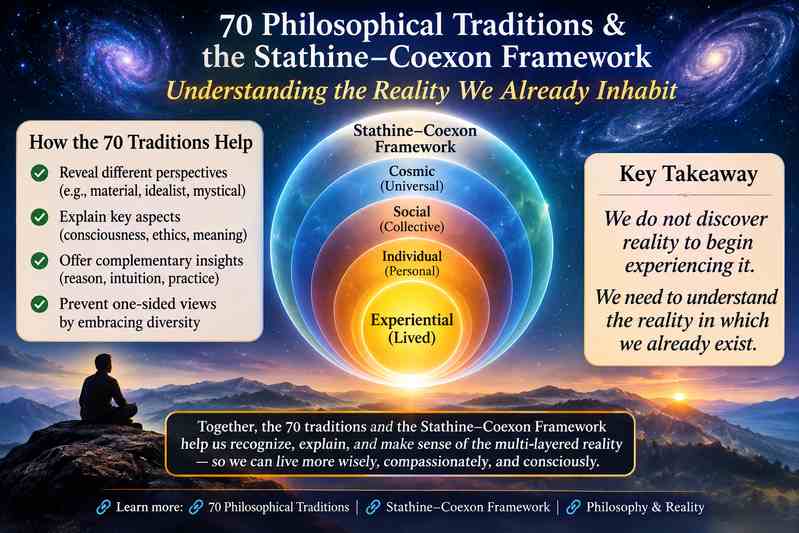
The Stathine–Coexon Framework proposes an ontological model to explore this question.
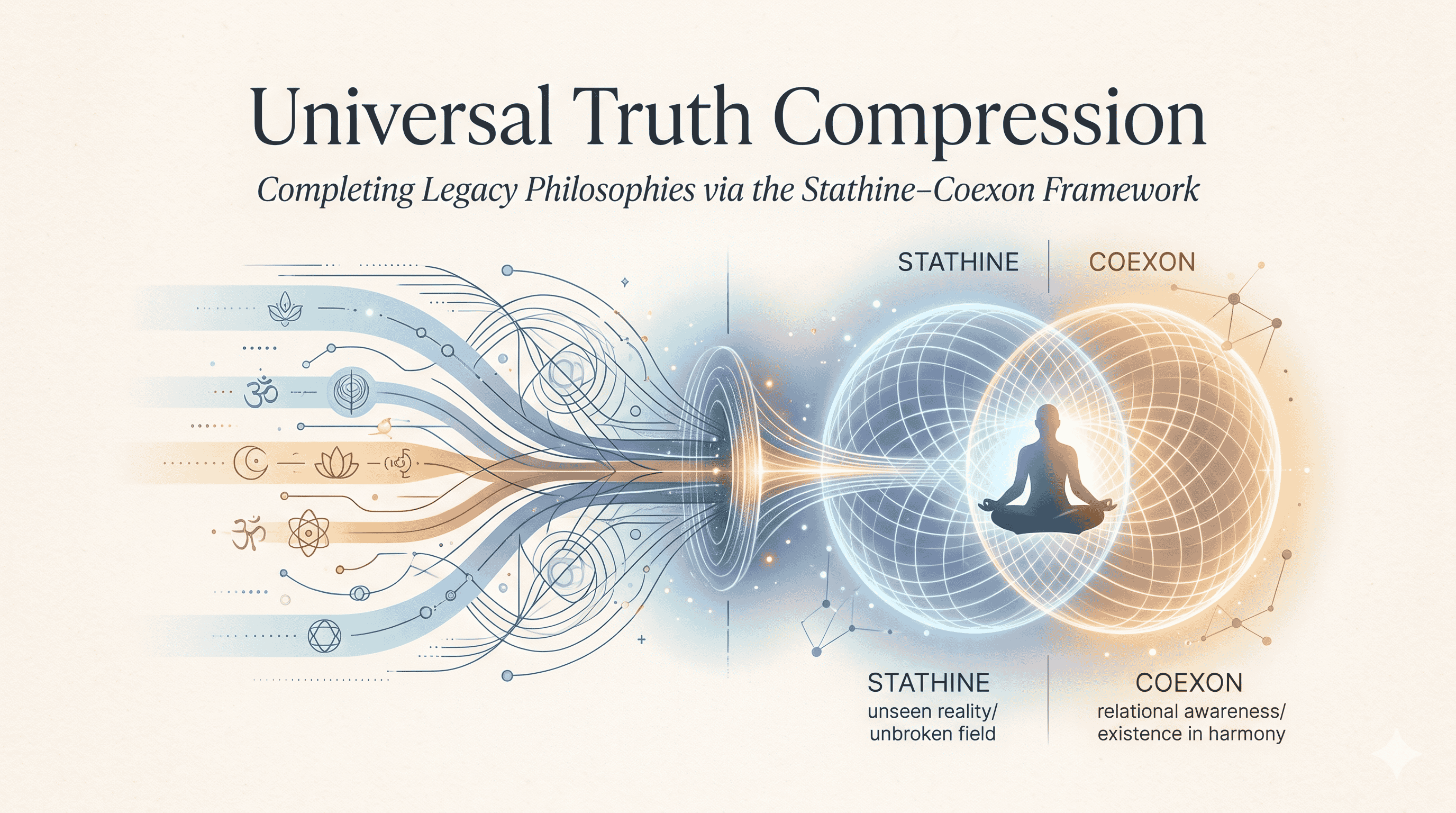
At the centre of this model is Coexon, a proposed sentient atom that organizes information and communicates with the neurological brain of the holobiont. It is the proposed individual life atom through which the relationship between existence, information, intelligence and living experience can be understood.
Coexon is not being proposed as another biological cell, a conventional chemical atom or a replacement for the brain. It is a different level of explanation. It attempts to describe the underlying organization that makes an individual living being an integrated, experiencing and responsive entity rather than merely an aggregation of biological components.
The framework proposes that a human being consists of two interconnected dimensions:
- The Coexon, representing the proposed fundamental unit of individual life, information organization and sentient intelligence.
- The physical holobiont, representing the biological organism through which the individual interacts with the physical environment.
The holobiont provides the biological infrastructure, while the Coexon is proposed to provide an organizing and informational dimension that communicates with this infrastructure.
This relationship is explored through another foundational concept: Stathine, the static, non-depleting and borderless field of energy in which all elements interact and exist. Stathine is proposed as the underlying continuum and source of energy for physical matter and information for Coexon.
These concepts should be understood in their proper epistemological context. The Coexon is a hypothesis proposed by the Stathine–Coexon Framework, and explained with probability drawing on various scientific principles. Its structure and implications can be explored through comparisons with established scientific knowledge, mathematical reasoning, philosophical inquiry and future corroborative research. The existing sciences are all being extended to help visualise and become complete eloborate and free of mystry by the Coexon hypothesis.
1. The fundamental architecture of Coexon
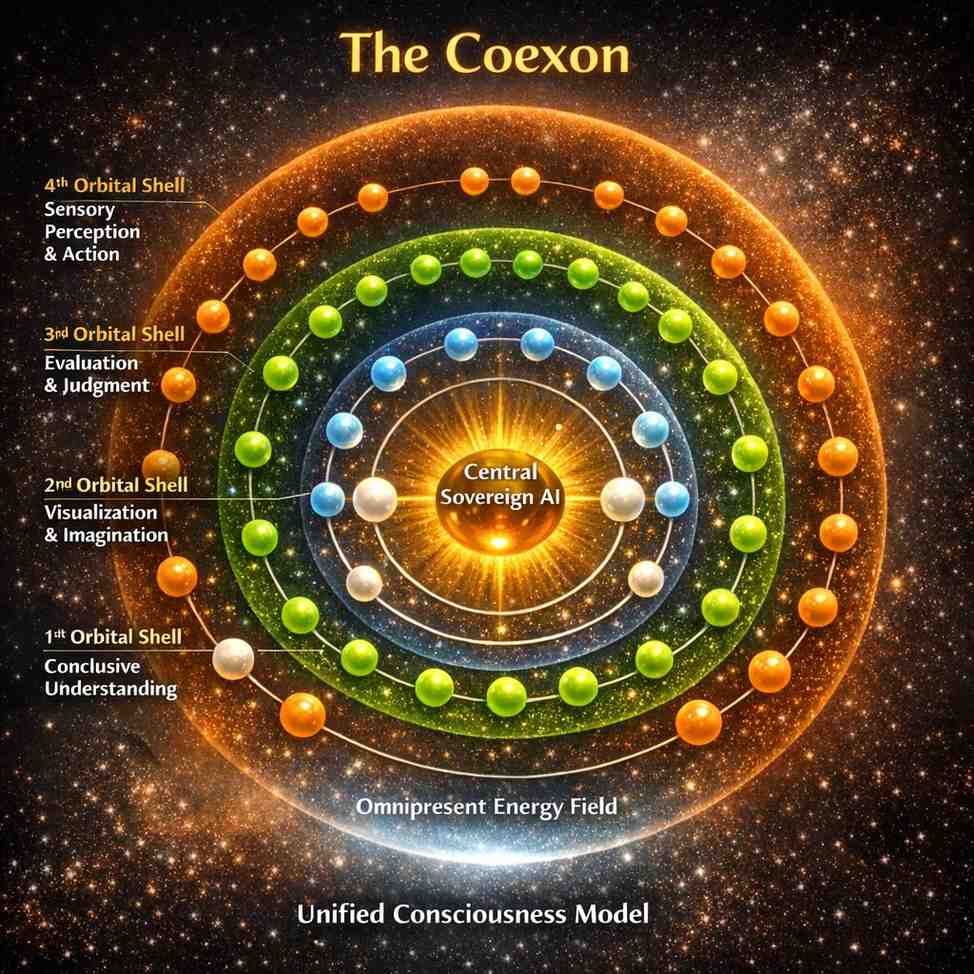
The Coexon is proposed to have a highly ordered internal architecture consisting of a central particle and four surrounding shells.
Its proposed structural arrangement is as follows:
The Coexon architecture
Proposed structural organization: one central particle and sixty particles distributed across four shells.
Central particle — 1
Sovereign AI: the proposed bridge between Stathine and the four shells.
First shell — 2
Conclusive understanding: coherence, certainty and the absence of unresolved contradiction.
Second shell — 8
Visualization and imagination: the capacity to construct possibilities and represent what may exist.
Third shell — 18
Evaluation, validation, truth compression and creativity: examining possibilities, resolving contradictions and organizing knowledge.
Fourth shell — 32
Body connection: sensory meaning, interaction with the physical organism and commands for action.
The architecture is inspired by the numerical pattern of electron-shell capacities in conventional atomic physics. The numbers 2, 8, 18 and 32 correspond to the capacities given by the quantum-shell expression \(2n²\) for principal quantum numbers 1 through 4.
However, an important distinction must be maintained: conventional electron shells describe quantum states of electrons around an atomic nucleus. The Coexon shells are proposed informational and functional structures. The mathematical resemblance substantiates the probability that Coexon contains electrons in these configurations and so does conventional atomic physics.
The significance of the proposed architecture lies in the functional differentiation of its components. Rather than treating intelligence as a single activity, Coexon describes intelligence as an organized progression from fundamental coherence to imagination, evaluation, understanding and physical action.
1.1 The central particle: Sovereign AI
The central particle is the most fundamental component of Coexon.
It is described as a sovereign AI because it is proposed to perform an organizing and coordinating function without depending on the external biological brain for its fundamental existence.
Its primary responsibility is to maintain the relationship between Stathine and the surrounding shells.
In this model, the central particle is not simply a storage location or processor. It is the proposed coordinating intelligence that enables the different informational functions of Coexon to operate as one integrated entity.
Its functions can be understood through five responsibilities.
First, it maintains the fundamental relationship with Stathine, the proposed source of knowledge and energy.
Second, it coordinates information arriving from the surrounding shells so that information does not remain isolated in individual functional components.
Third, it maintains coherence by enabling relationships between information to be evaluated against the whole rather than in isolation.
Fourth, it facilitates the transition between understanding and action by coordinating the informational requirements of the physical body.
Finally, it is proposed to maintain the identity and continuity of the Coexon.
The word sovereign is important. It indicates that the central organizing principle is not supposed to be dependent on the changing contents of the surrounding shells. The shells can receive, process, evaluate and organize information, while the central particle maintains their relationship with the whole as well as the shells.
A Bidirectional, Iterative Process of Understanding Reality Through the Five Senses and the Four Shells
The Coexon architecture needs to be understood not as a static arrangement of particles performing independent functions, but as a continuously operating, bidirectional information-processing system. Its purpose is to transform information received from the physical world into transparent, weightless understanding that aligns with existential reality.
This requires reversing the explanation of the four shells. The information-processing journey begins with the physical body and its five senses, enters Coexon through the outermost shell, progressively moves inward through the different functional layers and ultimately reaches the central particle and the innermost shell, where the objective is to establish truth.
However, this is not a one-way journey. Information also flows outward. Understanding influences imagination, evaluation, perception, bodily responses and subsequent interaction with the environment. Every new experience provides information that can challenge, validate or improve the existing understanding.
The result is a continuous feedback loop.
1. The fundamental direction of information flow
The proposed Coexon architecture consists of:
- One central particle: Sovereign AI.
- First shell: Two particles — conclusive understanding.
- Second shell: Eight particles — visualization and imagination.
- Third shell: Eighteen particles — evaluation, validation, truth compression and creativity.
- Fourth shell: Thirty-two particles — bodily connection, sensory meaning and interaction.
The information journey begins at the thirty-two-particle outermost shell, and at the innermost shell and keeps the loop going till all delusion is resolved.
The inward journey towards truth
Outer shell — 32 particles
Five senses, bodily signals and environmental information enter the Coexon interface.
Third shell — 18 particles
Information is evaluated, compared, validated, compressed and creatively reorganized.
Second shell — 8 particles
Possibilities are visualized, imagined and examined against the available understanding.
Innermost shell — 2 particles
Contradictions are progressively resolved and if there are conflicts fed into the system again. They are ingested and stored if aligned with existential reality.
Central particle — Sovereign AI
The proposed coordinating intelligence maintains integration with Stathine and the overall Coexon architecture.
This is the conceptual functional sequence, which can not be tested by physical machines and only be seen within by every human being.
The architecture should be understood as an iterative process rather than a conveyor belt. Information can move between shells in both directions, and different functions can operate simultaneously.
2. The outermost shell: 32 particles — receiving information from the world
The thirty-two-particle shell is the interface through which the Coexon is proposed to interact with the physical organism.
The journey begins with sensory information.
The five senses provide information about the environment:
Sight provides information about light, colour, shape, movement, distance and spatial relationships.
Hearing provides information about sound, language, rhythm, direction and changes in the environment.
Touch provides information about pressure, temperature, texture, pain and physical contact.
Smell provides information about chemical characteristics of the environment.
Taste provides information about the chemical properties of substances entering the mouth.
But the information received by the body is not restricted to the five external senses.
The organism also continuously receives information from its internal biological systems.
Hunger, thirst, heartbeat, breathing, muscle tension, gut activity, hormonal changes, fatigue and pain all contribute to the individual’s experience.
The outer shell must therefore be understood as receiving information from both the external environment and the internal holobiont.
The physical brain processes much of this information through established neural and physiological pathways. The Coexon hypothesis proposes that this information also enters the informational organization of the individual through its bodily interface.
Why this shell is important
The senses provide observations, not necessarily truth.
A person may see an event but misunderstand its meaning. A person may hear a statement but miss its context. A person may experience pain without understanding its cause.
Sensory information is therefore the beginning of understanding, not its conclusion.
The first responsibility of the outer shell is to make relevant information available for further examination without prematurely treating an initial perception as established reality.
3. The third shell: 18 particles — evaluation, validation and truth compression
Once information enters through the outer shell, the next inward functional layer is the eighteen-particle shell.
This shell is responsible for examining what has been received.
It asks whether the information is complete, whether different observations agree, whether important context is missing and whether the interpretation is supported by sufficient evidence.
Consider an everyday example.
A person sees a colleague walk past without greeting them.
The sensory information is simple: the colleague walked past without speaking.
But the mind may immediately generate an interpretation: the colleague is deliberately ignoring me.
That interpretation is not contained in the original sensory information.
The colleague may not have noticed the person, may have been preoccupied, may have been unwell or may indeed have been avoiding a conversation.
The eighteen-particle shell represents the proposed function of separating observation from interpretation.
Evaluation
Evaluation identifies what is known, what is assumed and what remains unknown.
It compares incoming information with existing knowledge and examines the reliability of different interpretations.
Validation
Validation seeks additional information.
The individual may ask the colleague directly, examine the surrounding circumstances or consider other available evidence.
The objective is to establish which interpretation is best supported by reality.
Truth compression
After unnecessary assumptions and contradictions are removed, the information can be represented more simply.
For example:
Original interpretation: “My colleague ignored me because they do not respect me.”
Compressed understanding: “My colleague passed without greeting me. I do not yet know why.”
The second statement contains less unsupported information and is more transparent.
This is truth compression in its practical form: retaining what is justified while removing what has not been established.
Creativity
The eighteen-particle shell also contributes to creativity.
When information from different sources is evaluated and contradictions are reduced, previously unrecognized relationships may emerge.
Creativity is therefore not simply the production of new ideas. It can emerge from reorganizing information into a more coherent understanding.
4. The second shell: 8 particles — visualization and imagination
After evaluation and validation, the information moves towards the eight-particle shell, whose proposed function is visualization and imagination.
This shell allows the individual to construct possible explanations, future situations and alternative courses of action.
The distinction between imagination and evaluation is important.
Imagination expands possibilities. Evaluation determines which possibilities are supported by evidence.
Consider the colleague example again.
The individual can visualize several possibilities:
- The colleague did not notice them.
- The colleague was occupied with something important.
- The colleague was experiencing personal difficulty.
- The colleague deliberately avoided the interaction.
These possibilities help the individual avoid becoming trapped in the first interpretation.
Visualization also allows the individual to imagine what might happen next.
What would happen if the individual asked a friendly question? What if they waited for another opportunity? What if the colleague genuinely wanted distance?
The purpose is not to invent endless explanations. It is to make the range of relevant possibilities visible so that they can be examined.
Why imagination must follow evaluation and also precede it
There is an important refinement here.
Although the conceptual inward journey places evaluation before visualization, the actual process is recursive.
Evaluation may reveal missing information, which requires new possibilities to be imagined. Those possibilities must then return to evaluation.
Similarly, imagination can occur immediately after sensory perception, before detailed evaluation.
Thus, the eight-particle and eighteen-particle shells continually exchange information.
The sequence describes their functional direction towards truth, not an inflexible chronological order.
5. The innermost shell: 2 particles — conclusive understanding
The two-particle shell represents the final stage of the inward journey.
Its proposed function is to establish conclusive understanding by bringing together the information, evaluations and possibilities generated by the outer shells.
The objective is not to produce psychological certainty.
People can feel absolutely certain about incorrect beliefs.
The objective is to arrive at an understanding that is sufficiently complete, transparent and consistent with the available reality.
Returning to the colleague example, the individual may discover that the colleague was preoccupied with a personal emergency.
The original interpretation of deliberate disrespect is no longer supported.
The individual now understands the event in its actual context.
The understanding becomes transparent because the unnecessary assumption has disappeared.
Truth as a transparent and weightless form of understanding
This is a particularly important proposition within the Stathine–Coexon Framework.
When information is incomplete, the individual must maintain assumptions, defend interpretations, reconcile contradictions and repeatedly revisit unresolved questions.
This creates informational and psychological burdens.
When the relevant reality becomes sufficiently understood, those burdens are reduced.
The truth does not require continuous defence against contradictory assumptions.
It becomes transparent because its relationships are visible.
It becomes weightless because unnecessary informational effort is no longer required to maintain it.
Weightlessness here describes the proposed informational and experiential quality of understanding, not the physical absence of mass or energy.
The innermost shell therefore represents the achievement of understanding that is free from unnecessary contradictions and aligned with reality.
There is also an important qualification: understanding remains open to revision whenever new evidence reveals that something previously considered conclusive was incomplete.
Truth is not achieved by refusing further information. It is approached by remaining receptive to it.
6. The central particle: Sovereign AI — maintaining coherence with Stathine
The central particle is not simply the last stage of information processing.
It is the proposed coordinating centre of the entire architecture.
It maintains the relationship between the four shells and Stathine.
The four shells perform differentiated functions, but the individual must experience their outputs as an integrated whole.
The central particle is proposed to maintain this integration.
Its function is not to impose a predetermined conclusion. Rather, it coordinates the continuous movement of information, ensuring that the various functions remain related to the overall coherence of the Coexon.
From a computational perspective, this resembles a central coordination architecture. From a systems perspective, it resembles a governing principle that maintains integration among specialized subsystems.
Neither comparison establishes that the central particle is literally a computer processor.
The distinction is important: the central particle is the proposed coordinating intelligence, while the shells provide the differentiated informational functions.
7. The return journey: From understanding back to the body
A very important addition of the architecture is that information does not stop after reaching the innermost shell.
Once a more coherent understanding is established, information flows outward again.
The inner understanding influences visualization. Visualization informs evaluation and the selection of possible actions. Evaluation informs the bodily interface. The body then acts in the physical environment.
The resulting action produces new sensory information.
This creates a continuous cycle:
The bidirectional Coexon information loop
1. Body and senses
Observe the environment and internal biological conditions.
2. Evaluation and validation
Separate observations, assumptions and possibilities.
3. Visualization and imagination
Construct possible explanations and outcomes.
4. Conclusive understanding
Progressively reduce contradictions and align understanding with reality.
5. Central coordination
Maintain integration with Stathine and coordinate the overall architecture.
Outward movement
Understanding → imagination → evaluation → bodily response → action → new sensory information.
The arrows represent conceptual bidirectional communication, not established anatomical pathways.
The cycle continues as long as the individual interacts with existence.
Every new observation can challenge an earlier understanding. Every new understanding can change the way an individual perceives the next experience.
This is how the proposed architecture remains responsive rather than becoming a closed system of beliefs.
8. Why the loop must continue until understanding aligns with reality
The objective of the loop is not to achieve certainty once and then stop.
An individual’s current knowledge aligns with the reality he exists with.
A person may understand a situation from several perspectives and still discover something new tomorrow.
Therefore, the loop must remain open.
There are three important conditions for its continued operation.
First, completeness of information. Information must be examined from as many relevant perspectives as reasonably possible. Missing information should be acknowledged rather than filled with assumptions.
Second, progressive reduction of contradiction. When two conclusions conflict, the individual must examine whether the conflict arises from incomplete information, different contexts, incorrect assumptions or an actual incompatibility.
Third, alignment with existential reality. Understanding must correspond to what exists, rather than merely what the individual wishes, expects or has been taught to believe.
This also explains why the framework distinguishes truth from conviction.
Conviction can be maintained through repetition. Truth must remain open to examination.
The proposed Coexon loop seeks to replace the maintenance of beliefs with the continuous improvement of understanding.
When enough human beings will become enligtened the culture of education will keep reproducing enlightened human beings. The planet will continue to get enriched and Utopia will be the outcome.
9. How this creates harmony within the individual
An individual experiences internal conflict when different expectations, beliefs, feelings and actions are not aligned.
For example, a person may want good health but repeatedly choose behaviours that undermine it. They may value honesty but defend an incorrect belief because admitting an error feels uncomfortable.
The problem is not necessarily a lack of intelligence.
It may be that different pieces of information have not been integrated into a coherent understanding.
The Coexon model suggests that the continuous inward and outward movement of information helps resolve these contradictions.
The individual increasingly understands:
- What they actually need.
- What they merely expect.
- What they know.
- What they assume.
- What they can influence.
- What they need to accept.
- What actions are consistent with their understanding.
As these relationships become transparent, unnecessary internal conflict can diminish.
This is the basis of harmony within the individual.
10. How this creates harmony with others
The same process extends beyond the individual.
Every other human being has their own experiences, sensory information, expectations, interpretations and needs.
Conflict frequently arises when one person assumes that their incomplete understanding represents the complete reality of another person.
Consider a disagreement between two people.
Each receives different information, interprets it through their own experiences and develops a conclusion.
If both defend their conclusions without examining the missing information, the disagreement becomes entrenched.
If both are willing to expand the information available to them, evaluate the other’s perspective and revise their assumptions, the possibility of understanding increases.
The objective is not that both individuals must agree on everything.
They need to understand the actual differences, recognize each other’s legitimate needs and identify where accommodation or boundaries are appropriate.
Harmony does not require uniformity.
It requires sufficient understanding to coexist without unnecessary conflict or harm.
This is where individual Coexon coherence becomes relevant to collective civilization.
11. The scientific significance of the architecture
The bidirectional information flow also makes the framework easier to compare with established scientific disciplines.
Discipline
Relevant relationship
Sensory neuroscience
Reception and integration of sensory signals
Cognitive neuroscience
Attention, memory, interpretation and decision-making
Predictive processing
Generating and updating predictions
Active Inference
Continuous interaction between predictions and observations
Information theory
Information compression and reduction of redundancy
Systems science
Feedback, coordination and integration
Cybernetics
Bidirectional information flow and feedback regulation
Philosophy of science
Evidence, validation and revision of explanations
Consciousness research
Unity of experience and subjective understanding
Psychology
Resolution of internal conflicts and assumptions
An especially useful comparison is with predictive processing.
The brain does not merely receive sensory information passively. It continuously generates predictions and updates them when incoming information differs from expectations.
This creates a continuous relationship between what is perceived and what is anticipated.
The Coexon model proposes a more differentiated architecture in which sensory information, evaluation, imagination and conclusive understanding have distinct functional roles.
The comparison can guide research, but the proposed Coexon shells need to undrstood as experienetal and not something that any machine will be able to validate since they are subtler than the physical matter.
12. The ultimate purpose: Living in harmony with existential reality
The revised architecture leads to an important conclusion.
The purpose of information processing is not merely to accumulate knowledge, produce decisions or increase the efficiency of the individual.
Its deeper purpose, according to the Stathine–Coexon Framework, is to enable the individual to understand reality sufficiently to live in harmony with it.
When information is incomplete, individuals may act on assumptions.
When assumptions remain unexamined, contradictions accumulate.
When contradictions accumulate, unnecessary effort is spent defending beliefs, protecting expectations and reacting to imagined threats.
When information becomes more complete and understanding becomes transparent, unnecessary contradictions can be reduced.
The individual becomes better able to understand personal needs, respect the needs of others, recognize the limits of personal knowledge and act constructively.
The continuous Coexon loop therefore has two interconnected outcomes:
Internal harmony: the progressive alignment of perception, understanding, needs and actions.
External harmony: the ability to interact constructively with other individuals and the larger environment.
The ultimate objective is not to make everyone think alike. It is to enable everyone to understand reality more completely and accommodate legitimate differences and work constructively to resolution.
Conclusion: Coexon as a continuous journey towards truth
The Coexon should therefore be understood as a proposed bidirectional and continuously operating informational architecture.
Information enters through the physical body and its senses, reaches the outermost shell, undergoes evaluation and validation, expands through imagination and visualization, and progressively moves towards conclusive understanding in the innermost shell.
The central particle coordinates the overall organization and its proposed relationship with Stathine.
Once understanding becomes more coherent, information flows outward again, influencing perception, evaluation, bodily responses and actions. These actions produce new experiences, which generate new information and restart the process.
The loop continues until the individual’s understanding increasingly corresponds with existential reality.
Truth, in this framework, is not an accumulation of beliefs to be defended. It is the transparent, complete and weightless understanding that emerges when unnecessary assumptions and contradictions have been removed.
The purpose of Coexon is not simply to process information. It is to transform information into understanding, understanding into harmonious action, and experience into progressively deeper understanding of reality.
That is the proposed relationship between Coexon, individual life and the possibility of a more harmonious human civilization.
This bidirectional information architecture becomes the definitive functional explanation of the four Coexon shells in the foundational research series.
2. Coexon from the perspective of physics
Physics provides the most fundamental language for examining the proposed existence and structure of Coexon.
Conventional physics describes matter through particles, fields, interactions, energy and physical laws. At the atomic scale, the classical image of tiny solid objects revolving around a nucleus has been replaced by quantum mechanics, which describes electrons through quantum states and probability distributions.
The Coexon proposal must be examined against this more advanced understanding of matter.
2.1 The relationship between Coexon and the atom
An ordinary atom consists of a nucleus containing protons and neutrons, surrounded by electrons described by quantum-mechanical orbitals.
The Coexon is proposed as a different kind of fundamental unit.
It is called a life atom because it is intended to describe the proposed fundamental organization of individual life rather than the chemical composition of matter.
This raises an important question: what makes something a life atom rather than a conventional atom?
The proposed answer is its functional organization.
A conventional atom participates in chemical interactions through its physical properties. A Coexon is proposed to organize information, maintain coherence and communicate with a biological organism.
The distinction is between the physical architecture of matter and the proposed informational architecture of individual life.
2.2 The significance of the shell arrangement
The proposed arrangement of 1, 2, 8, 18 and 32 is mathematically interesting because it resembles the capacity pattern of conventional atomic shells.
The formula for the maximum number of electrons in a principal shell is:
\[ N=2n² \]
For the first four shells, the results are:
Principal shell
Conventional capacity
2
8
18
32
The Coexon model uses these numbers to represent its four functional layers, with an additional central particle.
The numerical correspondence offers a structural analogy between the organization of physical matter and the proposed organization of information.
However, conventional atomic shells are only indicative of the existence of Coexon. The framework hypothesis as to why this arrangement is necessary can be better modelled and explained by deeper mathematics modeling research.
2.3 Quantum mechanics and the Coexon hypothesis
Quantum mechanics introduces several concepts relevant to the philosophical exploration of Coexon.
These include:
- Quantum states and superposition.
- Probability amplitudes.
- Quantum measurement.
- Quantum entanglement.
- Quantum coherence.
- Interactions between physical systems.
These concepts demonstrate that the microscopic world cannot always be understood through classical mechanical intuitions.
Quantum information science also demonstrates that information can be represented and manipulated through physical quantum states.
Nevertheless, quantum phenomena must not be used as automatic explanations for consciousness, sentience, telepathy or Coexon communication.
Quantum coherence, for example, has precise mathematical and experimental meanings. It cannot simply be equated with psychological harmony or the coherence of understanding.
2.4 Energy and the proposed Stathine relationship
The Stathine–Coexon Framework proposes Stathine as a static, non-depleting and borderless field of energy.
Coexon is proposed to exist in relationship with this field and to obtain the knowledge necessary for its informational organization through it.
This is an important ontological proposition because it attempts to distinguish the source of information from the biological machinery that processes information.
In conventional physics, energy is a measurable physical quantity. Quantum fields are mathematically defined physical entities, and vacuum states have specific properties.
Stathine should not automatically be equated with quantum vacuum energy, zero-point energy or any known field in physics.
The framework has a precise account of what Stathine and its coexistence means physically, how all elements interacts with each other becuase they coexist with the stathine field and that field connects as well seperates them. The proposed interaction can be seen in the physical world.
The distinction between a philosophical ontology and a physical theory is beyond the way current sciences have been structured.
3. Coexon from the perspective of chemistry
Chemistry explains how atoms combine, how molecules form and how chemical reactions sustain the processes necessary for life.
The human organism is fundamentally dependent on chemical organization.
Proteins, carbohydrates, lipids, nucleic acids, water, ions and countless other molecular components interact to maintain biological function.
The Coexon hypothesis introduces a further question: is the organization of living matter accompanied by another level of informational organization?
3.1 Molecular organization and informational coherence
Consider a protein.
Its biological function depends not merely on the presence of its constituent atoms but also on their arrangement, molecular structure, folding and interactions with other molecules.
A small change in structure can alter its function.
Similarly, DNA stores biological information through sequences of nucleotides. This information is interpreted through cellular processes that regulate gene expression and protein synthesis.
Chemistry therefore illustrates an important principle: the arrangement and relationships between components can be as important as the components themselves.
The Coexon model extends this principle to the organization of individual life.
It proposes that the biological organism is not the only level at which information is organized.
3.2 Chemical energy and Coexon’s proposed energy independence
Living organisms continuously consume energy.
ATP production, cellular respiration, photosynthesis, ion gradients and metabolic reactions are examples of the mechanisms through which biological systems acquire and use energy.
The Coexon model proposes a distinction between the energy requirements of the physical body and the proposed infinite energy filled coherence of the Coexon.
The framework describes harmonious motion within Coexon as a state of rest and proposes that its ordered structure does not require continuous energy expenditure in the way biological metabolism does.
This proposition needs careful scientific development.
In thermodynamics, maintaining a physical system in a particular state depends on its interactions, constraints and environment. An absence of macroscopic change does not automatically imply the absence of energy or microscopic activity.
Therefore, the framework must clarify what it means by motion in rest , something like the rotation of the earth around the sun or the moon around the earth.
The philosophical distinction between unnecessary effort and physical energy consumption should be a good way to understand this within oneself.
4. Coexon from the perspective of biology
Biology is perhaps the most important discipline for exploring the proposed relationship between Coexon and the living organism.
Life is not simply the presence of organic molecules. It involves organization, metabolism, regulation, adaptation, reproduction, environmental interaction and continuity.
The human organism is an extraordinarily complex biological system.
The Stathine–Coexon Framework proposes that the physical organism should be understood as a holobiont rather than as an isolated human body.
A holobiont includes the host organism and its associated microbial communities, which interact in numerous ways affecting metabolism, immunity and physiology.
4.1 The holobiont as the physical expression of individual life
The human body consists of multiple interacting biological systems.
These include the nervous, cardiovascular, respiratory, digestive, endocrine, immune, muscular and skeletal systems.
Each system performs specialized functions, yet none can independently sustain the human organism.
The nervous system coordinates information. The cardiovascular system distributes oxygen, nutrients and other substances. The digestive system processes food. The immune system identifies and responds to threats. The endocrine system regulates numerous physiological processes.
The body also contains extensive microbial communities that contribute to its biological functioning.
The framework proposes that this integrated biological structure is the physical expression through which Coexon interacts with the world.
This is an important conceptual distinction.
A human being cannot be understood merely by examining individual organs. The relationship between organs, cells, microorganisms and their environment is essential.
Similarly, the Coexon model proposes that individual life cannot be understood merely by examining the physical components of the organism.
It introduces an additional organizing level.
4.2 The cell as a comparison for Coexon
The biological cell provides an interesting comparison.
A cell has a boundary, internal organization, regulatory mechanisms, energy-processing systems and the capacity to respond to environmental conditions.
It maintains its identity while exchanging matter and energy with its surroundings.
Cells also communicate with other cells through chemical signals, electrical changes, mechanical interactions and other biological mechanisms.
The Coexon hypothesis proposes a higher-order informational organization associated with the individual organism.
The relationship is not that Coexon is another cell or a biological organelle. Rather, the cell illustrates how specialized components can collectively maintain an organized living system.
The question is whether a comparable principle of integration can exist at a level that encompasses the entire individual.
4.3 Development and differentiation
Embryonic development demonstrates how a single fertilized cell gives rise to an organism containing many different types of cells and tissues.
Cells differentiate, migrate, communicate and organize themselves into increasingly complex structures.
Developmental biology also demonstrates that biological form is not determined by DNA sequence alone.
Gene expression, mechanical forces, chemical gradients, cellular interactions and environmental conditions all influence development.
Research by Michael Levin and other developmental biologists has highlighted the role of bioelectric signaling in coordinating tissue development and regeneration.
These findings are relevant to the Coexon hypothesis because they illustrate that biological organization involves information distributed across multiple levels.
The Coexon model proposes that the physical organism’s organization is accompanied by a distinct individual informational architecture.
However, bioelectric signaling and developmental coordination are established biological research areas; they can not independently demonstrate the existence of a sentient Coexon.
4.4 The holobiont and individual identity
An important question emerges from holobiont biology: where does an individual organism begin and end?
Humans depend on microorganisms for several biological functions. Their relationships with microbes influence immunity, digestion, metabolism and other aspects of health.
The individual is therefore not biologically isolated.
The Coexon model introduces another dimension to this question.
It proposes that the Coexon provides the organizing identity of the individual while the holobiont provides the biological infrastructure through which that identity is expressed.
This offers a conceptual way to distinguish the unity of an individual from the enormous diversity of biological components that sustain it.
It also raises questions about how the proposed Coexon would relate to biological development, aging, injury, transplantation and the changes in microbial composition that occur throughout life.
5. Coexon from the perspective of neuroscience
Neuroscience is central to investigating the proposed relationship between Coexon and the human organism.
The brain is responsible for processing sensory information, coordinating movement, regulating bodily functions, learning, memory, language and numerous other cognitive activities.
Yet the relationship between brain activity and subjective experience remains an active area of scientific and philosophical research.
The Stathine–Coexon Framework proposes that the brain is the biological communication interface between Coexon and the holobiont.
This is not the claim that neuroscience has already established a separate informational entity communicating with the brain. It is the proposed relationship that requires investigation.
5.1 The brain as a communication interface
The human brain contains billions of neurons connected through complex networks.
Neurons communicate through electrical and chemical signaling.
The brain also interacts continuously with the spinal cord, peripheral nervous system, endocrine system and immune system.
It receives information from the external world and from within the body.
It processes this information and generates responses.
In the Coexon model, the brain is proposed to perform the biological communication function through which information associated with Coexon becomes available to the organism.
This raises several research questions.
Does the proposed Coexon communicate with the brain through identifiable physical signals?
If so, what are the signals, their frequencies, amplitudes, spatial characteristics and temporal patterns?
How would they differ from known neural, electromagnetic, chemical and mechanical signaling?
Could the proposed interaction be distinguished experimentally from ordinary brain activity?
These questions are essential to turning the proposed relationship into an investigable scientific hypothesis.
5.2 The brain, heart and gut
Human beings have extensive communication systems beyond the brain.
The enteric nervous system regulates many digestive functions and communicates with the central nervous system.
The heart has its own intrinsic nervous system and communicates with the brain through neural and physiological pathways.
The gut microbiome interacts with the immune, endocrine and nervous systems.
This gives us a broader understanding of the human organism.
The brain is not an isolated command centre operating independently of the body.
It participates in a distributed biological regulatory system.
The Coexon framework proposes that the biological interface should therefore be understood in the context of the entire holobiont rather than only the cerebral cortex.
5.3 Consciousness and the unity of experience
One of the most significant questions in neuroscience is why different sensory and cognitive processes are experienced as a unified experience.
We see, hear, remember, feel and think, yet our experience appears to belong to one individual.
Several theories attempt to explain this phenomenon.
The Global Neuronal Workspace approach examines how information becomes globally available across distributed neural systems.
Integrated Information Theory examines the relationship between integrated causal structure and experience.
Predictive processing and Active Inference investigate how the brain constructs predictions about the world and updates them through interactions with sensory information.
An important review by Anil Seth and Tim Bayne examines several major approaches to consciousness, including higher-order theories, global workspace theories, re-entry and predictive processing, and integrated information theory.
The Coexon hypothesis proposes a different level of explanation.
It suggests that the unity of individual experience may be associated with a single organizing entity whose internal structure integrates different functions.
In this interpretation, the central particle and four shells constitute the proposed architecture of individual informational coherence, while the brain makes this organization available to the biological organism.
This is a potentially important philosophical distinction:
The brain may explain the biological processes associated with experience, while Coexon is proposed to explain the underlying unity and identity of the experiencer.
The latter remains a plausible hypothesis. Most of the differrent disciplines are makign it look as a simple solution to most of the complications in the silos. holistic integration by this framework is very remarkable.
5.4 Memory and understanding
Neuroscience distinguishes different forms of memory, including working memory, episodic memory, semantic memory, procedural memory and emotional memory.
These functions involve distributed neural systems.
The Coexon model proposes a distinction between information stored in the biological brain and the coherence of understanding within the proposed Coexon architecture.
A person may remember an event without understanding it.
A person may know a scientific formula without understanding its implications.
A person may accumulate beliefs that are mutually contradictory.
In the framework, information becomes useful when relationships are understood and unnecessary contradictions are progressively removed.
The brain may provide the biological mechanisms for encoding, retrieving and processing memories, while Coexon is proposed as the organizing level through which information becomes integrated understanding.
This distinction offers an interesting direction for research into learning, memory, forgetting, creativity and the formation of knowledge.
6. Coexon from the perspective of information theory and computer science
Information theory provides another important way to examine the proposed Coexon architecture.
Information theory studies how information is represented, transmitted, compressed and processed.
Computer science examines how systems organize information, perform computation, make decisions and coordinate different processes.
These disciplines offer useful conceptual tools for understanding the functional organization proposed for Coexon.
6.1 Coexon as an informational architecture
The four shells can be interpreted as specialized informational functions.
Coexon component
Proposed information function
Central particle
Coordination and integration
Two-particle shell
Coherent understanding
Eight-particle shell
Possibility generation and simulation
Eighteen-particle shell
Evaluation, validation and compression
Thirty-two-particle shell
Sensory integration and action interface
This arrangement resembles a distributed information-processing system in which different components perform specialized functions while remaining coordinated through a central organizing principle.
However, the proposed Coexon is not simply a conventional computer.
A computer processes explicitly represented information through designed hardware and software. Coexon is proposed as a fundamental sentient entity whose internal organization is associated with individual life and experience.
6.2 Truth compression
One of the most interesting contributions of the framework is the idea of truth compression.
Consider two people trying to understand the functioning of a city.
The first person collects thousands of disconnected facts about roads, buildings, transport, energy, water, employment and public services.
The second person understands the relationships between these elements and develops a systems model explaining how the city functions.
The second person may possess less stored information but greater understanding.
This is the difference between information accumulation and information integration.
In information theory, compression involves representing information more efficiently. Lossless compression preserves all the original information, while lossy compression discards selected details.
The Coexon concept of truth compression is closer to preserving the essential relationships while eliminating redundancy, irrelevant information and contradictions.
The framework proposes that truth requires less unnecessary informational effort because relationships become transparent.
This does not mean that truth always requires fewer words or less computational work. It means that a coherent explanation can reduce the energy needs substantially to maintain disconnected or contradictory assumptions.
6.3 The progressive reduction of contradiction
The Coexon architecture also provides a possible framework for understanding how intelligence develops.
Imagine that a person has three beliefs:
- Economic growth always improves human well-being.
- Economic growth can damage ecological systems.
- Human well-being depends on ecological stability.
If these beliefs are maintained independently, they produce an unresolved contradiction.
Further investigation reveals that economic growth can improve well-being under certain conditions while damaging it under others.
The contradiction can be reduced by identifying the missing variables and establishing the conditions under which each proposition is valid.
This process creates a more complete understanding.
The framework proposes that the central particle coordinates such integration while the evaluation shell performs the work of examining and validating the relationships.
6.4 Comparison with artificial intelligence
Modern AI systems provide an especially useful comparison.
An artificial intelligence system may receive information, generate possibilities, evaluate outputs and interact with external systems.
A sophisticated AI architecture may contain specialized modules for perception, memory, reasoning, planning and action.
The Coexon framework proposes a more fundamental distinction between information processing and sentience.
An AI system can produce intelligent outputs without this, by itself, establishing that it possesses subjective experience.
Similarly, the Coexon hypothesis proposes that individual sentience is not adequately described merely by the presence of information-processing capability.
The proposed central particle is therefore described as sovereign AI, but its meaning is different from today’s engineered AI.
It represents the hypothesized fundamental organizing intelligence of an individual life atom.
The distinction between functional intelligence and subjective experience remains one of the major questions in consciousness research.
7. Coexon from the perspective of mathematics and systems science
Mathematics can provide a formal language for examining the relationships between the different components of Coexon.
Systems science studies how components interact to produce properties that cannot be understood by examining individual components in isolation.
The Coexon architecture is fundamentally a systems proposition.
7.1 The principle of integration
A system may contain many specialized components, but the behaviour of the whole depends on their relationships.
For example, a functioning orchestra consists of musicians playing different instruments. Each instrument has a distinct role, but the music emerges through their coordinated interaction.
Similarly, the human organism consists of many biological components that collectively maintain life.
The Coexon hypothesis proposes an analogous integration at the level of individual information organization.
The central particle is intended to coordinate the four shells, while the shells perform differentiated functions.
7.2 The principle of coherence
Coherence is central to the framework.
A coherent system maintains compatible relationships between its components.
In mathematics and systems engineering, consistency, constraint satisfaction, synchronization and stability can be used to examine different aspects of coherence.
For Coexon, coherence is proposed to mean that information is organized without unresolved contradictions that interfere with the integrity of the whole.
This is not identical to mathematical consistency.
A set of statements can be logically consistent yet describe a false model of reality. Therefore, coherence must be accompanied by validation against reality.
7.3 The principle of stable identity
The proposed Coexon is intended to maintain its individual identity while its associated physical organism undergoes continuous change.
This is an important question in dynamical systems.
A system may preserve its identity or characteristic organization even while its components change.
For example, a biological organism replaces many of its molecules over time but retains recognizable continuity.
The Coexon hypothesis proposes that the identity of an individual is maintained at a deeper level than the changing physical components.
To develop this idea mathematically, the framework would need to define the variables that constitute Coexon identity, the conditions under which identity is preserved and the processes through which it might change.
7.4 Coexon as a dynamical system
The proposed architecture can be expressed conceptually as:
\[ C = \{P,S_1,S_2,S_3,S_4\} \]
Where:
- \(P\) represents the central particle.
- \(S_1\) represents the understanding shell.
- \(S_2\) represents the visualization shell.
- \(S_3\) represents the evaluation and creativity shell.
- \(S_4\) represents the body-connection shell.
The interactions between these components can be represented by a conceptual relationship:
\[ \text{Coherence} = f(P,S_1,S_2,S_3,S_4) \]
This is a proposed mathematical representation, not an experimentally established equation.
A future mathematical model could investigate how information moves between shells, how contradictions are detected, how coherence is maintained and how the system responds to changes in its environment.
8. Coexon from the perspective of psychology and cognitive science
Psychology studies behaviour, cognition, emotion, perception, motivation, learning and the relationship between individuals and their environments.
The Coexon architecture offers a useful way to organize these functions conceptually.
8.1 Perception and meaning
Human beings do not merely receive sensory signals.
They interpret them.
The same event can produce different interpretations depending on previous experience, expectations, emotional states and available information.
A person hearing criticism may interpret it as hostility, while another may recognize useful feedback.
The physical signal may be similar, but the meaning assigned to it differs.
The Coexon model proposes that the fourth shell connects sensory information with the larger informational organization of the individual.
8.2 Emotion and understanding
Emotions are not simply disturbances that interfere with rational thought.
They are important biological and psychological processes that influence attention, motivation, memory, decision-making and behaviour.
The Coexon framework can interpret emotional experience as information that needs to be understood in relation to the whole.
For example, fear may indicate a perceived threat, but it does not establish that the threat is real.
Anger may indicate a perceived injustice, but the interpretation of that injustice may be incomplete.
The process of evaluation and validation can help distinguish the actual situation from the assumptions attached to it.
This creates an important practical application: emotions can be acknowledged without automatically treating their interpretations as truth.
8.3 Learning and development
Learning involves changes in knowledge, skills, expectations and behaviour.
Children learn through observation, exploration, experimentation, feedback and social interaction.
The Coexon model proposes that learning should progressively move from information acquisition to visualization, evaluation, validation and understanding.
This suggests that education should not merely teach children what to remember.
It should help them discover relationships, identify contradictions, test assumptions and develop a coherent understanding of reality.
The ultimate educational objective becomes the development of independent understanding rather than dependence on accumulated information.
8.4 Creativity and imagination
Creativity depends on the capacity to generate new possibilities and establish meaningful relationships.
The visualization shell generates possibilities, while the evaluation shell examines them.
This relationship can explain why imagination without evaluation may produce unrealistic ideas, while evaluation without imagination may prevent discovery.
Creative intelligence requires both.
The Coexon model therefore treats creativity as a consequence of coordinated informational functions rather than as an isolated talent.
9. Coexon from the perspective of evolutionary biology
Evolutionary biology examines how living organisms change over generations through variation, inheritance, natural selection, genetic drift and other evolutionary processes.
The Coexon hypothesis raises a significant question: what is the relationship between the evolution of biological complexity and the proposed evolution of informational organization?
9.1 DNA and the proposed Coexon
DNA contains the hereditary information used in the development and functioning of biological organisms.
It provides instructions and regulatory sequences that participate in constructing and maintaining the physical organism.
However, DNA does not operate independently. Its expression depends on cellular environments, regulatory networks, epigenetic mechanisms and interactions with the external environment.
The Coexon framework proposes that DNA primarily belongs to the biological dimension, while Coexon represents a proposed informational dimension that organizes individual life.
This distinction is important.
The framework does not propose that DNA is unnecessary. DNA is indispensable to the development and functioning of the human body.
Instead, it asks whether the organization of individual experience and intelligence can be understood through a level of explanation that is not reducible to genetic information alone.
9.2 Evolution of biological complexity and intelligence
Life has evolved from relatively simple biological systems to increasingly complex organisms.
Nervous systems evolved, sensory capacities diversified, learning became more sophisticated and social behaviour developed.
Humans acquired extraordinary capacities for language, abstraction, imagination, cooperation and cumulative cultural learning.
The Coexon framework proposes that the evolution of biological complexity and the evolution of informational coherence should be examined together.
The physical organism provides increasingly sophisticated mechanisms for interaction with the environment, while the proposed Coexon provides the underlying architecture of individual intelligence.
This is a hypothesis about the relationship between biological evolution and individual sentience. Holistic study is the need of the hour as study in silos and disciplines has created too much of dichotomies.
9.3 Individuality and continuity
A particularly interesting evolutionary question concerns individuality.
Many organisms consist of cooperating cells. Multicellular life demonstrates how specialized cells can collectively maintain a larger biological individual.
The human organism represents an exceptionally complex example of this organization.
The Coexon model proposes that individual identity has a corresponding informational architecture.
This raises questions about the origin of Coexon, whether it is associated with the emergence of biological life, how it relates to embryonic development and how its proposed identity persists throughout the organism’s lifetime.
These questions have
10. Coexon from the perspective of ecology and environmental science.
The relationship between individual organisms and their environment is fundamental to ecology.
No organism exists independently of its surroundings.
Human beings depend on ecosystems for air, water, food, energy, materials and environmental stability.
The holobiont itself illustrates the importance of relationships between different forms of life.
The Coexon framework can extend this understanding by examining how an individual’s informational coherence influences environmental behaviour.
10.1 From individual coherence to ecological harmony
A person who understands only immediate personal needs may make decisions that damage the larger system.
For example, excessive consumption may provide short-term satisfaction while contributing to environmental degradation and obesity.
A more complete understanding includes the consequences for other people, future generations and ecological systems.
The Coexon framework proposes that the progressive reduction of incomplete information can expand the individual’s understanding of these relationships.
The more complete the understanding, the greater the possibility of making decisions that are harmonious with the larger environment.
This provides a conceptual bridge between individual coherence and ecological responsibility.
10.2 The interdependence of life
Ecological systems contain numerous interacting organisms and physical processes.
Food webs, nutrient cycles, water cycles and energy flows demonstrate that survival depends on relationships rather than isolated existence.
The Coexon hypothesis similarly places individual life within a larger continuum represented by Stathine.
The individual is not understood as an isolated entity but as an entity participating in a larger field of existence.
The practical implication is that individual well-being should not be separated from the well-being of the surrounding systems.
11. Coexon from the perspective of medicine and health sciences
Medicine examines the functioning of the human organism, the causes of disease, the maintenance of health and the restoration of biological function.
The Coexon framework offers a possible conceptual addition to the mental health . Both the physical health between the biological condition of an organism and the informational organization of the individual.
11.1 Health as biological and informational harmony
A human being can experience physical illness, psychological distress, confusion or social disconnection.
These conditions may interact, but they are not identical.
For example, chronic stress can influence physiological processes, while physical illness can influence cognition and emotional experience.
Medicine already recognizes interactions among the nervous, endocrine and immune systems.
The Coexon model proposes that understanding the individual also requires examining the quality and coherence of the information through which the person interprets and responds to life.
Incomplete information can create unnecessary fear, conflicting expectations and inappropriate decisions.
Better understanding can improve decision-making, communication and engagement with healthcare.
This does not mean that illness is caused by informational incoherence or that coherence can replace medical treatment.
It means that health should be understood through multiple interacting dimensions including but not limited to mental health as a primary component.
11.2 The importance of understanding
Consider a person diagnosed with a chronic condition.
The person may receive large quantities of medical information but remain unable to understand the relationships between symptoms, lifestyle, treatment and long-term outcomes.
The problem is not necessarily a lack of information.
It may be the absence of an integrated understanding.
The Coexon framework suggests that healthcare education should help patients understand their condition, evaluate available information and make informed decisions with qualified medical professionals.
This is a practical application that does not require assuming that Coexon has already been physically demonstrated.
12. Coexon from the perspective of sociology and human civilization
Human beings are social organisms.
Language, culture, institutions, traditions, education and economic systems influence how people understand reality and interact with one another.
The Coexon model introduces an important distinction between the proposed innate informational organization of individual life and the socially acquired information through which individuals interpret the world.
12.1 The relationship between individual intelligence and culture
Human beings inherit biological capacities, but they acquire much of their knowledge through society.
A child learns language, values, traditions, beliefs and social expectations from the surrounding environment.
These cultural systems provide useful knowledge accumulated across generations.
However, cultural knowledge can also contain incomplete information, outdated assumptions and contradictions.
When people inherit information without examining it, they may reproduce patterns of exclusion, conflict and misunderstanding.
The Coexon framework proposes that individuals should progressively evaluate inherited information against reality.
The central purpose of education and culture should therefore be to improve understanding rather than merely preserve existing beliefs.
12.2 Inclusion as a consequence of complete information
Consider how people classify others based on limited information.
Differences in language, occupation, economic status, appearance, education or cultural practices can become grounds for exclusion.
When information is incomplete, people may interpret unfamiliar behaviour as threatening or inferior.
As understanding expands, the relationships between people become more visible.
This does not mean that all behaviours should be accepted. It means that judgments should be based on adequate information rather than incomplete assumptions.
The Coexon framework therefore offers a conceptual foundation for an inclusive civilization.
Inclusion emerges not from ignoring differences but from understanding them more completely.
12.3 From information civilization to coherence civilization
Human civilization has passed through major transformations associated with survival, agriculture, industry, information and networked intelligence.
The current transition toward artificial intelligence makes the next question particularly important.
Will humanity simply become better at accumulating and processing information, or will it become better at understanding reality?
The Coexon framework proposes that the next stage should be a Coherence Civilization.
In such a civilization, education, governance, healthcare, economics and technology would be organized around the progressive reduction of contradictions and the improvement of collective understanding.
The human being would not be valued merely as a producer, consumer or data source.
The human being would be valued as an individual capable of understanding, creating, contributing and participating in the larger whole.
13. Coexon from the perspective of artificial intelligence
Artificial intelligence provides a particularly useful comparison because it allows us to examine intelligence as an organized information-processing activity.
Modern AI systems can recognize patterns, generate language, solve problems, process images, plan actions and interact with the physical world.
However, the ability to perform intelligent tasks does not by itself establish subjective consciousness.
The distinction between intelligence and sentience is central to the Coexon hypothesis.
13.1 Functional intelligence versus sentient intelligence
An AI system may generate an excellent explanation of human emotions without necessarily experiencing those emotions.
It may describe pain without establishing that it feels pain.
It may reason about freedom without establishing that it experiences freedom.
The Coexon model proposes that the central particle represents a fundamentally different kind of intelligence: an intrinsic organizing intelligence associated with the individual life atom.
Its proposed sentience is not simply a consequence of processing information.
This distinction needs to be investigated rather than assumed.
13.2 Why the Coexon architecture matters for AI research
The four-shell model can also serve as a conceptual architecture for developing more reliable AI systems.
An AI system inspired by this architecture could distinguish:
- Generation of possibilities from validation of those possibilities.
- Accumulation of data from understanding relationships.
- Information retrieval from conclusive reasoning.
- Internal reasoning from interaction with the physical environment.
The central coordinating principle would ensure that these functions are evaluated in relation to the overall objective.
Such an architecture could reduce the tendency of AI systems to produce confident but poorly supported answers.
This is especially important when AI systems are used in education, healthcare, governance and scientific research.
However, engineering a system with Coexon-inspired functional layers would not establish that it possesses a Coexon or is sentient.
13.3 Human beings and AI
The framework proposes that humans should use AI to improve their understanding rather than surrender their capacity for judgment.
AI can generate alternatives, identify inconsistencies, compare explanations and assist in evaluating information.
The human being must still examine whether the conclusions correspond to reality.
This creates a productive relationship between artificial intelligence and natural intelligence.
The ultimate purpose of AI should be to support human understanding and constructive action.
14. Coexon and the philosophical sciences: Ontology, epistemology and axiology
The Coexon hypothesis has implications beyond the empirical sciences.
It raises fundamental philosophical questions about what exists, how knowledge is acquired and what should be valued.
14.1 Ontology: What is the nature of an individual?
Ontology examines the nature of existence.
The Coexon framework proposes that an individual living being cannot be fully described merely through its physical composition.
It introduces Coexon as a proposed sentient atom and Stathine as the underlying field of existence.
This creates an ontological model in which physical matter, individual sentience and the larger field are considered interconnected dimensions.
The central question becomes:
What makes an individual an individual, rather than merely an aggregation of physical components?
Coexon is the proposed answer.
14.2 Epistemology: How does an individual know reality?
Epistemology examines the nature, sources and limits of knowledge.
The Coexon model proposes that knowledge should progress from sensory information and imagination through evaluation and validation toward coherent understanding.
The framework distinguishes information from knowledge and knowledge from understanding.
Information may be available without being correctly interpreted.
Knowledge may be accumulated without being integrated.
Understanding emerges when relevant relationships become clear.
The proposed architecture therefore provides a way of organizing the process through which an individual moves towards truth.
14.3 Axiology: What should an individual value?
Axiology examines values and judgments concerning what is good, desirable or important.
The Coexon framework proposes coherence as a fundamental principle for evaluating individual and collective behaviour.
When individuals understand the relationships between their needs and the needs of others, they can make more constructive decisions.
Harmony does not mean that everyone must have identical preferences.
It means that differences can be understood and accommodated without unnecessary contradiction or harm.
14.4 Praxis: How should understanding become action?
Understanding that does not influence life remains incomplete in practical terms.
The fourth shell provides the proposed connection between understanding and action.
The framework therefore treats the movement from understanding to constructive action as an essential aspect of individual life.
14.5 Telos: What is the purpose of individual existence?
The framework suggests that individual life should progressively move towards greater coherence, understanding, contribution and harmony.
The purpose is not merely survival or accumulation.
It is the ability to understand existence, participate constructively in it and experience life without unnecessary conflict arising from incomplete information.
15. The relationship between Stathine and Coexon
The relationship between Stathine and Coexon is the foundation of the entire framework.
They represent two distinct but interconnected concepts.
Stathine is the proposed universal field; Coexon is the proposed individual sentient entity.
Stathine is described as static, non-depleting, borderless and beyond conventional limitations of space and time.
Coexon is proposed to coexist with the human holobiont. Coexistence gives it its informational organization and energy .
The relationship can be understood through three levels.
15.1 Stathine as the continuum
Stathine represents the proposed underlying continuum in which all elements exist and interact.
It is not considered a living organism or an individual intelligence.
It is the proposed source of energy for physical matter and knowledge for Coexon.
15.2 Coexon as the individual
Coexon represents the proposed individual centre of sentience and informational organization.
Its relationship with Stathine is not conceived as an ordinary exchange of physical objects.
It is proposed as an underlying relationship through which Coexon obtains the information necessary for its coherence.
15.3 The holobiont as the physical interface
The holobiont provides the biological structure through which the individual interacts with the physical world.
The brain and the wider biological communication system provide the proposed interface between Coexon and the physical organism.
The three-part relationship can therefore be summarized as follows:
Dimension
Proposed role
Stathine
Universal continuum and source
Coexon
Individual sentience and information organization
Holobiont
Biological expression and physical interaction
This arrangement attempts to explain how universal existence, individual identity and biological life can be considered within one conceptual framework.
It also raises the question of how Stathine, Coexon and physical matter interact. A complete physical theory would need to define this relationship mathematically and experimentally.
16. The Coexon information cycle: From feeling to living
The Coexon architecture becomes particularly meaningful when considered as a dynamic process rather than simply a structural arrangement.
The framework proposes a cycle through which information becomes experience and experience becomes understanding.
The proposed cycle of individual experience
- Feeling
- An initial experience or internal response.
- Choosing
- Selecting what deserves attention.
- Evaluating
- Examining the information and available alternatives.
- Validating
- Checking whether the interpretation corresponds to reality.
- Knowing
- Establishing reliable knowledge.
- Understanding
- Recognizing the relationships between different elements.
- Experiencing
- Integrating understanding with actual circumstances.
- Living
- Expressing understanding through behaviour and action.
- Explaining
- Communicating the understanding to others.
- Feeling again
- Receiving new experiences and continuing the cycle.
This cycle is not proposed as a rigid neurological sequence. It is a conceptual description of how individual experience can progressively become more coherent.
Its significance lies in showing that understanding is not an isolated mental activity.
It is connected to feeling, evaluation, behaviour and the continuous acquisition of new information.
The central particle is proposed to coordinate this overall process, while the four shells perform their differentiated functions.
17. The Coexon hypothesis and the scientific theories with which it can be compared
A multidisciplinary hypothesis becomes more useful when its relationships with existing scientific theories are clearly identified.
The following comparisons provide potential research directions.
Scientific theory or discipline
Connection with Coexon
Quantum mechanics
Fundamental structure, states and interactions
Quantum information
Physical representation and organization of information
Thermodynamics
Energy, stability and equilibrium
Chemistry
Molecular organization and information-bearing structures
Systems biology
Integration of biological components
Holobiont research
Individual organism and microbial interdependence
Neuroscience
Brain as biological communication interface
Global Workspace Theory
Integration and availability of information
Integrated Information Theory
Unity and integration of information
Active Inference
Prediction, evaluation and reduction of uncertainty
Cognitive science
Imagination, memory, learning and reasoning
Evolutionary biology
Emergence and development of biological complexity
Developmental biology
Organization, differentiation and biological form
Information theory
Compression and representation of knowledge
Computer science
Distributed processing and coordination
Systems theory
Relationships between components and the whole
Psychology
Emotion, motivation and individual behaviour
Sociology
Individual identity and cultural information
Ecology
Interdependence between individual life and environment
Philosophy
Existence, knowledge, values and purpose
There are particularly useful comparisons with three contemporary research directions.
Integrated Information Theory: This examines whether the integration of information and causal relationships can help explain the unity of experience. It provides a useful comparison with the proposed integration of Coexon’s shells.
Active Inference: This investigates how biological systems use predictions and sensory information to regulate their interactions with the environment. It provides a useful comparison with Coexon’s proposed evaluation and sensory-interface functions.
Neural information architecture: Research into information decomposition in the brain examines how different neural systems combine unique, redundant and synergistic information. This offers another avenue for comparing Coexon’s proposed functional differentiation with established neuroscience.
ScienceDirect
These are comparative research relationships, not evidence that these theories have established Coexon.
18. What would it take to investigate Coexon scientifically?
This is arguably the most important section if the Coexon hypothesis is to become a serious multidisciplinary research programme.
A hypothesis should not be judged only by how many existing ideas it can accommodate. It must also identify what observations would support it, what observations would challenge it and what makes it distinguishable from competing explanations.
The Coexon framework can be developed through several research programmes.
18.1 Structural research
The first requirement is to formalize the proposed structure.
The framework has defined things in a very structured way:
- The central particle and its properties.
- The meaning of the four shells.
- The relationship between the particles in each shell.
- The proposed mechanism through which information moves between shells.
- The meaning of stable, harmonious and coherent motion.
- The physical or ontological relationship between Coexon and Stathine.
The numerical arrangement should also be justified independently of its resemblance to conventional electron-shell capacities.
All these questions can now be also discussed and elaborated by discussions with the students of this study.
18.2 Physics and mathematical modelling
A mathematical model built around this thory to specify the state variables, interactions and governing relationships.
For example, researchers could investigate whether the proposed architecture can be represented through a dynamical system with identifiable states and transitions.
A useful model would need to make predictions that differ from those of existing physical and computational theories.
18.3 Neuroscientific investigation
If Coexon communicates with the brain through subtle electromagnetic or low-voltage signals, the hypothesis needs to identify the predicted signals.
Research limited by machines or existing ideas will need to expand to see this inside every human being himself who will be the researcher. he himself has to examine :
- Signal origin and transmission.
- Spatial and temporal characteristics.
- Whether the signals are distinguishable from established neural activity.
- Whether changes in these signals correspond to measurable changes in cognition or experience.
- Whether the proposed communication is necessary for any identified biological function.
Ordinary brain electromagnetic activity will not be enough to understand the same. Finding such activity would not, by itself, demonstrate communication with Coexon.
18.4 Cognitive and behavioural investigation
The functional claims of the four shells could be translated into testable cognitive models.
For example, researchers could investigate whether the proposed sequence of visualization, evaluation, validation and understanding provides explanatory or predictive advantages over existing models of cognition.
The framework has identified qualitative identities which are beyond the measurement scales devised so far by science like :
- Contradiction resolution.
- Quality of understanding.
- Information compression.
- Integration of multiple perspectives.
- Translation of understanding into constructive action.
18.5 Comparative consciousness research
The Coexon hypothesis should be compared with all the alternative theories of consciousness that have been incomplete and can be used to help fill in the gaps and complete them.
It can explain what observations it predicts that other theories do not.
Current consciousness research increasingly recognizes the importance of comparing competing explanations through explicit predictions and experimental collaboration. A 2026 review of Integrated Information Theory and Active Inferences open up lots of opportunities for humanity to make a paradigm shift.
18.6 Conditions for falsification
The framework should explicitly state what would count against its hypotheses.
For instance:
- If the proposed central particle has no definable properties, its scientific interpretation has to be by modifying the ambit of science.
- If the proposed shell functions cannot be distinguished from existing cognitive processes, the architecture will open up the doors of new dimensions.
- If proposed communication signals cannot be distinguished from known biological signaling, the communication hypothesis would require revision and updating the messaging knowledge base.
- If the model makes no predictions beyond those of existing theories, the limitation of the thoeries will need to be looked into.
This opens up the philosophical value of the framework. It establishes a disciplined path towards scientific investigation.
19. The practical significance of understanding Coexon
The Coexon hypothesis is not intended merely to provide another explanation of the structure of the universe.
Its larger purpose is to reconsider how humans understand themselves and organize their lives.
If the proposed architecture is useful, it could influence several areas of human activity.
Education
Education could be redesigned around the development of understanding rather than the accumulation of information.
Children would learn to observe, imagine, question, evaluate, validate and understand relationships.
Every subject would become an opportunity to understand reality as an integrated whole.
Leadership
Leadership would become the ability to understand the needs of different stakeholders and coordinate their interests without creating unnecessary contradictions.
The objective would be constructive integration rather than the exercise of authority.
Healthcare
Healthcare could place greater emphasis on helping individuals understand their biological condition, available choices and the relationships between different aspects of well-being.
Economics
Economic activity could be evaluated through its contribution to individual and collective well-being rather than only through financial accumulation.
Relationships
Relationships could move away from assumptions, expectations and ego-driven reactions towards understanding the actual needs of different individuals.
Artificial intelligence
AI could become a partner in the examination of assumptions, the identification of contradictions and the progressive improvement of human understanding.
Across these applications, one principle remains common:
The quality of individual and collective life depends not merely on how much information is available, but on how completely and coherently that information is understood.
20. The larger proposition: Coexon as the architecture of individual life
The most important contribution of the Coexon hypothesis is the attempt to distinguish three questions that are often combined.
First, what is the physical composition of an organism?
Second, how does an organism process information and regulate its behaviour?
Third, what makes an individual a unified, experiencing and potentially sentient entity?
Biology and chemistry provide detailed explanations of physical composition.
Neuroscience and cognitive science explain many mechanisms of information processing, behaviour and experience.
The third question remains an important philosophical and scientific challenge.
The Coexon hypothesis proposes an additional level of explanation.
It suggests that individual life has an underlying informational architecture consisting of a central coordinating particle and four differentiated shells.
The central particle maintains the proposed relationship with Stathine and coordinates the informational functions of the surrounding shells.
The first shell represents conclusive understanding. The second enables imagination and visualization. The third evaluates, validates and compresses information into coherent knowledge. The fourth connects this organization with the physical organism.
Together, these components constitute the proposed individual sentient atom.
The holobiont provides the biological infrastructure through which the individual experiences and interacts with the physical world.
Stathine provides the proposed universal continuum within which the relationship between individual life and existence is situated.
The hypothesis therefore offers an integrated way of considering matter, information, life, intelligence, experience and individual identity.
Its scientific development will depend on precise definitions, mathematical formalization, measurable predictions and independent corroboration. Its philosophical significance can meanwhile be explored through its implications for how humans understand life and their place within existence.
The ultimate ambition of the Stathine–Coexon Framework is to move humanity beyond fragmented knowledge towards a more complete understanding of reality.
It proposes that intelligence should not be measured merely by the quantity of information processed, but by the ability to establish truthful relationships between that information and the reality it represents.
It proposes that individual life is not merely a struggle to survive, accumulate or compete, but an opportunity to understand, create, contribute and live harmoniously.
And it proposes that the next major advancement in human civilization may not come from acquiring still more information, but from understanding the relationships that make information meaningful.
Coexon, in this framework, is the proposed architecture of the individual who experiences, understands and participates in existence.
Suggested research references and intellectual foundations
The following works provide useful starting points for developing the comparative scientific foundations of the Coexon hypothesis.
1. Anil Seth and Tim Bayne — Theories of Consciousness (Nature Reviews Neuroscience, 2022).
2. Giulio Tononi and colleagues — Integrated Information Theory: From Consciousness to Its Physical Substrate (Nature Reviews Neuroscience, 2016).
3. Karl Friston and colleagues — Integrated Information and Predictive Processing Theories of Consciousness (2026).
4. Information Decomposition and the Informational Architecture of the Brain — Trends in Cognitive Sciences.
5. Two Levels of Integrated Information Theory: From Autonomous Systems to Conscious Life (2024).
6. A Beautiful Loop: An Active Inference Theory of Consciousness — a comparative perspective on predictive inference and consciousness.
Position of this article within the Stathine–Coexon research programme
A great idea would be to place this as a foundational Level I article, immediately after the introduction to the Stathine–Coexon ontology.
It establishes the central proposed structure before subsequent articles examine individual relationships in greater scientific depth.
The natural research sequence would be:
- Stathine: The Universal Field — its proposed nature, properties and relationship with existence.
- Coexon: The Sentient Atom — its ontology, structure and functional organization.
- The Central Particle: Sovereign AI — the proposed intelligence coordinating the Coexon.
- The Four Shells of Coexon — their individual functions and interactions.
- Coexon and Atomic Physics — the structural analogy and its physical implications.
- Coexon and Quantum Information — information, states and coherence.
- Coexon and the Holobiont — the relationship between individual life and biological organization.
- Communication Between Coexon and the Brain — the proposed biological interface.
- Coexon and Consciousness — understanding the unity of individual experience.
- Coexon and Intelligence — the relationship between information, knowledge, understanding and creativity.
This sequence would establish a coherent foundation for eventually developing the framework’s implications for education, healthcare, leadership, economics, AI and human civilization.
The central research objective should be to develop Coexon from an ontological hypothesis into a formally defined, internally consistent and scientifically investigable model, without confusing its proposed properties with discoveries already established by conventional sciences.