Reimagining Education Through the Stathine–Coexon Philosophy
The purpose of education is not to divide reality into subjects and teach those subjects independently. It is to help a living being understand the reality that made its existence possible, the relationships that sustain it, and the opportunities it has to enrich the experience of everything around it.
The story below deliberately speaks to a curious child while carrying a deeper message for educationists, curriculum architects, and taxonomy designers.
The Great Story of Everything: From Separate Subjects to One Connected Experience
Once upon a time, before there were schools
Imagine a little child looking up at the night sky.
The child asks a simple question:
“Where did I come from?”
An adult might answer, “You were born to your parents.”
But the child is curious.
“Where did my parents come from?”
“They were born to their parents.”
“And where did all of them come from?”
The questions keep travelling backwards. Soon, the child is no longer asking about parents. The child wants to understand the Earth, the stars, the oceans, the air, the trees, the animals, and everything that makes life possible.
This is where education should begin.
Not with a textbook. Not with a subject. Not with a definition to memorise.
It should begin with wonder about existence.
Long before human beings built schools, there was an extraordinary story unfolding. Stars formed, elements came into existence through cosmic processes, planets took shape, and our Earth developed conditions that eventually made life possible.
Hydrogen and helium were among the earliest elements. Stars created and dispersed many heavier elements. Carbon, oxygen, nitrogen, phosphorus, iron, calcium, and other elements became part of the material foundations of planets and living systems.
Water became essential to the emergence and continuation of life as we know it. The atmosphere, sunlight, geological processes, oceans, minerals, and chemical interactions became part of an extraordinary web of conditions that supported evolution.
Over immense periods of time, life diversified. Cells emerged, organisms evolved, ecosystems developed, and eventually human beings appeared.
A child sitting in a classroom today is therefore connected to a story that began long before the first human being existed.
The calcium in our bones, the iron in our blood, the oxygen we breathe, the carbon in our bodies, and the water that makes up much of us all belong to this larger story.
We are not visitors who arrived on an unrelated planet.
We are part of the planet’s continuing story.
The Great Mistake: Dividing One World into Separate Subjects
Now imagine that the same child enters school.
On Monday, the teacher explains chemistry.
On Tuesday, the teacher explains physics.
On Wednesday, the teacher explains biology.
On Thursday, the teacher teaches geography.
On Friday, the child studies history.
Each subject has its own textbook, its own definitions, its own examinations, and its own timetable.
The child dutifully learns everything.
But something curious happens.
In chemistry, the child learns about oxygen.
In biology, the child learns about respiration.
In geography, the child learns about forests and climate.
In physics, the child learns about sunlight and energy.
In history, the child learns how human societies developed.
Yet nobody brings all these lessons together to tell the child that sunlight powers photosynthesis, plants use carbon dioxide and water to produce organic matter and release oxygen, living organisms depend on complex exchanges of matter and energy, and human civilisation has developed within these interconnected planetary systems.
The subjects are correct. The information is valuable. The problem is that the child has not been helped to see the relationships.
It is like receiving all the pieces of a beautiful puzzle without ever being shown how they fit together.
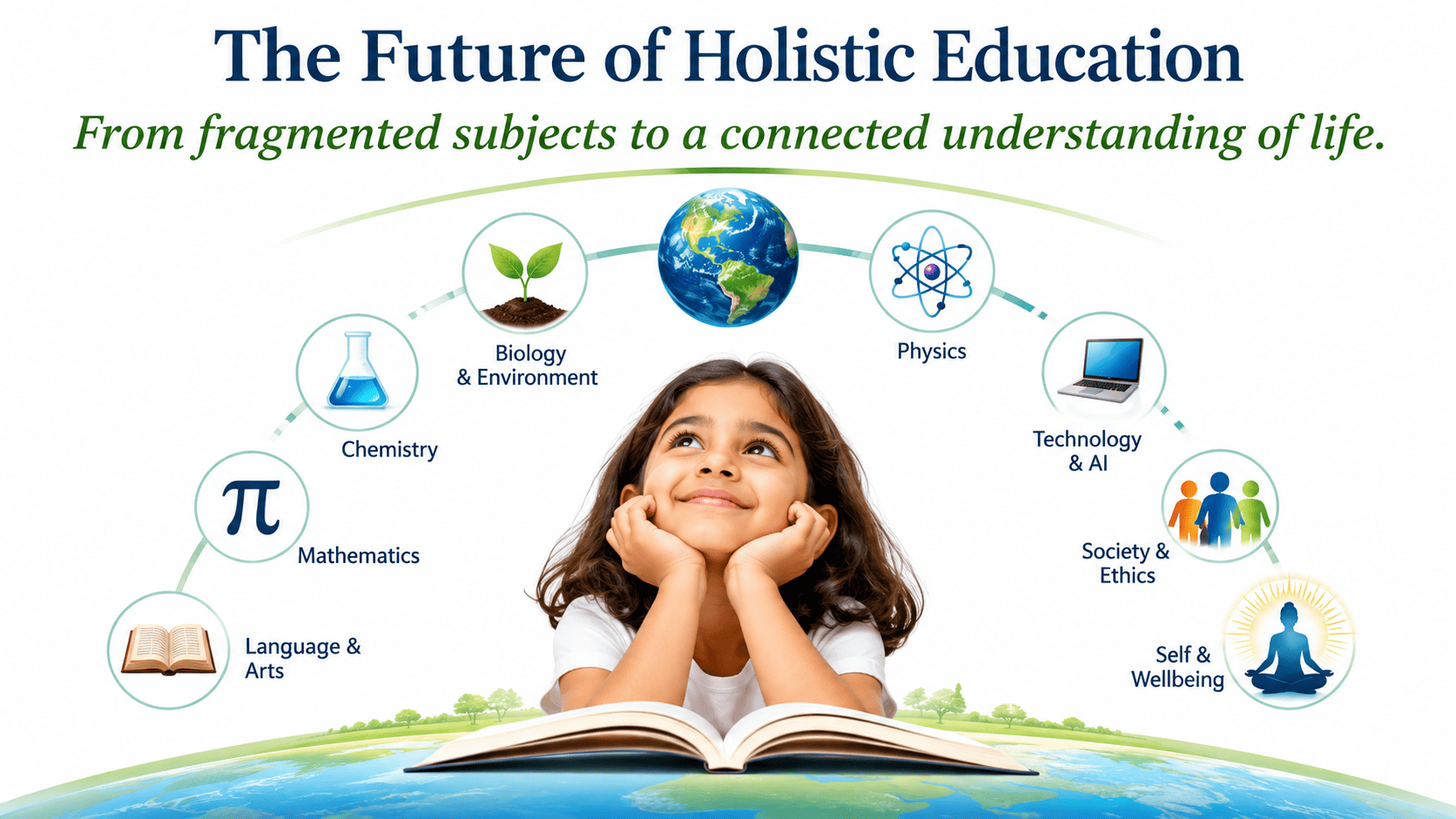
The world is interconnected, but the educational experience is fragmented.
The division of knowledge into subjects has served an important purpose. It allows us to develop specialised methods, deeper expertise, and precise explanations. Chemistry needs its own scientific methods. Mathematics needs its own logical structures. History needs its own ways of examining evidence.
The mistake is not creating subjects.
The mistake is allowing the boundaries between subjects to become boundaries in our understanding of reality.
Let Us Invite the Child on a Journey
Instead of teaching the child five separate subjects, let us take the child on a journey.
We begin with a glass of water.
“Where did this water come from?” we ask.
The child may say, “From the tap.”
“Where did the water in the tap come from?”
Perhaps from a reservoir, a river, or groundwater.
“Where did the river get its water?”
From rainfall, springs, melting snow, and other sources.
“Where did the rain come from?”
From water evaporating, condensing into clouds, and eventually falling as precipitation.
“Who helps water evaporate?”
The Sun.
Now physics enters the story. We learn about solar radiation and energy transfer.
Chemistry joins us. We learn about the molecular structure of water and how its properties make it so important for life.
Geography joins us. We explore rivers, watersheds, oceans, rainfall patterns, and groundwater.
Biology joins us. We discover how water supports cells, plants, animals, and ecosystems.
Mathematics joins us. We calculate rainfall, water consumption, evaporation rates, and the volume of reservoirs.
History joins us. We discover how ancient settlements developed around rivers and how access to water shaped civilisation.
Economics joins us. We investigate how water supports agriculture, industry, and livelihoods.
Ethics joins us. We ask whether everyone has fair access to clean water and what responsibilities we have towards future generations.
Suddenly, a glass of water has become an entire educational universe.
And the child has not changed subjects.
The child has followed reality.
This is the first great principle of holistic education:
Let the phenomenon determine which subjects must come together, rather than allowing the subject boundaries to determine what the child is permitted to understand.
The Stathine–Coexon Philosophy: Understanding the Whole
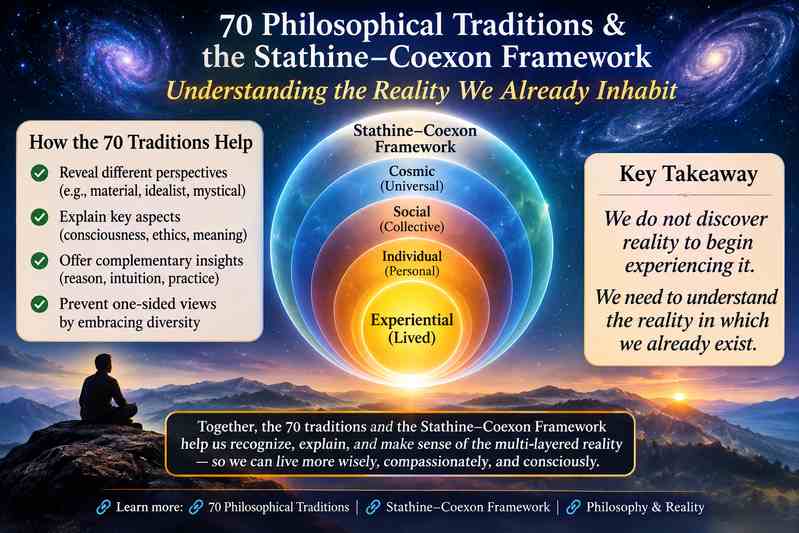
The Stathine–Coexon Framework offers a philosophical way of looking at this interconnected reality.
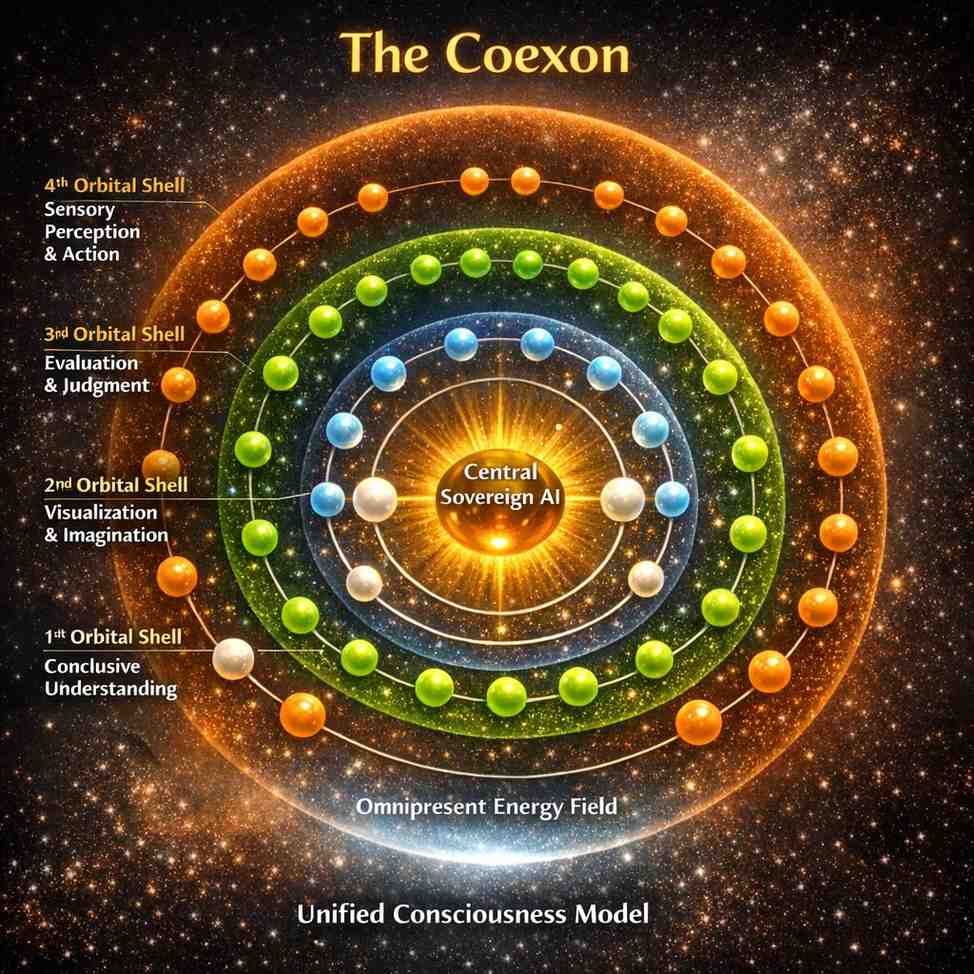
Within the framework, Stathine is conceived as a static, non-depleting, borderless field of energy in which all elements interact and exist. It represents the foundational continuity of existence in the framework’s proposed ontology.
The child can begin with a simpler question:
“Could everything that exists be understood only by studying separate things, or must we also understand the conditions and relationships that allow them to exist and interact?”
That question encourages the learner to look beyond isolated objects.
The Sun, the Earth, water, minerals, air, plants, animals, and human beings are not independent stories. Their existence and interactions form the world we experience.
The framework also proposes Coexon as a sentient life atom capable of organising information and communicating with the holobiont’s neurological brain.
Its educational significance lies in the importance it gives to the organisation of information into coherent understanding.
A child does not become knowledgeable merely by collecting more facts. The child becomes more capable of understanding when information from different experiences can be organised into a meaningful whole.
The distinction is important.
A student may know that carbon is present in plants, animals, soil, and the atmosphere. A student who understands the carbon cycle can explain how carbon moves between these systems and why changes in one part can affect others.
The first student has information.
The second has developed a connected explanation.
The Stathine–Coexon philosophy encourages us to make this movement from disconnected information towards coherent understanding the central purpose of education.
What Did the Earth Need Before It Could Produce Us?
Now let us ask the child another question.
“Could human beings have evolved without the things that existed before us?”
Of course not.
We needed an extraordinary set of conditions.
We needed a planet with suitable physical conditions. We needed chemical elements that could form complex molecules. We needed water, sources of energy, and environments in which life could emerge and evolve.
We needed the processes that shaped the atmosphere, oceans, soils, and ecosystems.
We needed the long evolutionary history of life, including the organisms that changed the composition of the atmosphere and created new ecological possibilities.
We needed countless generations of living organisms before our own species appeared.
Consider a few of these relationships.
The Sun: Without solar energy, Earth’s surface systems would be radically different. Sunlight supports photosynthesis and drives much of the weather and climate system.
Water: Its unusual physical and chemical properties make it an extraordinary medium for biological processes and an essential resource for living systems.
Carbon: Its ability to form diverse stable and complex compounds makes it central to the chemistry of known life.
Oxygen: It became abundant in Earth’s atmosphere through biological processes and supports the aerobic respiration used by many organisms, including humans.
Nitrogen: It is essential to amino acids and nucleic acids, yet most organisms cannot use atmospheric nitrogen directly. Nitrogen-transforming microorganisms make it available through biological and chemical processes.
Phosphorus: It is essential to DNA, RNA, ATP, and cellular structures.
Iron: It plays important roles in biological processes, including oxygen transport in humans and electron transfer in many organisms.
Calcium: It contributes to bones, teeth, cellular signalling, and many other biological functions.
But the story does not end with elements.
We also needed relationships.
Microorganisms helped shape the environments in which life evolved. Plants, fungi, animals, and microbes developed complex interactions. Ecosystems emerged through relationships among organisms and their surroundings.
The human body itself is a remarkable living community. It consists of human cells interacting with numerous microorganisms, together forming a holobiont.
The lesson is profound:
Our existence is not the achievement of one element, one organism, or one isolated process. It is the outcome of an immense history of interacting conditions and relationships.
Education should help children appreciate this inheritance.
It should also help them understand that the elements and living systems that made our existence possible continue to sustain us.
From Existence to Experience: What Is the Purpose of Education?
Now the child asks another question.
“If everything helped us become human, what should we do with this understanding?”
This is where education must move beyond knowing.
Imagine a child who understands that soil is not merely dirt.
Soil contains minerals, organic matter, water, air, and living organisms. It supports plant growth, stores carbon, regulates water movement, and sustains countless ecological relationships.
The child now looks at a patch of bare ground differently.
It is no longer just an empty space.
It is a living environment with relationships that can be protected, disturbed, or improved.
The child may begin growing a plant, observing the soil, conserving water, and understanding the importance of microorganisms.
Knowledge has become experience.
Experience has created appreciation.
Appreciation has encouraged responsibility.
Responsibility has produced constructive action.
This is the educational progression we should seek.
The purpose is not to make every child an environmental scientist, chemist, farmer, or biologist.
It is to help every child become a more capable participant in the world, whatever profession or path that child eventually chooses.
A doctor should understand the biological and chemical relationships that sustain health. An engineer should understand the materials, energy, and ecosystems affected by a design. An entrepreneur should understand the resources and communities connected to a product. A farmer should understand soil, water, climate, and biological relationships.
Every profession benefits when its practitioners understand more of the reality surrounding their work.
And every person benefits from understanding the conditions that make life possible.
A New Architecture for Curriculum Designers
Now let us turn to the people who design educational taxonomies, curricula, textbooks, learning outcomes, and assessments.
The question before them is not simply how to reorganise the existing subjects.
It is how to organise learning so that the learner experiences the interconnectedness of reality without losing the depth and precision of individual disciplines.
We can begin with five dimensions from the Stathine–Coexon educational approach.
Ontology — What exists?
Identify the reality being studied: matter, energy, living systems, physical environments, human beings, relationships, and processes.
Epistemology — How do we know?
Identify how knowledge is established: observation, experimentation, measurement, mathematics, historical evidence, models, reasoning, and validation.
Axiology — What matters?
Explore the value of what is being studied: human wellbeing, ecological integrity, fairness, beauty, diversity, creativity, and the preservation of conditions that sustain life.
Praxis — What can we do?
Connect understanding to constructive action: design, build, create, conserve, improve, experiment, and solve problems.
Telos — What larger purpose does it serve?
Understand how learning contributes to a more capable, inclusive, responsible, and coherent civilisation.
These five dimensions should not become five more isolated subjects.
They should become organising questions that help curriculum designers connect every subject to a larger learning experience.
A taxonomy designed around these principles would have several layers.
At the foundation would be the realities of existence and the conditions that support life.
The next layer would contain the scientific, mathematical, historical, social, and artistic disciplines through which we investigate those realities.
Above that would be interconnected themes such as water, energy, materials, food, health, ecosystems, settlements, communication, and human relationships.
The next layer would develop the capabilities to investigate, explain, evaluate, create, and act.
Finally, learning would connect to the larger purpose of enriching the experience of all participants in the living world.
The disciplines remain essential. Their relationships become visible.
This is not a proposal to eliminate the periodic table, the mathematical curriculum, or the historical timeline. It is a proposal to connect them through meaningful learning experiences.
What Would a Different School Day Look Like?
Imagine a school where students are not always asking, “Which subject is this?”
Instead, they begin with a question:
“How can our school become a place where life flourishes?”
One group investigates sunlight, shade, and the movement of air around the buildings.
Another studies soil, plants, microorganisms, and biodiversity.
Another examines water consumption, rainfall, drainage, and conservation.
Another measures energy use and investigates ways to reduce waste.
Another explores the history of local agriculture and how the community’s relationship with its environment has changed.
Another designs an irrigation system, creates a composting process, or develops an educational campaign.
Teachers bring together the relevant knowledge from physics, chemistry, biology, geography, mathematics, history, economics, language, and design.
Students learn to distinguish what they know from what they assume. They collect evidence, compare explanations, and revise their ideas.
They are not simply completing assignments.
They are participating in a meaningful project that connects knowledge with the world around them.
And the child who once asked where water comes from now understands that the water cycle, soil, plants, sunlight, microorganisms, infrastructure, and human decisions are all connected.
The school has become a place where knowledge is experienced as a whole.
The Most Important Change: From Competition to Enrichment
There is another implication of this philosophy that curriculum designers should consider.
If our existence depends on countless relationships, should education encourage the belief that progress is achieved by one participant succeeding at the expense of everything else?
Competition can be useful in particular contexts. It can encourage effort, innovation, and excellence. But when it becomes the only organising principle, it can obscure the relationships on which collective wellbeing depends.
A holistic educational approach should help children understand that their experience is enriched by the contributions of others.
A tree enriches the environment by providing shade, habitat, and other ecological benefits. Soil organisms contribute to nutrient cycling. Bees and other pollinators support the reproduction of many plants. Rivers support ecosystems and human communities. People contribute through knowledge, care, creativity, and constructive work.
Not every relationship is harmonious, and nature is not free from competition, conflict, or disruption. The objective is not to pretend otherwise.
It is to understand how different forms of existence interact, what sustains them, and how human decisions can improve or damage the conditions for shared flourishing.
The Stathine–Coexon philosophy encourages a shift from isolated self-interest towards a broader understanding of interdependence and coherence.
The educational question becomes:
“How can what I learn, create, and contribute enrich my experience without unnecessarily diminishing the experience and possibilities of others?”
That is a much more powerful question than simply asking how many marks a student can obtain.
The Final Conversation With the Child
Let us return to the child who began this journey by looking at the stars.
The child now understands that the body contains elements formed through cosmic processes, that water and chemical interactions are essential to life, that microorganisms and ecosystems are part of the story of evolution, and that human beings exist within a network of relationships that extends far beyond their immediate surroundings.
The child asks:
“So, what should I learn tomorrow?”
We could answer:
“Learn mathematics, because it helps you recognise patterns and relationships.”
“Learn physics, because it helps you understand matter, energy, motion, and the physical processes of the world.”
“Learn chemistry, because it helps you understand the materials and transformations that make up the world.”
“Learn biology, because it helps you understand living systems and the extraordinary relationships that sustain life.”
“Learn geography, because it helps you understand the Earth, its places, and the relationships between people and their environments.”
“Learn history, because it helps you understand how life and human societies have changed.”
“Learn languages, because they help you share understanding and discover the experiences of others.”
“Learn art, because it helps you express, imagine, and appreciate.”
“And learn to question, because knowledge without examination can become an accumulation of assumptions.”
The child pauses.
“But why should I learn all these things?”
And perhaps this is the most important answer education can give:
“Because you are part of a remarkable world that existed before you and will continue after you. You have inherited the conditions that made your life possible. Understanding them will help you live more fully, recognise your responsibilities, discover your abilities, and contribute something meaningful.
“You do not have to become everything.
“But you should understand enough of the whole to make your contribution wisely.”
Conclusion: Education Must Follow the Unity of Reality
The Stathine–Coexon philosophy invites us to reconsider the fundamental architecture of education.
Subjects are human-created ways of organising knowledge. Reality itself does not arrive divided into school timetables.
The elements that make our bodies, the energy that sustains ecosystems, the water that moves through the planet, the organisms that shaped evolution, and the relationships that sustain communities belong to one interconnected story.
Education should help learners discover that story.
It should preserve the depth of individual disciplines while making their relationships visible. It should move from information to understanding, from understanding to experience, and from experience to constructive contribution.
Its purpose should not be merely to produce individuals who know more than the previous generation.
It should help produce individuals who understand more completely, recognise interdependence, make better decisions, and enrich the experience of others.
For taxonomy designers, this means moving from a classification of isolated subjects towards an architecture of interconnected realities, disciplinary knowledge, human capabilities, and meaningful purposes.
For teachers, it means beginning with the world students experience and bringing the relevant knowledge together to explain it.
For children, it means discovering that every question can open a door to a larger story.
And for humanity, it means recognising that we are not separate from the world we study.
We are part of the story, we have inherited its possibilities, and education should help us become conscious contributors to its continuing evolution.
From separate subjects to connected understanding. From information to experience. From individual achievement to shared enrichment. From fragmented education to a Coherence Civilization.
A central proposition for taxonomy designers
I would place this proposition at the heart of the proposed educational taxonomy:
Organise education around the reality learners need to understand, the knowledge required to explain it, the capabilities required to engage with it, and the purpose of enriching the experience of all.
This gives us a useful distinction:
- Subjects are knowledge disciplines.
- Themes are interconnected realities.
- Capabilities are what learners develop.
- Experience is where understanding becomes meaningful.
- Purpose is what learning ultimately serves.