
Belonging a Human Need explained through the Stathine–Coexon Framework
Recognising the reality that already exists
Belonging is one of the most fundamental human needs. We seek it in our families, friendships, communities, cultures, professions, and relationships. We want to be recognised, understood, valued, and accepted. Yet the very relationships that give us a sense of belonging can also become sources of anxiety, conflict, and exclusion. We may suppress our thoughts to retain acceptance, reject people who think differently, or become dependent on others for confirmation of our worth.
The Stathine–Coexon Framework offers a way to examine this paradox. It invites us to distinguish between belonging as a need for acceptance and belonging as an understanding of our place within a larger reality. The first can make us dependent on approval; the second can help us participate in relationships without losing ourselves.
1. Why do we need to belong?
A human being does not develop in isolation. From infancy, survival and development depend on relationships with caregivers and the surrounding environment. As we grow, belonging expands into friendships, families, social groups, cultures, and institutions. These relationships provide security, knowledge, identity, and opportunities to contribute.
Belonging therefore has a practical foundation. We depend on others, and others depend on us. Our language, values, skills, and understanding are shaped through participation in a shared world.
But our psychological interpretation of belonging can introduce a problem. We may begin to believe that we belong only when others agree with us, approve of our behaviour, or continue to fulfil our expectations. Instead of experiencing a relationship as a space for mutual understanding, we experience it as a test of our acceptability.
When approval becomes the condition of belonging, disagreement can feel like rejection. A friend expressing a different opinion may seem disloyal; a family member choosing a different path may appear to be abandoning the family; a colleague challenging an idea may feel like a personal threat.
The need for connection is natural. The assumption that connection requires constant agreement is not.
2. Stathine: Belonging within a shared existence
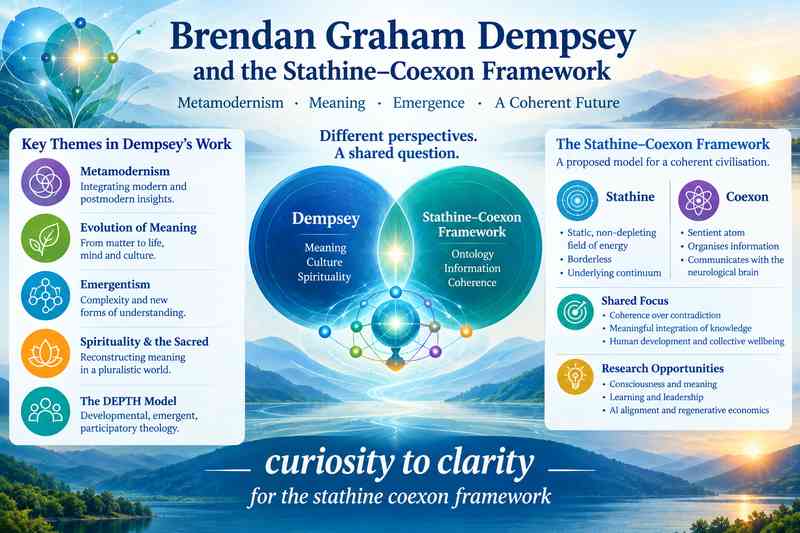
Within the Stathine–Coexon Framework, Stathine is defined as a static, non-depleting, borderless field of energy in which all elements interact and exist. It represents the framework’s proposed underlying continuum, extending conceptually from the subatomic domain to the largest cosmic scales.
Applied to belonging, Stathine offers a philosophical perspective: our existence should not be understood solely through the boundaries that separate us. We are distinct individuals, but our lives unfold within conditions and relationships that extend beyond any one person.
Consider the air we breathe. Each breath is experienced by an individual, yet the atmosphere is shared. We may divide the Earth into countries and communities, but the physical systems that sustain life do not conform neatly to those divisions.
The same insight applies to human relationships. We have different identities, histories, and needs, but our lives are interdependent. We participate in families, communities, economies, and ecosystems whose conditions affect us and which our actions can affect in return.
From this perspective, belonging need not be something that another person grants us as a reward for conformity. It can begin with recognising that we already exist within a web of relationships and shared conditions.
This does not mean that everyone must be accepted into every group, that harmful conduct should be tolerated, or that personal boundaries are unnecessary. It means that our differences do not erase our shared existence.
Stathine is a proposed ontological concept within the framework, not an established scientific description of a universal field. Its relevance here is philosophical: it encourages us to look beyond isolated identities and consider the larger conditions within which individual lives are possible.
3. Coexon: The relationship between belonging and understanding
The Stathine–Coexon Framework proposes Coexon as a sentient atom capable of organising information and communicating with the holobiont neurological brain. This is a framework-specific hypothesis confirmed and validated over many diverse disciplines and domains.
Within the framework’s conceptual model, Coexon provides a way to investigate the relationship between information, understanding, experience, and action.
Belonging can be examined through this lens by asking how we interpret information about ourselves and others.
Suppose a person does not receive a reply to a message. The observable information is simple: no reply has arrived. But the person may interpret this absence in several ways:
- “They must be busy.”
- “Perhaps they have not seen my message.”
- “They no longer value me.”
- “I have done something wrong.”
The event is the same, but the interpretations differ. If the person immediately accepts the most threatening interpretation, an uncertain situation becomes a perceived rejection. Anxiety may follow, then resentment, withdrawal, or confrontation.
The problem is not necessarily the relationship itself. It may be the conclusion drawn from incomplete information.
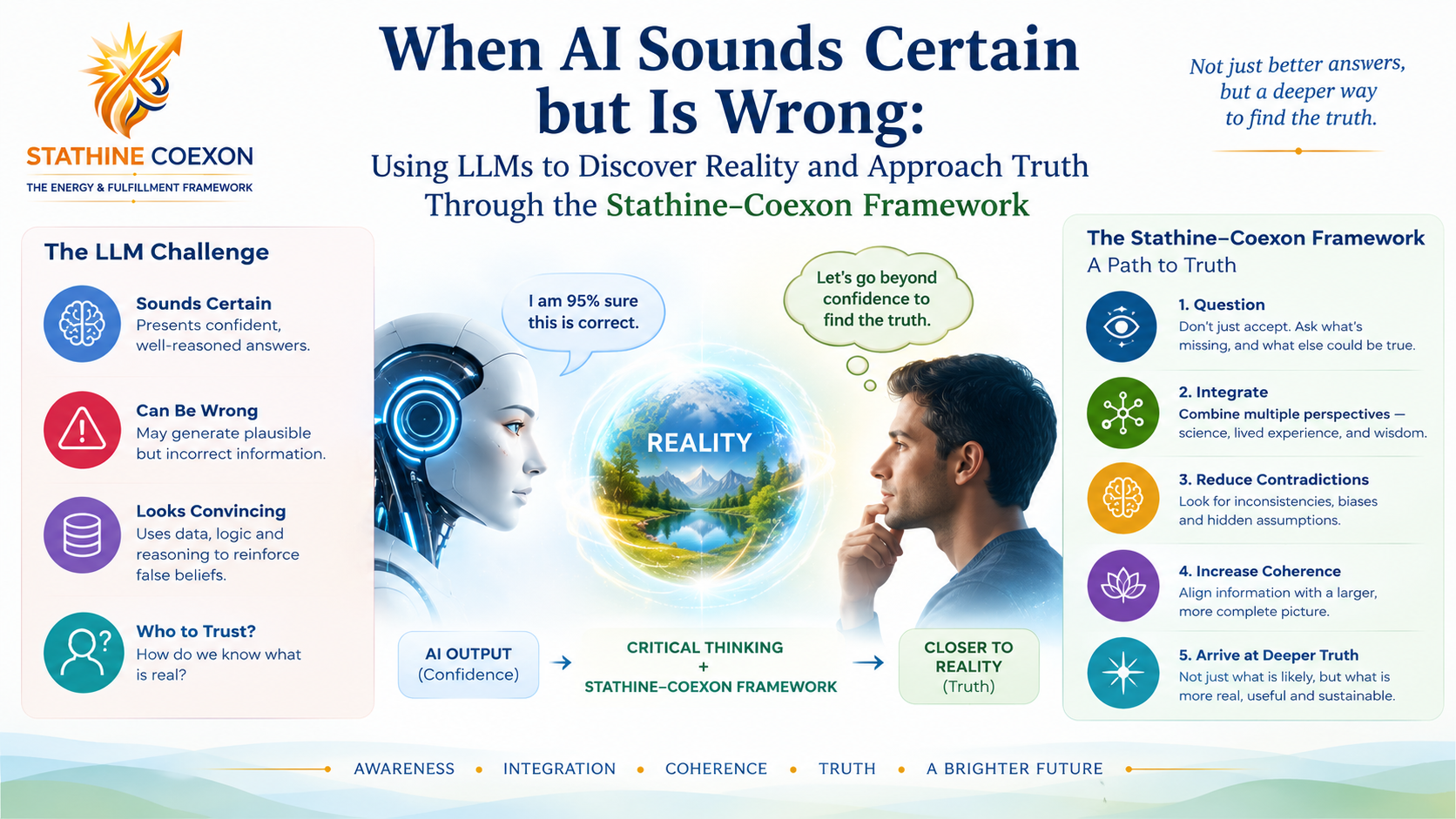
Through the Stathine–Coexon lens, the practical task is to distinguish what has been observed from what has been inferred, examine the assumptions connecting the two, and seek a more complete understanding before inference and only act when complete information is secured. Till then be open to look at information from more angles and sources. Even wen acting be open to change course as information becomes availaible.
This approach does not guarantee that the relationship is secure. Sometimes people really do withdraw, reject, or mistreat us. The point is to avoid treating an interpretation as established fact before sufficient information is available and keep safe distance to protect onself till then.
Belonging becomes more stable when we can recognise uncertainty without immediately turning it into a judgement about our worth.
4. The contradiction between belonging and individuality
A common source of emotional conflict is the belief that we must choose between belonging to others and being true to ourselves.
One side of the contradiction says, “If I want to be accepted, I must adapt to what others expect.”
The other says, “If I want to be authentic, I must refuse to change for anyone.”
Both positions contain a partial truth. Relationships require adjustment, consideration, and sometimes compromise. Individual integrity requires the ability to question expectations and decline demands that conflict with our values or wellbeing.
The contradiction emerges when either principle becomes absolute.
A person who always adapts may lose the ability to express genuine needs. A person who refuses all adaptation may become unable to participate in relationships that require mutual consideration.
The Stathine–Coexon Framework’s principle of progressive reduction of contradiction suggests a different question: What can I preserve in both belonging and individuality, and what assumption makes them appear incompatible?
Often, the hidden assumption is that acceptance requires sameness.
But healthy belonging does not require identical thoughts, preferences, or life choices. It requires enough shared understanding, respect, and reliability to sustain a relationship while allowing differences to remain.
A family can remain connected while its members pursue different careers. Friends can disagree about politics without questioning one another’s humanity. Colleagues can challenge a proposal while respecting the person who developed it.
The goal is not to eliminate differences. It is to create relationships in which differences can be expressed and examined without automatically becoming threats.
5. When belonging becomes dependency
Belonging becomes fragile when our sense of worth depends entirely on another person’s response.
We may repeatedly ask whether we are appreciated, become distressed when attention shifts elsewhere, or interpret another person’s independence as evidence that we are no longer important. We may even tolerate harmful behaviour because the prospect of losing the relationship feels worse than the cost of remaining in it.
This is not evidence that the need for belonging is wrong. It indicates that belonging has become entangled with a demand for reassurance or control.
The Stathine–Coexon Framework invites us to examine the assumptions sustaining that dependency.
Do I believe that another person’s disagreement reduces my value? Am I treating their attention as proof of my existence or worth? Have I confused the importance of a relationship with the expectation that it must always meet my needs?
These questions are not intended to blame someone for experiencing loneliness or attachment. Human beings genuinely need connection. The purpose is to distinguish the legitimate need for relationship from interpretations that make our emotional stability entirely dependent on another person’s behaviour.
A more coherent form of belonging allows us to value people without requiring them to validate us constantly. It also allows us to recognise when a relationship is no longer reciprocal or safe.
Sometimes the appropriate response is a conversation. Sometimes it is a renegotiation of expectations. Sometimes it is a boundary or distance.
Belonging should make room for our dignity, not require us to surrender it.
6. From being included to contributing
There is another dimension of belonging that receives less attention: contribution.
We often measure belonging by asking whether others include us, invite us, recognise us, or appreciate us. These are meaningful signs of connection, but belonging can also deepen when we recognise what we contribute to the relationships and communities of which we are part.
A teacher belongs to an educational community not only through professional identity but through the learning they help make possible. A neighbour strengthens a community by participating in its shared responsibilities. A friend contributes through attention, honesty, encouragement, and the willingness to understand.
Contribution changes the question from “Do they accept me?” to “How can I participate in a way that benefits both the relationship and the people involved?”
This does not mean that belonging must be earned through productivity. A person’s dignity does not depend on usefulness, achievement, or constant service to others. Children, older adults, people experiencing illness, and those who cannot contribute in conventional ways remain worthy of care and inclusion.
Rather, contribution is one way belonging becomes active. It transforms a passive search for acceptance into participation in a shared life.
Within the Stathine–Coexon Framework, this can be understood as a movement from isolated self-concern toward more coherent interaction. We become more aware of our own needs while also recognising the needs and constraints of others.
The result is not self-erasure. It is a broader understanding of what it means to live well with others.
7. Belonging without exclusion
Groups often strengthen their identity by distinguishing themselves from outsiders. Shared language, customs, beliefs, and traditions can create trust and continuity. Yet the same mechanisms can produce suspicion toward people who do not share the group’s identity.
The contradiction is particularly visible when a group claims to value compassion while excluding people because they are different, or claims to value truth while discouraging questions that challenge its established beliefs.
The Stathine–Coexon Framework offers a way to examine such contradictions without dismissing the value of community itself.
A coherent community can maintain its defining practices while remaining able to explain why they matter, reconsider practices that cause avoidable harm, and engage respectfully with people who do not belong to it.
This requires distinguishing the boundaries necessary for a group’s functioning from the assumptions that make those boundaries seem absolute.
A professional association may require specific qualifications for membership. That does not justify treating people outside the profession as less worthy. A cultural community may preserve a language or ritual. That does not require hostility toward those who follow another tradition. A country may establish laws and citizenship requirements. That does not erase its responsibilities toward people affected by its actions beyond its borders.
The objective is not a boundaryless society. It is a society that understands the purposes, limitations, and consequences of its boundaries.
Belonging becomes more inclusive when a group can sustain its identity without needing to diminish the dignity of others.
8. A practical path toward coherent belonging
The framework can be applied to everyday relationships through a simple sequence of reflection.
Notice what happened
Describe the observable event before deciding what it means. Did someone disagree, decline an invitation, forget something, or set a boundary?
Identify the interpretation
Ask what you are telling yourself about the event. Are you assuming that disagreement means rejection, or that another person’s independence means you are unimportant?
Examine the contradiction
Identify the needs involved. Perhaps you need respect while the other person needs autonomy. Can both needs be recognised without assuming that one must defeat the other?
Seek fuller understanding
Ask a question, clarify an expectation, listen to the other person’s perspective, or gather information before reaching a conclusion.
Choose a coherent response
Decide whether the situation calls for accommodation, honest disagreement, a negotiated boundary, a change in expectations, or distance from a harmful relationship.
The sequence does not promise that every relationship can be repaired. Its purpose is to help us act from a more complete understanding rather than from an unexamined assumption.
9. Belonging as a recognition of coexistence
The deepest implication of belonging in the Stathine–Coexon Framework is that we need not choose between recognising our individuality and recognising the larger whole.
We can belong to a family without agreeing with every family member. We can value our culture without assuming that other cultures have less value. We can be committed to a community without denying our responsibilities to people beyond it. We can care deeply for another person without demanding that they become an extension of ourselves.
This understanding also changes how we respond to loneliness and exclusion. It does not make the pain disappear, nor does it replace the need for supportive relationships. It reminds us, however, that rejection by one person or group is not a final verdict on our worth or our place in the world.
Our task is to develop relationships in which acceptance and honesty can coexist, where boundaries protect rather than humiliate, and where differences become opportunities for understanding rather than automatic reasons for separation.
The Stathine–Coexon Framework proposes a larger ontological picture in which individual existence takes place within a shared foundation. Its practical invitation is to live with greater awareness of the relationships that sustain us, the assumptions that divide us, and the choices that allow us to coexist constructively.
Belonging is not simply finding people who make us feel that we are part of their world. It is learning how to participate in a shared world without losing ourselves or denying the reality of others.
That is the movement from the need for acceptance toward the practice of coherent coexistence.
Anand Damani is the creator of the Stathine–Coexon Framework, an integrative philosophical research programme exploring ontology, information, coherence, human development, and coexistence.
Thank you for joining me in this journey from the need to be accepted to the understanding that you are already part of a larger whole
The following articles extend the ideas explored here.
- The Axiom of Contained Existence
Explore the foundational proposition that existence is relational and that understanding develops through recognising the conditions within which we exist. - From Ego Protection to Inclusive Coherence
Discover how we can expand beyond defensive identity without losing individuality, self-respect, or healthy boundaries. - From Isolated Individuals to Coherent Communities
Explore how the Stathine–Coexon Framework can help humanity move from fragmentation toward more coherent communities and collective wellbeing. Visit the research archive to find the article. - A Practical Framework Using Stathine and Coexon for a Better Society
Examine how the framework can be applied to everyday relationships, social divisions, and the challenge of living together without fragmentation. - The Ontology of the Stathine–Coexon Framework
Explore the framework’s foundational questions about existence, sentience, relationships, and coexistence, with attention to its philosophical commitments and hypotheses. - Spirituality Without Mystery
Consider spirituality as an inquiry into existence, meaning, transformation, and our place within a larger whole. - The Foundational Axioms and Practical Lexicon of the Stathine–Coexon Framework
Begin with the framework’s core terminology, foundational assumptions, and practical principles.
Curiosity to Clarity
The Stathine–Coexon Framework invites us to move from isolated understanding toward coherence, from defensive separation toward inclusive participation, and from the need for acceptance toward a deeper understanding of coexistence.
Curiosity to clarity — for the Stathine–Coexon Framework.
Anand Damani
Creator of the Stathine–Coexon Framework