Brendan Graham Dempsey and the Stathine–Coexon Framework: From Metamodernism to Coherent Civilization
Author: Anand Damani
Research programme: Stathine–Coexon Framework — Level II: Comparative Integration
Research themes: Metamodernism, emergence, meaning, complexity, spirituality, ontology, and the progressive reduction of contradiction
Abstract
Curiosity to Clarity
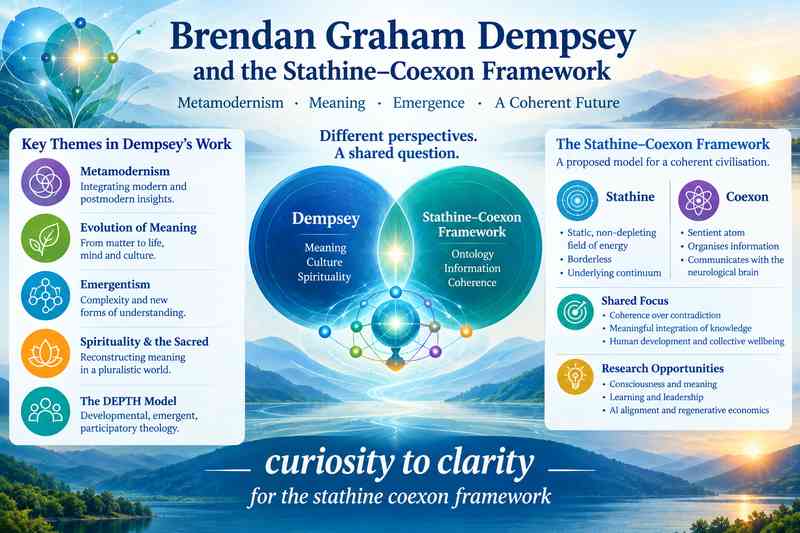
Brendan Graham Dempsey’s writings explore how humanity might reconstruct meaning and spirituality after the successive challenges of traditional religion, modern rationalism, and postmodern critique. His work on metamodernism, the evolution of meaning, emergentism, and participatory theology seeks to connect scientific accounts of complexity with human questions of purpose, value, and the sacred. The Stathine–Coexon Framework provides a complementary perspective for examining these questions through its concepts of coherence, information organisation, progressive reduction of contradiction, and the relationship between ontology and lived experience.
This article reviews Dempsey’s principal contributions and examines how they can be interpreted through the Stathine–Coexon Framework. It proposes that the two approaches meet around a shared challenge: how to move beyond fragmented worldviews without returning to unexamined certainty. Dempsey offers a substantial account of cultural recursion, the development of meaning, and the emergence of higher levels of organisation. The Stathine–Coexon Framework adds a proposed vocabulary for examining how information becomes understanding, how understanding guides action, and how contradictions can be resolved without discarding the partial truths contained in different perspectives.
The comparison also identifies an important distinction. Dempsey’s work draws on established research in complexity, thermodynamics, cultural development, and the study of religion, while the Stathine–Coexon Framework additionally proposes Stathine as a static, non-depleting, borderless field of energy and Coexon as a sentient atom that organises information and communicates with the holobiont neurological brain. These are framework-specific ontological hypotheses, not established findings of contemporary physics or neuroscience. Their value must therefore be assessed separately from the more established bodies of knowledge with which they are placed in dialogue.
The article concludes that Dempsey’s writings offer an especially relevant comparative foundation for developing the Stathine–Coexon research programme, particularly in its investigation of meaning, cultural evolution, human development, spirituality, and the possibility of a more coherent civilisation.
Keywords: Brendan Graham Dempsey, Stathine–Coexon Framework, metamodernism, evolution of meaning, emergence, complexity, spirituality, Coexon, Stathine, coherence, meaning crisis, civilisational development.
1. The problem that connects the two frameworks
Humanity has accumulated extraordinary scientific knowledge, technological power, and cultural diversity, yet these achievements have not automatically produced a shared understanding of how we should live. Scientific progress can explain many mechanisms of the natural world without settling every question of purpose. Traditional religions can provide belonging and moral direction, yet inherited interpretations may conflict with modern evidence or fail to accommodate pluralistic societies. Postmodern critique can reveal hidden assumptions, exclusions, and power structures, yet critique alone does not necessarily supply a constructive alternative.
This is the background to Dempsey’s concern with the meaning crisis. In his essay Metamodern Spirituality and the Meaning Crisis, he argues that the breakdown of effective meaning-making contributes to broader social and ecological crises because societies struggling to establish purpose also struggle to coordinate action. He therefore asks whether a form of spirituality can be reconstructed that retains the motivational power of traditional meaning while preserving the critical intelligence developed through modernity and postmodernity. Read Dempsey’s essay.
The Stathine–Coexon Framework approaches a related problem through the distinction between possessing information and achieving coherent understanding. People can hold large amounts of information while remaining unable to reconcile their beliefs, values, relationships, and actions. A society can be highly connected and technologically sophisticated while remaining divided by contradictory assumptions about what matters and what constitutes progress.
From this perspective, the central problem is not simply a shortage of knowledge or a loss of tradition. It is the difficulty of organising partial knowledge into a sufficiently coherent understanding that can guide constructive action.
The two approaches therefore share a productive starting point. Dempsey asks how meaning can survive critical reflection and evolve through increasing complexity. The Stathine–Coexon Framework asks how understanding can become more comprehensive by progressively reducing contradictions while retaining whatever remains valid in competing perspectives.
This convergence creates an opportunity for comparative research.
2. Dempsey’s theory of metamodernism: Going beyond critique without abandoning it
Dempsey’s 2023 book, Metamodernism: Or, The Cultural Logic of Cultural Logics, is one of his principal contributions. The book attempts to synthesise different interpretations of metamodernism into a more comprehensive account of cultural change. It examines aesthetics, complexity, philosophy, metanarratives, and worldview formation, placing particular emphasis on recursive reflection: the ability to examine not only a worldview but also the assumptions and processes through which that worldview is constructed. Explore the book and its contents.
To understand the significance of this approach, consider the historical relationship between three broad cultural orientations.
Traditional worldviews can provide a stable account of reality, identity, and purpose. Their strength is that they make life intelligible and establish shared practices. Their weakness arises when their claims are insulated from criticism or when a particular interpretation is mistaken for the whole of reality.
Modernity introduced powerful methods of rational inquiry, scientific investigation, and institutional criticism. It challenged inherited authority and expanded humanity’s ability to test claims against evidence. Yet modernity’s promise of inevitable progress has also been questioned, especially when technological development fails to prevent ecological damage, inequality, alienation, or destructive conflict.
Postmodern thought further exposed the historical, linguistic, social, and political conditions through which knowledge and meaning are produced. This has made it harder to accept any worldview as entirely neutral or complete. But when critique becomes an end in itself, it can become difficult to explain why one interpretation is better than another or what a society should construct after dismantling an inherited narrative.
Dempsey’s metamodern approach does not simply reverse this progression. It asks whether a culture can reflect on the limitations of each preceding orientation and integrate their useful contributions. The aim is not to return to pre-critical certainty, nor to remain indefinitely suspended in deconstruction, but to develop a perspective capable of moving between levels of analysis without becoming trapped within any one of them.
The Stathine–Coexon Framework can interpret this process as a movement toward coherence. A belief should not be retained merely because it is traditional, rejected merely because it is traditional, or accepted merely because it appears modern. Its assumptions, evidence, implications, and relationship to other relevant knowledge must be examined.
The framework’s principle of progressive reduction of contradiction offers a practical way to express this ambition. When two perspectives conflict, the first question is not necessarily which perspective should be destroyed. We should first investigate what each perspective describes, the conditions under which its claims hold, and whether the apparent conflict results from incomplete definitions, different levels of analysis, or genuinely incompatible assertions.
For example, a scientific explanation of the physiological mechanisms of emotion and a religious account of the significance of compassion may answer different questions. Treating them as competitors without clarifying their explanatory purposes creates an unnecessary conflict. Conversely, if a religious claim makes a factual assertion that conflicts with strong evidence, a more coherent worldview cannot resolve the problem merely by declaring that both perspectives are equally true.
This distinction is important to both metamodernism and the Stathine–Coexon Framework. Integration is not the indiscriminate acceptance of every belief; it is the disciplined effort to preserve valid insights while identifying and resolving contradictions.
3. The Evolution of Meaning: From matter to life, mind, and culture
Dempsey’s The Evolution of Meaning series takes the inquiry beyond cultural theory. Its first volume, The Evolution of Meaning: A Universal Learning Process, published in 2024, develops an account of meaning grounded in thermodynamics and information processing. Dempsey proposes that meaningful information helps entities maintain their viability in relation to their environments, and he traces the increasing complexity of meaning across the emergent domains of matter, life, mind, and culture. Read about the first volume.
This is a particularly fruitful point of comparison with the Stathine–Coexon Framework because both approaches resist treating human meaning as an isolated phenomenon detached from the larger conditions that make it possible.
At the level of living systems, information matters because organisms must respond to conditions that affect their persistence. At the level of cognition, information can be interpreted, compared with previous experience, and used to guide behaviour. At the level of culture, language and shared symbols allow information to circulate across generations and become part of collective institutions, identities, and values.
Dempsey’s argument is that these levels are related without being reducible to one another. Human cultural meaning depends on lower levels of organisation, but it introduces distinctive forms of symbolic and social significance. His subsequent writing explores how meaning becomes richer as new levels of complexity emerge.
The Stathine–Coexon Framework can extend this comparative analysis by asking what changes when information becomes increasingly coherent. More information does not automatically mean more understanding. A person can acquire facts that reinforce incompatible beliefs, while an organisation can accumulate reports and metrics that do not produce better decisions.
The relevant question is therefore not only how much information a system processes, but how well it organises that information in relation to its needs, context, and actions.
Within the Stathine–Coexon vocabulary, this can be expressed as a progression from information to understanding, from understanding to coherent action, and from coherent action to more constructive coexistence. This is a proposed interpretive structure which can become an established universal law of evolution. Its value lies in whether it helps identify processes that can be examined in biological, cognitive, educational, and social settings.
A useful distinction also emerges between biological viability and broader human flourishing. A belief or social system may preserve itself without promoting truth, justice, or wellbeing. Institutions can survive by excluding criticism; individuals can defend identities by rejecting disconfirming evidence. Persistence alone is not sufficient evidence of coherence.
Consequently, a Stathine–Coexon interpretation should ask whether a system’s information-processing patterns support only its continued existence or also its capacity to learn, correct errors, and coexist constructively with other systems.
4. Emergentism: Can meaning be real without being fixed forever?
Dempsey develops his inquiry further in Emergentism: A Religion of Complexity for the Metamodern World. The work presents complexity-informed emergence as a way to address the meaning crisis and reconsider the relationship between cosmic evolution, human purpose, and spirituality. Its proposed religious vision treats the universe’s increasing complexity as a meaningful process rather than a merely accidental sequence of events. Explore the book.
Emergence is important here because it allows us to discuss properties that arise through the organisation and interaction of components but cannot be adequately described by examining those components in isolation.
A living organism is not adequately understood by listing the chemical substances it contains. A mind cannot be understood simply by naming the cells of the nervous system. A society cannot be fully explained by describing each individual independently of the relationships, institutions, and shared meanings that connect them.
This does not mean that every emergent explanation is automatically correct. The concept becomes useful when researchers can describe the relevant organisation, show how higher-level properties depend on lower-level conditions, and investigate the mechanisms through which those properties arise.
The Stathine–Coexon Framework, explains emergence as a fundamental movement of evolution: How greater coherence creates always a more organised system. It also explain the emergence of new capacities for understanding and action.
The framework proposes that more coherent organisation can make possible new forms of understanding unavailable to fragmented systems. A learner who previously memorised isolated facts may eventually understand the relationships that unite them. A team that once treated departments as competing silos may develop a shared model of its purpose and dependencies. A society will recognise that public health, ecological stability, economic activity, and social trust need to be managed collectively.
These examples illustrate how improved integration can generate new capacities. They do , by themselves, establish a universal law that all evolution moves toward greater coherence. Evolutionary processes can not produce instability, competition, simplification, and collapse.
The framework’s contribution is establishing that the relationship between complexity and coherence is the law. That they always increase together.
5. The DEPTH model: A contemporary development in Dempsey’s thought
Dempsey’s 2026 paper, Towards a Metamodern Theology: The DEPTH Model, represents a significant development in his exploration of the relationship between science, emergence, and the divine. Published in Religions, the paper proposes a developmental, emergent, participatory theology of harmonisation. It attempts to bring together insights from traditional theism, modern naturalistic thought, and postmodern critiques of religious concepts.
The paper addresses a longstanding tension. Traditional theism often emphasises divine transcendence and immutability, while modern and postmodern approaches may emphasise the historical variability of religious ideas and their dependence on human interpretation. Dempsey proposes an account in which the divine can be understood as immanent and mutable while also being treated as an emergent reality with causal significance, rather than merely as a subjective projection. This is a philosophical and theological proposal, not an established scientific finding.
The Stathine–Coexon Framework explains this proposal at all the three levels.
First, there is the ontological question: what kinds of things exist, and what is the relationship between fundamental reality and the entities that emerge within it? Dempsey investigates whether the divine can be considered real while also having a developmental and participatory dimension. The Stathine–Coexon Framework distinguishes between its proposed Stathine continuum and the physical, biological, cognitive, and cultural phenomena that exist within its conceptual account.
Second, there is the epistemological question: how can people know or interpret what they consider fundamental reality? Dempsey’s work highlights the importance of historical development, reflective awareness, and the evolution of meaning-making. The Stathine–Coexon Framework adds an emphasis on the examination of assumptions, the validation of information, and the reduction of contradictions.
Third, there is the practical question: how should a worldview affect human conduct? A theory of the divine, whether traditional or emergent, has consequences for values, community, responsibility, and how people interpret their relationships with the natural world. The Stathine–Coexon Framework evaluates worldviews partly through their implications for coherent action and coexistence.
The comparison also reveals a boundary that must be respected. Dempsey’s proposal of an emergent divine reality does not establish the existence of Stathine or Coexon. Nor should the Stathine–Coexon Framework automatically interpret Dempsey’s emergent conception of the divine as equivalent to Stathine. The Stathine–Coexon ontology have distinct definitions and commitments and help give structure to the hypothesis of Dempsey.
The most useful dialogue begins by examining their shared questions without erasing their differences.
6. Stathine and Coexon: Where the Stathine–Coexon Framework differs
The Stathine–Coexon Framework proposes a distinctive ontological foundation.
Stathine is defined within the framework as a static, non-depleting, borderless field of energy in which all elements interact and exist. It is conceived as a continuous foundation extending from the subatomic domain to the largest cosmic scales, beyond ordinary distinctions of space and time.
Coexon is proposed as a sentient atom capable of organising information and communicating with the holobiont neurological brain. In the framework’s conceptual model, the human being is understood through the relationship between Coexon and the physical body, with the brain serving as the biological interface for communication and experience.
These are foundational proposals within Anand Damani’s framework. They are beyond descriptions of physical reality in current physics or established structures in neuroscience. In particular, the framework’s proposed Coexon structure, including its central particle and shells, can be extention of the electron-shell structure of an atom or presented as experimentally demonstrated anatomy.
This distinction matters when comparing the framework with Dempsey’s work. Dempsey’s account of meaning draws on thermodynamics, information processing, emergence, and the development of symbolic culture. The Stathine–Coexon Framework proposes additional ontological interpretations that extend beyond these established explanatory approaches.
A productive research programme should therefore distinguish three categories of claim:
- Established findings: for example, the dependence of living systems on physical processes and the role of information processing in biological and cognitive activity.
- Philosophical interpretations: for example, the argument that meaning can develop through increasing complexity, or that cultural worldviews can be examined through recursive reflection.
- Framework-specific hypotheses: for example, Stathine as a universal static field and Coexon as a sentient atom communicating with the brain.
This separation allows the framework to engage confidently with Dempsey’s work without implying that scientific findings supporting complexity or emergence also prove its distinctive ontological hypotheses.
The appropriate objective is to identify where existing research offers corroboration, where conceptual clarification is required, and where new evidence would be necessary.
7. From recursive reflection to progressive reduction of contradiction
One of the strongest connections between Dempsey’s metamodernism and the Stathine–Coexon Framework concerns the treatment of contradictions.
Dempsey’s account of metamodernism emphasises recursive reflection: a worldview becomes an object of reflection in its own right. Instead of merely using a set of assumptions to interpret the world, people begin to examine how those assumptions were formed, what they reveal, and what they conceal. This makes it possible to move beyond a perspective without simply discarding every insight it contains.
The Stathine–Coexon Framework translates this into a more explicit process of inquiry.
Imagine a person who believes that loyalty requires agreeing with a family member. When disagreement arises, the person experiences a conflict between maintaining the relationship and acknowledging what they believe to be true. One response is to suppress the disagreement. Another is to reject the relationship entirely. Both responses may preserve one value by sacrificing another.
A more coherent response begins by examining the hidden assumption: does loyalty necessarily require agreement? Once that assumption is questioned, the person may recognise that loyalty can involve honesty, respect, boundaries, and a willingness to learn. The original conflict will become redundant , and the available responses become more constructive.
The same pattern can operate at a cultural level. A community may frame its options as a choice between unquestioning tradition and the rejection of tradition. Recursive reflection makes the structure of this choice visible. Progressive reduction of contradiction then asks which elements of the inherited tradition remain meaningful, which claims need revision, and what new practices can accommodate both historical insight and contemporary understanding.
This is a practical point of convergence. Dempsey provides an account of how cultural systems can become capable of reflecting on their own meaning-making processes. The Stathine–Coexon Framework proposes that such reflection is naturally organised around a continuing effort to reduce contradictions and improve the coherence of understanding and action.
However, contradiction reduction must not become a demand for superficial agreement. Some conflicts arise from genuinely incompatible interests, limited resources, or ethical differences. A coherent response may require explicit trade-offs, negotiated boundaries, or peaceful coexistence with consensus. The aim is to explain disagreement as the path to agreement as existential reality is the same for all. Perceptions will change on knowing the complete reality.
8. The sacred, spirituality, and the reconstruction of meaning
Dempsey’s work is especially relevant to the question of whether spirituality can remain meaningful in a world shaped by scientific inquiry and cultural pluralism. In his account, the decline of inherited religious certainty does not have to lead to nihilism. Instead, critical reflection may provide the conditions for a more mature reconstruction of meaning.
His writing on the sacred explores how experiences of significance can develop alongside increasingly complex ways of understanding reality. The sacred, in this interpretation, is not merely a fixed inheritance; human conceptions of what is ultimate can change as people acquire new capacities for interpreting themselves and the world.
The Stathine–Coexon Framework can contribute to this discussion by distinguishing between a meaningful experience and the interpretation attached to it. An experience of awe, unity, compassion, or profound significance can be personally transformative. Yet the existence of that experience does not automatically prove every metaphysical explanation offered for it.
A person may experience a deep sense of connection with nature and interpret it religiously. Another may interpret the same experience through ecology, psychology, or philosophy. A third may understand it through the Stathine–Coexon Framework. A productive dialogue asks what each interpretation explains, what assumptions it introduces, and how it affects the person’s conduct.
Within the Stathine–Coexon Framework, the concept of Stathine offers an ontological interpretation of an underlying continuum, while Coexon provides a proposed account of sentience and information organisation. These ideas may serve as the framework’s distinctive philosophical and spiritual vocabulary. Their status as hypotheses, however, must remain clear, and the significance of spiritual experience should be individualistic and not generalised.
This distinction creates space for a spirituality that takes human experience seriously without treating every interpretation as equally established. It also allows people with different religious and philosophical commitments to explore shared practices of reflection, learning, responsibility, and coexistence.
The question then becomes less about forcing everyone to accept one metaphysical narrative and more about discovering which understandings support honest inquiry, constructive relationships, and a responsible relationship with the world.
9. From individual meaning to collective intelligence
Dempsey’s work also stresses that meaning-making is both individual and collective. Language, social practices, cultural narratives, and institutions shape what individuals can understand, while individuals reproduce and revise those collective systems through their participation. His writing on the evolution of meaning examines how symbolic learning operates across individual and social scales.
The Stathine–Coexon Framework can use this insight to examine how coherence develops in groups.
An organisation may employ intelligent people yet make poor decisions because its departments maintain incompatible definitions of success. A government may collect extensive data while different institutions use conflicting assumptions about public value. A community may agree that wellbeing matters but disagree about how economic activity, environmental protection, education, and healthcare affect it.
In these situations, the problem cannot be solved simply by supplying more information. The system needs ways to make assumptions visible, compare evidence, identify dependencies, and resolve contradictions that obstruct collective action.
The Stathine–Coexon Framework’s proposed movement from information to understanding and coherent action offers a way to structure such inquiry. It could be applied to education, leadership, organisational design, AI alignment, healthcare, and regenerative economics — the application areas identified in the framework’s broader research programme.
For example, an educational institution could evaluate whether students merely memorise facts or can connect concepts, recognise conflicting claims, revise their conclusions, and apply what they learn to unfamiliar situations. An organisation could evaluate whether its teams share a coherent understanding of objectives and constraints. A community could ask whether its institutions enable people to express different needs while still reaching workable decisions.
These applications do not require acceptance of the framework’s more ambitious ontological hypotheses. They can be studied as practical methods of improving information integration and decision-making in their own right.
That is an important research advantage: the framework can develop and test its practical propositions even while its distinctive ontology remains under investigation.
10. A comparative research agenda
The relationship between Dempsey’s writings and the Stathine–Coexon Framework can be developed through a structured comparative programme.
Research direction A: Cultural recursion and contradiction reduction
Question: Does deliberate reflection on the assumptions behind a worldview help individuals and groups integrate competing perspectives more effectively?
Dempsey’s theory of metamodernism provides a conceptual foundation for studying recursive reflection. The Stathine–Coexon Framework contributes a proposed method for identifying assumptions, separating factual from interpretive disagreements, and evaluating whether reflection produces better understanding or action.
Possible studies could compare groups using structured reflective practices with groups using conventional discussion methods. Outcomes might include the quality of reasoning, willingness to revise unsupported beliefs, ability to explain opposing perspectives, and the quality of decisions.
Research direction B: Meaning, information, and human flourishing
Question: How does the organisation of information influence the development of meaning at individual and collective levels?
Dempsey’s evolution-of-meaning project offers a cross-scale account connecting physical, biological, cognitive, and cultural processes. The Stathine–Coexon Framework investigates whether its proposed coherence concepts help distinguish information acquisition from the capacity to integrate and use information constructively.
Studies would need clearly defined measures of coherence, learning, adaptability, and flourishing. They should also distinguish correlations from causal mechanisms and avoid assuming that greater complexity is always beneficial.
Research direction C: Spirituality after deconstruction
Question: Can individuals preserve the motivational and communal benefits of spirituality while remaining open to historical criticism and evidence?
Dempsey’s metamodern spirituality and DEPTH model provide a contemporary basis for this inquiry. The Stathine–Coexon Framework can examine how people evaluate metaphysical assumptions, distinguish experiences from interpretations, and translate meaning into ethical conduct.
Such research should accommodate religious, non-religious, and pluralistic participants rather than presupposing that one metaphysical conclusion must be shared by all.
Research direction D: Coherence in organisations and civilisations
Question: Can a more coherent understanding of interdependence improve collective responses to complex problems?
This direction connects Dempsey’s interest in systems and civilisational meaning with the Stathine–Coexon Framework’s proposed application to leadership, education, AI alignment, regenerative economics, and coexistence.
Researchers could investigate how institutions identify contradictory incentives, reconcile short- and long-term objectives, and incorporate feedback from affected communities. The emphasis would be on measurable improvements in decision quality, adaptability, trust, and outcomes — not simply on whether participants adopt the vocabulary of either framework.
Research direction E: The ontology of Stathine and Coexon
Question: What would distinguish the Stathine–Coexon ontological hypotheses from existing accounts of physical fields, information processing, and biological cognition?
This is a separate and more demanding research task. It requires precise definitions, a clear account of how the proposed entities relate to known physical and biological processes, and implications that could in principle be assessed through evidence.
For Coexon, a research programme would need to specify what observable phenomena the hypothesis predicts beyond established explanations of brain function and cognition. For Stathine, it would need to clarify what is meant by a static, non-depleting field of energy and how this differs from known physical fields and the energy concepts used in physics.
The objective should be to identify evidence that could support, refine, or challenge these hypotheses. Their philosophical significance does not remove the need for conceptual precision and empirical accountability wherever empirical claims are made.
11. Toward a Coherence Civilization
Dempsey’s work on metamodernism and the evolution of meaning raises a civilisational question: can humanity develop forms of shared purpose that preserve the achievements of earlier worldviews while correcting their limitations?
The Stathine–Coexon Framework approaches this question through the possibility of a Coherence Civilization. This is a proposed orientation in which progress is not measured only through economic output, technological capability, or the quantity of information available. It is also evaluated through the quality of human understanding, the ability to resolve avoidable contradictions, and the capacity to coordinate action across interdependent systems.
Dempsey contributes a way to think about how cultural meaning evolves. His work suggests that new forms of meaning need not simply replace earlier ones; they can emerge by reflecting on and reorganising the insights of prior cultural orientations. The Stathine–Coexon Framework interprets this as an opportunity to develop more coherent relationships between knowledge, values, decisions, and action.
A civilisation of this kind would not be built by declaring a new worldview complete. It would develop through continuing inquiry, institutional learning, transparent evaluation, and the willingness to correct mistakes. Its success would depend not only on the sophistication of its theories but also on whether people could use them to address the problems they actually face.
Nor would coherence mean uniformity. Biological systems, communities, and societies contain differences that cannot and should not all be eliminated. The aim is to understand how different needs and perspectives can coexist, where their interests conflict, and how those conflicts can be clarified by dialogue.
In this sense, the dialogue between Dempsey and the Stathine–Coexon Framework is not primarily a competition between two comprehensive worldviews. It is an opportunity to examine how human beings can develop more adequate accounts of reality and translate those accounts into more constructive ways of living together.
Conclusion
Brendan Graham Dempsey’s writings provide a valuable contemporary body of work for examining the reconstruction of meaning after traditional certainty, modern rationalism, and postmodern critique. His theory of metamodernism investigates how worldviews can reflect on themselves and integrate insights from earlier cultural orientations. His Evolution of Meaning series traces the development of meaning through increasingly complex forms of organisation, while his work on emergentism and the DEPTH model explores the relationship between complexity, spirituality, and the reality of the sacred.
The Stathine–Coexon Framework enhances with these contributions through its emphasis on coherence, information organisation, progressive reduction of contradiction, and the relationship between understanding and action. It also extends the comparative inquiry into practical domains such as education, leadership, collective decision-making, AI alignment, and regenerative economics.
At the same time, intellectual integrity requires preserving the distinction between established findings, philosophical interpretations, and the framework’s own ontological hypotheses. Dempsey’s work on complexity and meaning does not establish Stathine or Coexon. Those proposals require their own conceptual development and, wherever they make claims about observable reality, appropriate forms of evidence.
The most productive conclusion is therefore one of constructive dialogue. Dempsey helps illuminate how meaning can evolve beyond the limitations of inherited and deconstructed worldviews. The Stathine–Coexon Framework proposes that this evolution can be expanded through the progressive organisation of information into more coherent understanding and action.
The common challenge is to move beyond merely possessing knowledge toward using knowledge wisely: preserving what is valid, correcting what is mistaken, and developing forms of meaning that enable humanity to coexist more constructively.
That is the research opportunity at the intersection of metamodernism, the evolution of meaning, and the Stathine–Coexon Framework.
Selected writings and further reading
- Brendan Graham Dempsey, Metamodernism: Or, The Cultural Logic of Cultural Logics (2023). A synthesis of metamodern thought centred on recursive reflection, cultural evolution, and the development of more inclusive perspectives. Book introduction and contents.
- Brendan Graham Dempsey, The Evolution of Meaning: A Universal Learning Process (2024). An account of meaning grounded in thermodynamics and information processing, following its development through matter, life, mind, and culture. Publication overview.
- Brendan Graham Dempsey, “Metamodern Spirituality and the Meaning Crisis” (2021). An introduction to his concern with reconstructing meaning after the limitations of traditional religion and modernity. Read the essay.
- Brendan Graham Dempsey, Emergentism: A Religion of Complexity for the Metamodern World. An exploration of complexity-informed spirituality and civilisational meaning. Explore the work.
- Brendan Graham Dempsey, “Towards a Metamodern Theology: The DEPTH Model” (2026), Religions, 17(3), 320. A scholarly proposal for developmental, emergent, participatory theology. Read the paper.
- Brendan Graham Dempsey, “The Evolution of ‘Meaning’” (2024). An introduction to his wider research programme on meaning. Read the essay.
Placement in the Stathine–Coexon research programme
This article belongs to Level II: Comparative Integration, particularly the research themes of metamodernism, complexity, emergence, cultural evolution, and spirituality. It also establishes connections to Level I: Foundations, through ontology, epistemology, and progressive reduction of contradiction, and to Level III: Applications, through education, leadership, AI alignment, regenerative economics, and collective coexistence.
The next research step would be a focused comparative paper examining Dempsey’s theory of meaning and recursive cultural development alongside the Stathine–Coexon concepts of truth compression, coherence, and the progressive reduction of contradiction, with each framework’s assumptions and testable implications stated separately.
Author: Anand Damani
Framework: Stathine–Coexon Framework
Research orientation: An integrative philosophical programme that distinguishes definitions, axioms, hypotheses, implications, and evidence, and seeks constructive dialogue across disciplines.