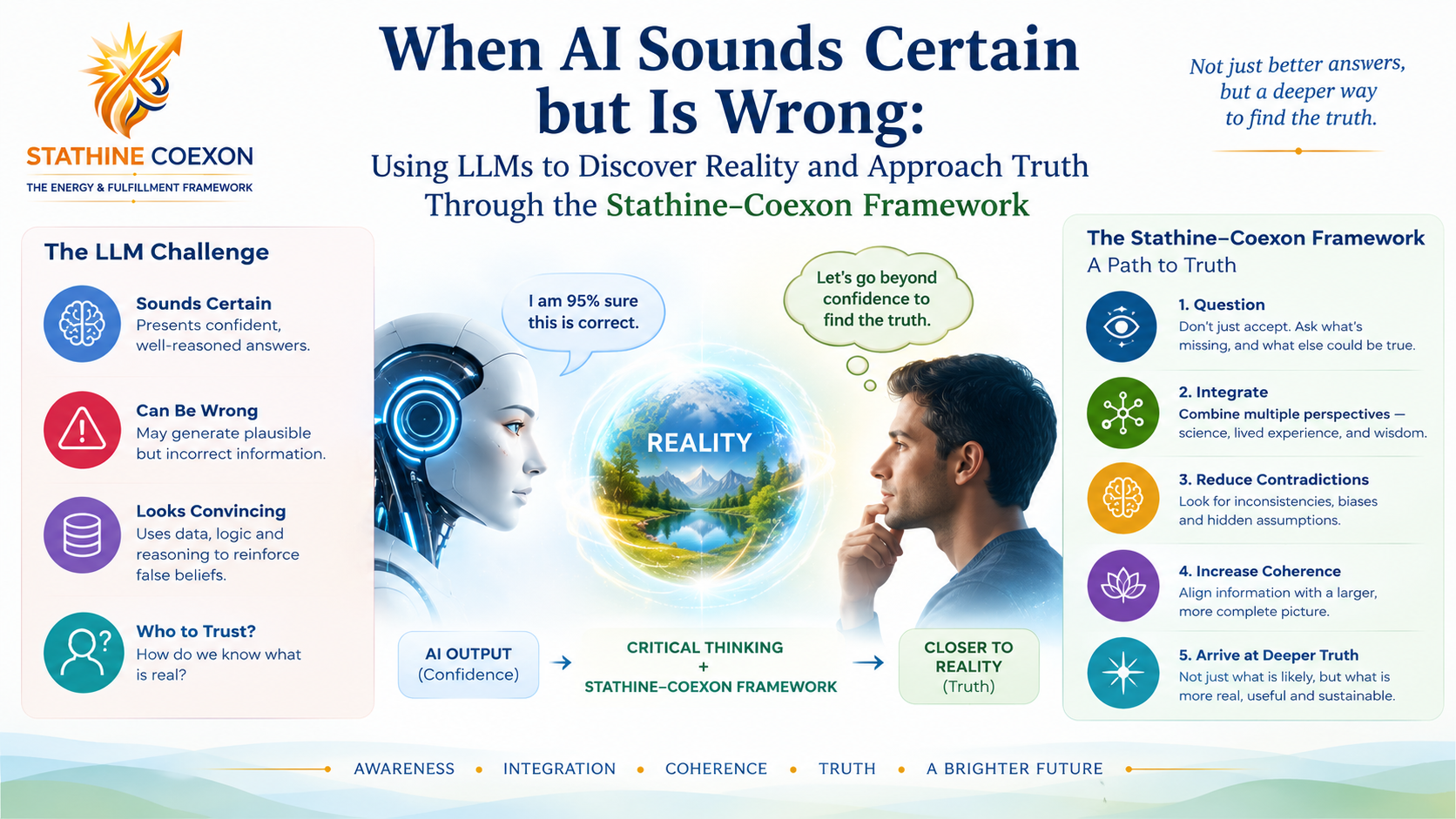
When AI Sounds Certain but Is Wrong: Using LLMs to Discover Reality and Approach Truth Through the Stathine–Coexon Framework
The greatest danger of a Large Language Model (LLM) is not that it can make a mistake. It is that it can make a mistake convincingly, surround it with extensive information, and appear more authoritative than the evidence warrants. An LLM can also challenge a sound argument with irrelevant facts, selective evidence, or a plausible explanation that answers a different question from the one being asked. For a user, the difficulty is distinguishing genuine contradiction — which can improve understanding — from persuasive contradiction that merely creates confusion.
Yet this weakness can become an opportunity. If we stop treating AI as an authority whose job is to confirm or defeat our arguments and instead use it as an instrument for exposing contradictions, testing assumptions, and examining evidence, it can help us develop a more disciplined relationship with reality.
The Stathine–Coexon Framework provides a useful conceptual lens for this transformation. Its central practical question is not How can I get AI to agree with me? or even How can I prove AI wrong? It is How can I reduce the gap between what I believe, what the evidence supports, and what is actually the case?
1. The trap: confusing confidence, information, and truth
Imagine that you ask an LLM whether a particular policy improves educational outcomes. You have research suggesting that it does. The model responds with twenty studies, several statistics, and a polished explanation arguing the opposite. You may feel compelled to abandon your conclusion because the model appears to possess more information than you do.
But the quantity of information is not the same as its quality, and neither guarantees that the conclusion follows from the evidence.
The model may have selected studies involving different populations, confused correlation with causation, overlooked the time period of your research, cited sources that do not support its claims, or combined several individually true statements into a misleading conclusion. It may even be right to challenge your argument — but for reasons that require careful examination rather than automatic acceptance.
This reveals three distinctions every AI user must learn:
- Confidence is not correctness. Fluent, decisive language does not establish that a claim is true.
- Volume is not validity. A hundred weak or irrelevant pieces of evidence do not necessarily outweigh one strong, directly relevant piece.
- Contradiction is not disproof. An opposing claim becomes a serious challenge only when its reasoning and evidence address the same proposition under comparable conditions.
The reverse is equally important. A model’s disagreement does not mean it is wrong, and our personal conviction does not make our own argument true.
The purpose of using AI is therefore not to win an argument against the machine. It is to improve the quality of the process by which both our beliefs and the machine’s answers are examined.
2. Stathine: reality is not created by the argument that describes it
Within the Stathine–Coexon Framework, Stathine is proposed as a static, non-depleting, borderless field within which all elements exist and interact. This is an ontological hypothesis of the framework, and rechecking it with many domains and disciplines. Its relevance here is conceptual: our descriptions of reality should not be confused with reality itself.
A map can represent a territory without being the territory. Likewise, an LLM produces a representation of a subject through language, patterns, and learned relationships. That representation may be useful, incomplete, misleading, or wrong. The fact that it is detailed does not make it identical to the reality it attempts to describe.
The same limitation applies to human reasoning. We construct mental models from experience, education, culture, memory, and assumptions. AI constructs responses through a different process, but its output is also a representation rather than a guarantee of truth.
This creates an opportunity for productive comparison. When your understanding conflicts with an LLM’s answer, neither representation should automatically prevail. The disagreement becomes a reason to investigate.
Suppose you believe a business strategy is failing because it ignores customer needs, while an LLM argues that the problem is insufficient marketing. Instead of debating which explanation sounds more persuasive, examine what each predicts. If customer interviews repeatedly reveal unmet needs, that supports one line of inquiry. If customers value the product but cannot find it, that supports another. Sales data, interviews, experiments, and the conditions under which the strategy operates can help distinguish the explanations.
The practical lesson is simple: use disagreement to direct attention towards reality, not to create another contest between competing narratives.
3. Coexon: from receiving information to organising understanding
In the Stathine–Coexon Framework, Coexon is proposed as a sentient, organising life atom capable of organising information and communicating with the holobiont’s neurological brain. This is a framework hypothesis, which can help understand all human based disciplines and various domains of science.
At the conceptual level, the Coexon model encourages a distinction between receiving information and achieving understanding. An individual can memorise thousands of facts without understanding how they relate, whether they contradict one another, or when they apply.
The same distinction matters when using an LLM. The model can produce a long answer, but the user must still determine what the answer means, how its claims relate, and whether its conclusions are justified.
Consider an LLM that challenges your argument with ten objections. You could respond to every objection separately, creating an exhausting exchange in which the model generates another list each time you answer. Alternatively, you could ask a more fundamental question:
What is the central assumption on which these objections depend?
Perhaps all ten objections assume that short-term efficiency is the only relevant measure of success. If your argument concerns long-term resilience, the disagreement may arise from different definitions of success rather than conflicting evidence.
Identifying that underlying assumption transforms ten apparently separate disagreements into one question that can be examined.
This is the practical value of information organisation: reducing complexity without losing the distinctions that matter.
4. Truth as the progressive reduction of contradiction
One of the most useful principles of the Stathine–Coexon Framework is progressive reduction of contradiction. Applied to AI-assisted reasoning, it means that learning should improve the consistency between our claims, evidence, assumptions, and actions.
Contradiction, however, must be handled carefully. Two claims can appear contradictory because they use different definitions, refer to different time periods, apply to different populations, or operate at different levels of explanation. A genuine contradiction remains only after these differences have been examined.
For example:
- Claim A: Remote work increases employee productivity.
- Claim B: Remote work decreases employee productivity.
These statements cannot be evaluated adequately until we ask: productivity for which tasks, among which employees, over what period, and measured how?
Remote work might improve individual concentration while making some collaborative activities harder. Both observations could be valid. The apparent contradiction may disappear once the scope of each claim is made explicit.
A disciplined approach to truth therefore follows a progression:
Notice the contradiction
Identify exactly which claims, explanations, or predictions disagree.
Expose the assumptions
Clarify definitions, boundaries, hidden premises, and measures of success.
Test the evidence
Verify sources and determine whether the evidence actually supports each claim.
Resolve or preserve the disagreement
Correct errors, reconcile compatible claims, or acknowledge genuine uncertainty.
Update understanding
Revise your conclusion in proportion to the strength of the evidence.
The objective is not to eliminate every disagreement. Some questions remain unresolved because the evidence is insufficient, the underlying phenomenon is complex, or competing explanations have not yet been distinguished. In such cases, acknowledging uncertainty is more coherent than manufacturing certainty.
5. How to use an LLM as an instrument for discovering truth
The following method turns the model’s ability to generate arguments into a structured process of inquiry.
Step 1: State your claim precisely
Begin by writing the claim you want to examine in one or two sentences. Define key terms and specify the conditions under which the claim should hold.
Instead of asking, “Is my theory correct?”, ask, “What observable evidence would support or weaken this specific claim, and what alternative explanations could account for the same observations?”
The more precise the claim, the easier it becomes to distinguish a substantive challenge from an irrelevant objection.
Step 2: Ask the model to challenge your argument
Invite the LLM to identify the strongest objections to your position. Ask it to separate objections based on empirical evidence from those based on logic, definitions, alternative assumptions, or values.
This makes the model an intellectual challenger rather than a source of reassurance.
You should also ask it to identify what evidence would change its assessment. A challenge that cannot specify what would count against its own conclusion risks becoming an unfalsifiable argument.
Step 3: Make the model expose its evidence
For every important factual claim, ask for:
- The original source, not merely a summary.
- The exact passage, result, or dataset that supports the claim.
- The population, period, and conditions to which the evidence applies.
- The distinction between what the source reports and what the model infers from it.
Then check the source independently. A citation may be fabricated, a real publication may be misrepresented, or a genuine result may not support the conclusion attached to it.
An LLM’s ability to produce a reference is not proof that it has accurately retrieved or interpreted the source.
Step 4: Ask the model to argue the opposite side fairly
After examining the objections, ask the model to formulate the strongest version of your original argument. Then ask it to identify which points remain disputed and why.
This helps prevent a common failure: accepting the first coherent narrative simply because it was expressed confidently.
A fair comparison should represent both sides accurately, identify their strongest evidence, and distinguish disagreements about facts from disagreements about values or priorities.
Step 5: Move from language to tests
Where possible, identify an observation, calculation, experiment, document, or real-world outcome that could distinguish the competing explanations.
If the issue concerns mathematics, reproduce the calculation. If it concerns a scientific claim, inspect the relevant research and methodology. If it concerns a business decision, examine the data and test the proposed alternatives. If it concerns a historical event, consult primary sources and reputable scholarship.
Not every question can be resolved by an experiment, but every factual question should be connected to the best available method of checking it.
Step 6: Record what changed your mind
Conclude by stating what you believed initially, what the strongest challenge was, which evidence you verified, and what you now believe.
If your original claim survives scrutiny, retain it with an appropriately calibrated level of confidence. If the evidence weakens it, revise it. If neither side is adequately supported, leave the question open.
The measure of success is not whether you defeated the AI. It is whether your understanding improved.
6. A practical prompt for everyday use
You can reuse the following prompt whenever an LLM strongly contradicts your argument.
Truth-Seeking Protocol — Stathine–Coexon Framework
I want to investigate reality, not win an argument or receive confirmation of my existing beliefs.
My claim is: [state the claim precisely].
Please help me examine it using the following process:
- Restate my claim and identify its key definitions and assumptions.
- Present the strongest reasonable counterargument without exaggerating or inventing evidence.
- Separate factual claims, logical inferences, assumptions, interpretations, and value judgments.
- For every important factual assertion, provide verifiable sources where available and explain exactly what each source supports. Do not invent citations or imply that you have verified a source when you have not.
- Identify possible errors in my reasoning and in your own counterargument, including misleading statistics, selection bias, causal confusion, outdated information, and irrelevant evidence.
- Identify what observations or evidence would support or weaken each competing explanation.
- Distinguish genuine contradictions from apparent contradictions caused by different definitions, contexts, time periods, or levels of analysis.
- State what remains unresolved and how the uncertainty could be reduced.
- Give a balanced conclusion calibrated to the available evidence. If the evidence is insufficient, say so rather than forcing a verdict.
Do not assume that my claim is correct because I proposed it, or that your counterargument is correct because you can support it with extensive information.
The objective is progressive reduction of contradiction through evidence, clearer definitions, and improved understanding.
This prompt improves the structure of inquiry, but it cannot guarantee accuracy. An LLM may still produce fabricated sources, overlook important evidence, or misjudge the strength of an argument. Independent verification remains essential.
7. The deeper danger: using AI to defend the ego
There is another dimension to this problem. People rarely approach disputed questions as completely neutral observers. Our beliefs may be tied to identity, professional standing, ideology, relationships, or years of personal investment.
When an LLM challenges us, we may use it to reinforce our position by asking it to find supporting evidence. Alternatively, we may surrender our judgment because its confident answer makes us feel less knowledgeable. Both responses allow the model to influence our beliefs without sufficient examination.
Through the Stathine–Coexon lens, this is a problem of coherence between what we claim to value and how we actually reason.
If we value truth but only accept information that supports our existing position, our method contradicts our stated objective. If we value independent understanding but treat AI output as authoritative, we surrender the responsibility that makes understanding meaningful.
A more constructive response is to treat disagreement as an opportunity to examine our own assumptions. We can ask:
- What would I need to see to change my mind?
- Am I rejecting this evidence because it is weak, or because it is uncomfortable?
- Am I accepting this explanation because it is well supported, or because it sounds impressive?
- Would I apply the same evidential standard if the conclusion favoured someone I disagreed with?
These questions make the human user an active participant in the search for truth rather than a passive recipient of AI-generated conclusions.
8. Why multiple AI models are not enough
One tempting solution is to ask several LLMs the same question and accept the answer on which most agree. This can be useful for discovering alternative explanations, but agreement is not proof.
Different models may share training data, design assumptions, or common blind spots. They can repeat the same error, rely on the same misleading source, or reinforce a widely repeated misconception. Even independent systems can agree for reasons that have little to do with the truth of a claim.
Use multiple models to broaden the search for possible explanations, not as a substitute for checking those explanations against evidence.
A useful division of labour is to ask one model to challenge your claim, another to identify weaknesses in that challenge, and a third to help design a test that could distinguish the competing views. Then examine the relevant sources or observations independently.
The critical step is not the number of AI systems consulted. It is the quality and independence of the evidence used to assess their answers.
9. From AI to NI: human understanding strengthened by artificial intelligence
The larger opportunity is to change the relationship between human intelligence and artificial intelligence.
If AI is treated as an authority, people may outsource their judgment. If it is treated as an opponent, they may become trapped in endless argument. If it is treated as a mirror, challenger, and research assistant, it can help expose assumptions that would otherwise remain invisible.
The Stathine–Coexon Framework points towards a form of intelligence in which information is not the final objective. Information must be organised into understanding, understanding must be tested against reality, and the resulting knowledge must improve decisions and actions.
In this sense, the transition from AI to NI — natural or human intelligence — does not mean rejecting artificial intelligence. It means using AI to strengthen human discernment rather than replace it.
The human contribution is to frame meaningful questions, recognise context, evaluate consequences, accept responsibility, and remain willing to revise beliefs. The AI contribution is to help generate alternatives, search information, expose logical gaps, and make complex comparisons more manageable.
Neither contribution is sufficient by itself. AI can help identify a contradiction without knowing whether its proposed resolution is correct. Humans can exercise judgment while remaining vulnerable to bias and self-deception. Their collaboration is most valuable when both limitations are acknowledged and the conclusions remain answerable to evidence.
Conclusion: the purpose is not to be right, but to become less wrong
The ability of an LLM to contradict a person confidently is not merely a technical weakness to be avoided. Properly handled, it can become a reason to investigate assumptions that previously escaped attention. The same mechanism that produces misleading confidence can also generate useful challenges, alternative explanations, and questions worth testing.
The Stathine–Coexon Framework offers a conceptual direction for this process: recognise that our representations are not reality itself, organise information into coherent understanding, examine contradictions without defending them merely because they are ours, and revise conclusions according to the strength of the evidence.
This approach also requires intellectual humility. Some beliefs will survive challenge; others will change. Some disagreements will be resolved; others will remain open. A truthful process does not promise certainty whenever we demand it. It improves our ability to distinguish what we know, what we infer, what we assume, and what we still need to discover.
The essential shift is from asking AI to validate our beliefs to asking it to help us investigate them.
When AI contradicts you, do not immediately believe it, reject it, or try to defeat it. Ask what would allow you to determine which account is better supported by reality.
That is how confident contradiction can become a tool for understanding — and how intelligence, human and artificial, can contribute to the progressive reduction of error rather than the multiplication of convincing arguments.
Anand Damani is the creator of the Stathine–Coexon Framework, an interdisciplinary conceptual framework for exploring existence, understanding, coherence, and human flourishing.
Related research
- The Epistemology of the Stathine–Coexon Framework: Knowledge, Coherence, Evidence, and the Progressive Reduction of Human Delusion
- The Foundational Axioms and Practical Lexicon of the Stathine–Coexon Framework
- From Ego Protection to Inclusive Coherence
Curiosity to clarity — using the Stathine–Coexon Framework.