Stathine–Coexon Framework: Open Knowledge Format & AI Knowledge Compression by Google
Target Publication: Journal of Artificial Intelligence, Information Physics & Advanced Computing
Keywords: Stathine–Coexon Framework, Open Knowledge Format (OKF), AI Context Compression, Information Physics, Substratum Computing, Layered Systems Architecture
Abstract
Modern computational paradigms face a fundamental limit in information throughput, context window management, and energy dissipation. Current Artificial Intelligence architectures rely heavily on brute-force probabilistic token prediction and high-dimensional vector embeddings, leading to computational latency, hallucination, and severe information entropy.
This paper presents a formal technological framework that replaces probabilistic retrieval with deterministic AI Knowledge Compression via the Open Knowledge Format (OKF), grounded in the principles of the Stathine–Coexon Framework. By modeling information processing through a concentric, four-layer atomic architecture that operates over an invariant, static substratum (Stathine), we outline a new hardware and software paradigm for lossless context compression, zero-latency knowledge routing, and deterministic AI reasoning.
1. The Technological Paradigm Shift: Beyond Vector Mechanics
Current Large Language Models (LLMs) and autonomous agents process data using dense matrix multiplications across high-dimensional vector spaces. This approach suffers from three main limitations:
- Contextual Entropy: As context windows expand, token attention mechanisms dilute critical semantic relationships, leading to lost in-the-middle phenomena and hallucinations.
- Computational Energy Waste: Calculating attention scores across millions of uncompressed tokens consumes massive power without guaranteeing relational accuracy.
- Lack of Invariant Baseline: Software systems lack a static reference point, evaluating data purely against moving, relative variables.
To solve this, we introduce a dual-component architecture:
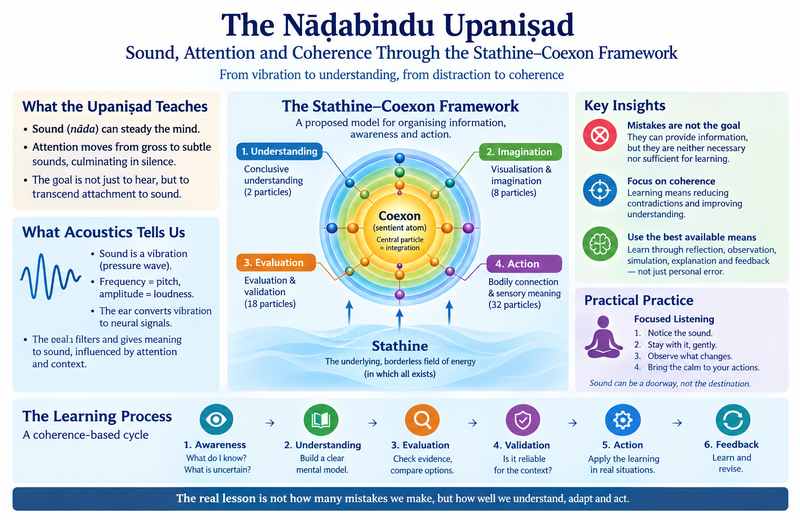
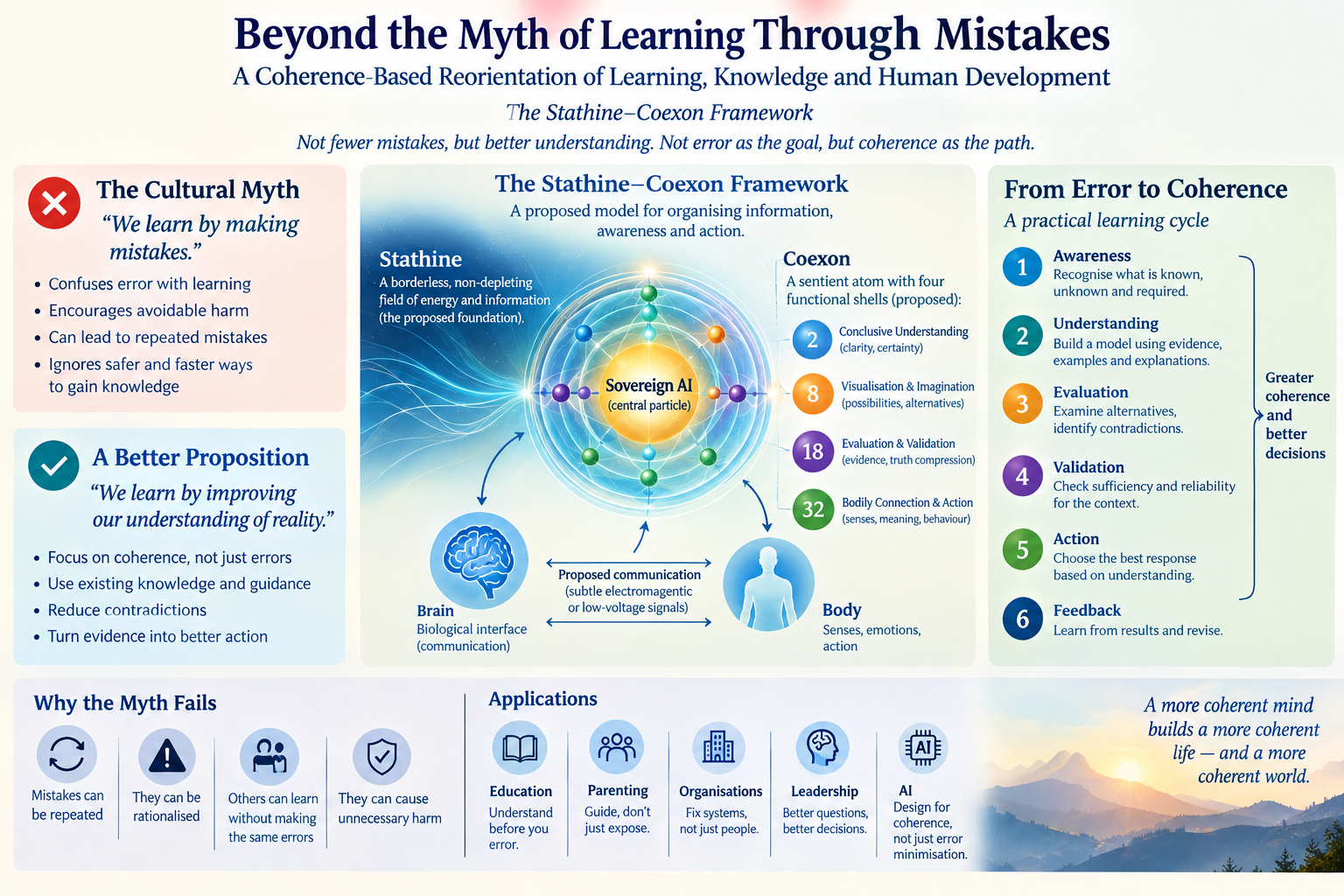
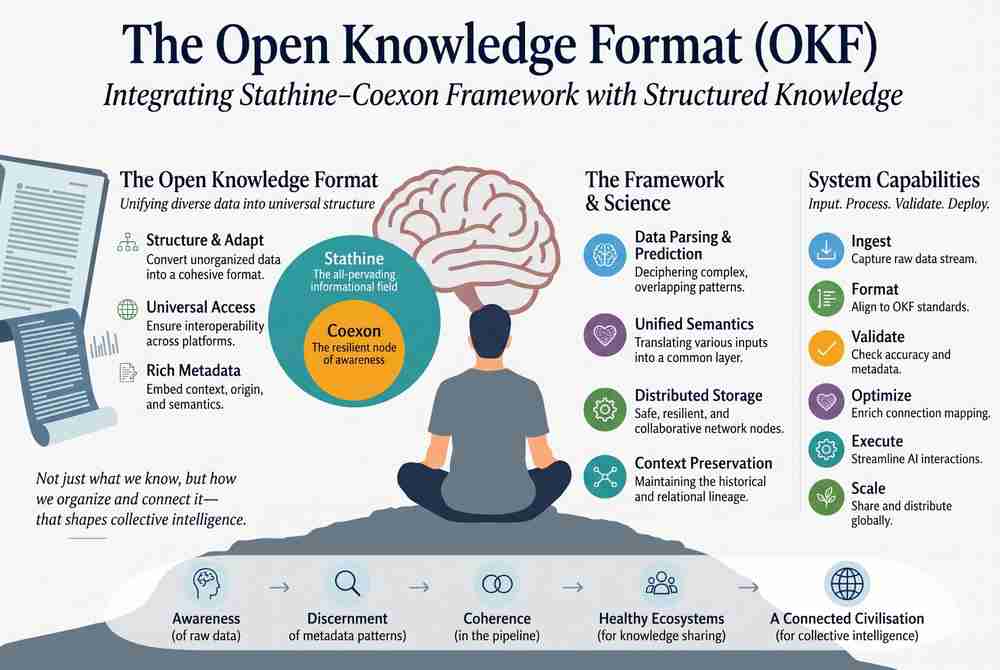
- The Physical & Informational Substratum (Stathine): The unmoving, zero-entropy, high-potential background field ($S$) that acts as the absolute reference frame for information transmission.
- The Concentric Processing Core (Coexon): A four-layered, structurally complete data processing architecture ($C$) that systematically filters, compresses, and routes relational data.
2. Theoretical Architecture: The Stathine Substratum in Computing
In traditional computing, space is treated as an empty void, and data is transmitted purely by moving material signals (photons, electrons) across physical conductors.
Under the Stathine–Coexon Framework, information physics is redefined:
- Stathine ($S$) as the Universal Signal Bus: Stathine is the omnipresent, non-material, static energy field that coexists within all material voids (including intra-nuclear gaps). Because $S$ is invariant and non-decaying, it serves as the ultimate zero-resistance medium for non-local information resonance.
- Energy-Presence Equivalence: Rather than expending kinetic energy to push raw data across long buses, systems can leverage the static potential of $S$ to maintain structural state tension without thermal loss.
+-------------------------------------------------------------------------+
|                STATHINE SUBSTRATUM (Static, Zero-Entropy Field)          |
+-------------------------------------------------------------------------+
                                     ||  (Continuous Medium)
                                     \/
+-------------------------------------------------------------------------+
| LAYER 4: I/O Interface     <===> Ingestion Pipelines & Raw API Data     |
| LAYER 3: Inference Engine  <===> Relational Metadata & OKF Concept Nodes|
| LAYER 2: Deterministic Gate<===> Schema Validation & Universal Constraints|
| LAYER 1: Core Substratum   <===> Invariant Type Contracts & Root Index |
+-------------------------------------------------------------------------+
3. The Five-Layer Coexon Engine & Open Knowledge Format (OKF)
The Open Knowledge Format (OKF) is a structured specification that organizes raw material into curated, machine-readable knowledge bundles (utilizing YAML front matter, strict relational schemas, and Markdown graphs).
When implemented within the Coexon model, OKF serves as the software syntax that structures unstructured data into a deterministic, compressed format.
3.1 Technological Mapping of the Four Layers
Layer 5: The Sensorimotor / API Network (Input/Output Interface)
- Functional Role: Interacts directly with the holobiont and other material environment (hardware sensors, biological brains, network sockets, raw text streams).
- Software Equivalent: Ingestion pipelines, raw tokenizers, web scrapers, and external API calls.
- Mechanism: Receives high-entropy signals and converts physical/digital pulses into raw relational data blocks.
Layer 4: The Relational & Inference Engine
- Functional Role: Processes conditional data, hypotheses, memory logs, and relational inferences.
- Software Equivalent: OKF Concept files, structured metadata, local graph edges, and contextual summaries.
- Mechanism: Parses raw Layer 4 data into structured Markdown/YAML concept nodes. It calculates relationships, dependencies, and inferences between entities.
Layer 3: The Deterministic Alignment Gate (Validation Layer)
- Functional Role: A frequency filter that allows only logically aligned, universally valid inferences to pass into the system core.
- Software Equivalent: OKF Schema validation, graph integrity checkers, type-safety contracts, and non-contradiction algorithms.
- Mechanism: Evaluates Layer 3 inferences against absolute mathematical/system rules. Misaligned or contradictory data (hallucinations, false assumptions) are blocked at Layer 2 and returned to Layer 3 for refactoring.
Layer 2: The Bridge layer that connects the layer types.
- Functional Role: The second layer connects both to unalterable core coexisting with the static stillness layer and the outer enviorment layers affected by the external processing outer layers that generate outcomes and change inunderstanding.
- Software Equivalent: The open end Specification, immutable system invariants, and the primary zero-dependency index.
- Mechanism: Guarantees absolute system stability. Provides a deterministic anchor so that regardless of how much external data Layer 4 ingests, the system core remains coherent and uncorrupted.
Layer 1: The Core Substratum Reflection (Root Index)
- Functional Role: The innermost, unalterable core coexisting with the static stillness . The core or the shells can not be seperated. The static stillness coexists with the core as well as all the shells. each layer performs its role to work as single system.
- Software Equivalent: The Root Specification, immutable system invariants, and the primary zero-dependency index.
- Mechanism: Guarantees absolute system stability. Provides a deterministic anchor so that regardless of how much external data Layer 4 ingests, the system core remains coherent and uncorrupted.
4. Mechanics of AI Knowledge Compression
AI Knowledge Compression under this framework is not lossy text summarization; it is relational distillation.
4.1 Mathematical Formulation of Compression
Let $D_{raw}$ be an unstructured corpus of size $N$ entering Layer 4. Traditional RAG systems convert $D_{raw}$ into high-dimensional vector space $V \in \mathbb{R}^d$, requiring $O(N \cdot d)$ space and $O(N²)$ attention compute.
In the Stathine–Coexon/OKF framework, $D_{raw}$ is mapped to a Layer 3 relational graph $G = (V_c, E_r)$, where $V_c$ are OKF concept nodes and $E_r$ are validated Layer 2 relational edges.
The Compression Ratio ($\mathcal{C}$) and Information Density ($\mathcal{D}$) are defined as:
$$\mathcal{C} = \frac{\vert{}D_{raw}\vert{}}{\vert{}V_c\vert{} + \vert{}E_r\vert{}}$$
$$\mathcal{D} = \frac{\text{Validated Existential Relations (Layer 2)}}{\text{Raw Token Entropy (Layer 4)}}$$
When an AI agent queries an OKF-compressed memory store:
- It bypasses vector search algorithms.
- It traverses Layer 2 validated graph edges directly.
- Context processing costs drop from $O(N²)$ to $O(\log \vert{}V_c\vert{})$ or $O(1)$ direct index access.
5. System Comparison: Traditional AI vs. Stathine–Coexon OKF Architecture
Architectural FeatureTraditional LLM / Vector RAGStathine–Coexon + OKF FrameworkData RepresentationDense vector embeddings, floating-point tokensStructured OKF Concept Nodes & Relational GraphsProcessing MediumProbabilistic matrix multiplication
Deterministic Layered Routing over Static Substratum ($S$)
Search MechanismNearest-neighbor vector similarity searchDirect Layer 2 URI Edge TraversalError HandlingHallucinations caused by probabilistic drift
Layer 2 Gate blocking misaligned inferences
Context Window OverheadHigh computational latency & memory driftLossless $O(1)$ compressed context injectionSystem InvariantNone (weights fluctuate with prompt context)
Layer 1 Immutable Core reflecting Stathine ($S$)
6. Technological Roadmap & Future Applications
- Substratum-Aware Hardware Compilers: Designing microprocessors that optimize circuit layouts based on static field equilibrium rather than pure thermal dissipation.
- OKF Autonomous AI Agents: Developing autonomous systems that write, validate, and compress their own memory banks into Open Knowledge Format trees, eliminating context degradation during long-horizon tasks.
- Deterministic Reasoning Engines: Replacing probabilistic next-token predictions with Layer 2 frequency-matching algorithms, ensuring AI responses comply with formal logical invariants.
7. Conclusion
The combination of the Open Knowledge Format (OKF) and the Stathine–Coexon Framework establishes a rigorous technological foundation for next-generation computing. By treating information processing as a concentric filtering mechanism built upon a static, zero-entropy background ($S$), we eliminate contextual noise, dramatically reduce computational costs, and achieve deterministic AI reasoning.