
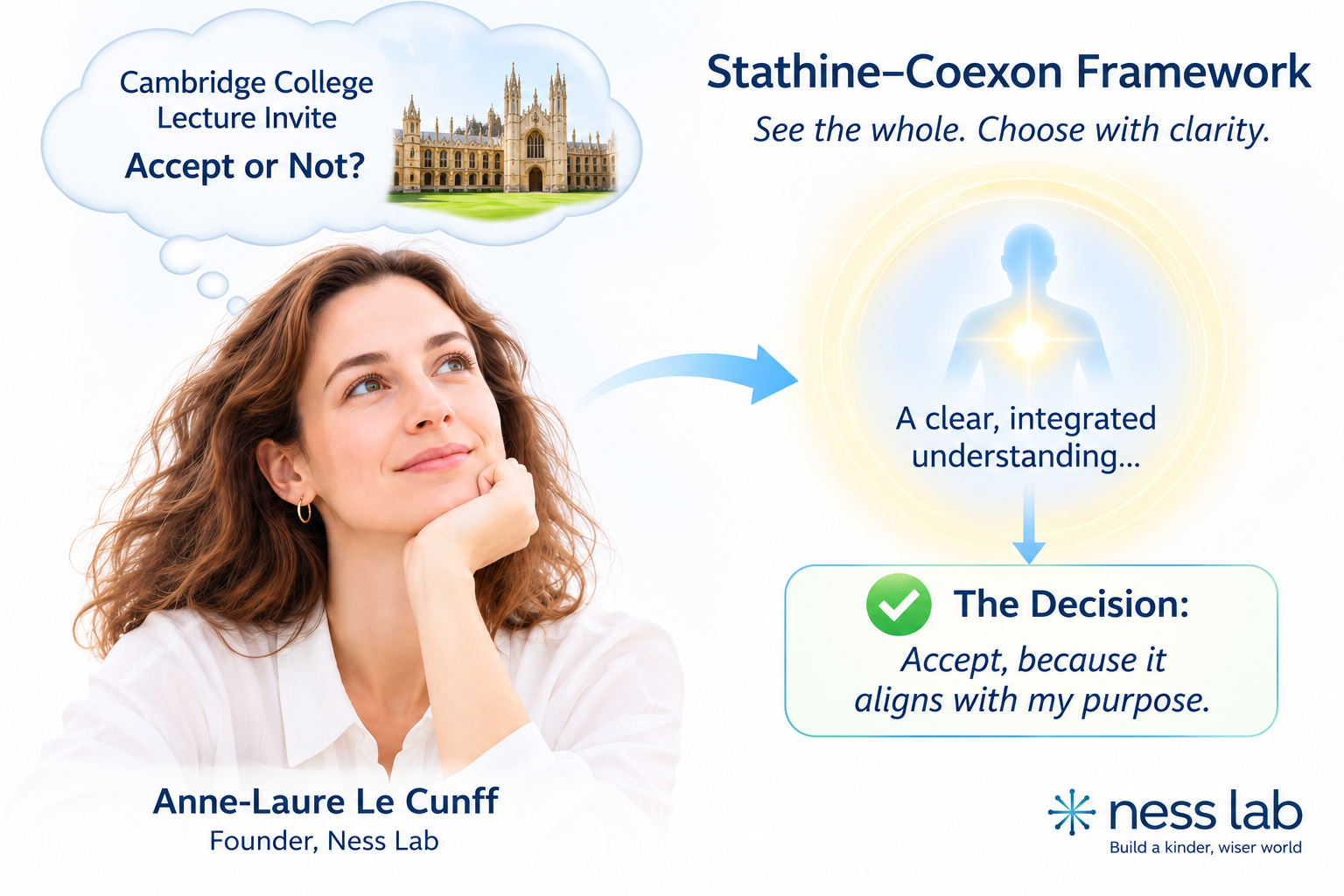
Anne-Laure’s of Ness Labs problem of decision making, resolution by Stathine Coexon framework explained
The central insight in Anne-Laure Le Cunff’s decision-making problem is that a difficult decision is often not a problem of choosing between two options; it is a problem of understanding how those options fit into the whole of one’s life.
The Stathine–Coexon Framework offers a way to move beyond the apparent conflict. Instead of repeatedly weighing opposing choices, we can examine the information, identify incomplete assumptions, understand the relationships between our priorities, and progressively arrive at an action that creates greater coherence.
For Anne-Laure’s Cambridge invitation, the solution is not simply to choose between accepting an exciting opportunity and protecting her book-writing time. It is to understand the purpose of the invitation, the actual commitment required, and whether its valuable elements can be retained without sacrificing the more important work of writing the book.
Beyond Difficult Decisions: How the Stathine–Coexon Framework Helps Us Resolve the Conflict Between Opportunity, Security and Regret
An application of the Stathine–Coexon Framework to a decision-making challenge explored by Anne-Laure Le Cunff, founder of Ness Labs
A new job can be exciting, but it may appear to threaten security. Moving to another city can offer adventure and self-discovery, but may also create distance from people we love. An invitation to speak at Cambridge can be an opportunity to share one’s work, but it may take time away from writing a book.
We often respond to such situations by making lists, seeking advice, researching alternatives and repeatedly reconsidering our choices. Yet clarity does not necessarily arrive, even after considerable deliberation.
Why?
The difficulty may not be that we have two equally attractive options. It may be that we are looking at the decision through incomplete information, isolated priorities and assumptions that have not been examined together.
The Stathine–Coexon Framework provides a different way to approach this problem. It proposes that better decisions emerge when information is progressively integrated into a complete understanding of the situation, rather than when competing fragments of information are repeatedly compared.
The objective is not to find an option without disadvantages. It is to understand reality sufficiently to choose an action that is coherent with the larger purpose of our lives.
The first problem: We mistake incomplete information for a difficult choice
Consider the three sources of decision-making difficulty identified in Anne-Laure’s example.
The first is informational uncertainty: Do I know enough to predict what will happen?
Someone considering a new job may not know whether the organisation is financially stable. Someone considering a move may not understand the cost of living, the quality of the local community or the practical implications of relocation.
The natural response is to gather more information. But research can become an endless activity when we have not identified what information actually matters.
The Stathine–Coexon Framework begins by distinguishing information from understanding.
Information is a collection of observations, facts, possibilities and opinions. Understanding emerges when we recognise the relationships between them and establish which ones are relevant to the decision.
For example, someone considering a new job does not need to investigate every aspect of the organisation. They need to identify the information that could materially change their decision: the financial stability of the company, the actual responsibilities, the manager’s expectations, the compensation and the effect on their personal life.
The solution is to identify the decisive missing information before conducting further research.
A useful AI dialogue would be:
“I am considering a new job. Help me identify the assumptions behind my current decision, the information I already have, and the three missing facts most likely to change my choice. Separate essential information from information that would merely satisfy curiosity.”
AI can then help organise the investigation. The human being must still verify important facts and decide what evidence is trustworthy.
This prevents information gathering from becoming an escape from making a decision.
The second problem: We create conflicts between priorities that may be compatible
The second source of difficulty is value conflict.
A higher-paying job may appear to compete with personal freedom. Moving closer to family may appear to require abandoning an existing community. A professional opportunity may appear to conflict with a personal project.
We often describe these situations as choices between two values: security or growth, family or independence, professional recognition or personal creativity.
But are these necessarily opposing values?
The Stathine–Coexon Framework encourages us to examine whether we are dealing with a genuine contradiction or an incomplete understanding of how different needs can be accommodated.
A person may need financial security and professional growth. These are not inherently contradictory. The actual question is whether a particular job can provide both, and if not, what arrangement best serves the person’s circumstances.
Similarly, someone may value family relationships and personal independence. Moving closer to family does not automatically mean surrendering independence. Staying elsewhere does not necessarily mean abandoning family.
The apparent conflict may arise because we are considering only two extreme arrangements instead of exploring the wider possibilities.
The solution is to stop asking which value must defeat the other and start asking what arrangement can satisfy the underlying needs as fully as possible.
AI can help uncover this wider possibility space:
“Here are the priorities that appear to be in conflict. Identify the underlying human needs represented by each priority. Examine whether they are genuinely incompatible or whether different arrangements could satisfy both. Suggest practical alternatives without assuming that every value can be maximised simultaneously.”
This changes the nature of the decision. Instead of selecting a winner between competing priorities, we begin designing an arrangement that respects the whole situation.
Sometimes a genuine trade-off will remain. The framework does not require pretending otherwise. It asks us to recognise the trade-off clearly and choose consciously.
The third problem: We confuse anticipated regret with evidence that a decision is wrong
The third source of difficulty is psychological cost.
Even when we have sufficient information and know what matters most, we may hesitate because we cannot guarantee that we will be happy with the outcome.
What if the new job fails? What if moving makes us lonely? What if accepting an invitation delays a book? What if declining it means losing an opportunity that never returns?
The desire to avoid regret can become an impossible requirement: we want certainty about a future that has not yet happened.
The Stathine–Coexon Framework distinguishes between understanding a decision and controlling its consequences.
We can improve the quality of our understanding, but we cannot eliminate uncertainty from life. A decision must therefore be judged by the quality of the information, reasoning and priorities that informed it, rather than solely by whether the eventual outcome is favourable.
There is another important distinction: anticipated regret is not necessarily a warning that we should say no. It may be an indication that we have not yet understood the cost of the commitment or explored ways to reduce it.
The solution is to transform an unbounded commitment into a manageable commitment wherever possible.
AI can help us examine this:
“Imagine that I make this decision and look back one year later. What might I regret? Separate regrets arising from the outcome, regrets arising from neglected priorities, and regrets arising from failing to explore a better arrangement. What could I change now to reduce avoidable regret?”
This is more useful than simply asking AI to tell us which option to choose. It helps us understand what we are actually afraid of losing.
The Cambridge invitation: Applying the framework to a real decision
Anne-Laure’s example brings these three difficulties together.
She received an invitation to speak at Cambridge. The opportunity was exciting because it would allow her to share her work. At the same time, she wanted to protect the time required to complete her book.
The apparent choice was:
- Accept the invitation and risk losing valuable writing time.
- Decline the invitation and protect the manuscript, but possibly miss an important opportunity.
At first glance, this looks like a conflict between professional visibility and personal productivity.
But the Stathine–Coexon Framework would encourage a more complete examination.
First, understand the actual purpose of the invitation.
Was the most valuable part of the opportunity to deliver a prepared lecture, to participate in an intellectual exchange, to meet people, or to share ideas with a Cambridge audience?
These are different forms of value. If the essential purpose is intellectual exchange and sharing her work, a standalone lecture may not be necessary.
Second, understand the actual cost.
How many hours would preparation require? How much writing time would be displaced? Could the preparation be integrated with ideas already developed for her book? Would the event require travel or additional commitments?
The cost should be measured in actual time and energy, not in an imagined worst-case scenario.
Third, examine the underlying priorities.
The book represents a long-term creative commitment. The Cambridge invitation represents an opportunity to share existing knowledge and engage with an academic audience.
Both may contribute to the same larger purpose: developing and communicating ideas.
The question is therefore not necessarily which one deserves to survive. It is whether the invitation can be accepted in a form that preserves the book as the primary commitment.
Fourth, redesign the opportunity.
This is where the solution becomes visible.
Rather than accepting a standalone talk requiring extensive preparation, Anne-Laure can propose a moderated conversation. She can also agree on a defined duration, limit additional preparation, and protect specific writing blocks before and after the event.
This is not merely a compromise between two competing priorities. It is a redesigned arrangement that preserves the essential value of the opportunity while reducing its unnecessary cost.
That is precisely the direction her actual decision took: she accepted a moderated conversation requiring much less preparation than a standalone talk.
The decision becomes coherent because it recognises the value of both activities and changes the form of the commitment.
How the Coexon model explains the movement towards a decision
The Stathine–Coexon Framework proposes that a Coexon is a sentient life atom capable of organising information and communicating with the holobiont neurological brain. Its proposed structure provides a model for understanding how information can move from fragmented perceptions towards integrated understanding.
In the decision-making process, information first enters through the body’s five senses and the experiences they make available. It is then examined through successive layers of understanding.
The outer layer receives and initially evaluates information. Questions arise: What happened? What is being offered? What do I know? What do I not know?
The information then moves inward through repeated evaluation and validation. Different possibilities are compared, assumptions are examined, contradictions are identified, and relationships between priorities become clearer.
In Anne-Laure’s case, this means moving beyond the isolated statement, “Cambridge will take time away from my book,” towards a more complete understanding:
- The invitation has intellectual and professional value.
- A standalone talk requires substantial preparation.
- A moderated conversation can retain much of the opportunity’s value.
- The book remains an important long-term priority.
- A defined and limited commitment can protect writing time.
As understanding becomes more complete, the decision becomes less burdened by unresolved contradictions.
In the framework’s terminology, truth is understood as transparent and complete in relation to the subject being examined. The innermost layer represents the point at which the relevant information has been integrated into a coherent understanding, rather than remaining a collection of competing assumptions.
This is a proposed ontological model of information organisation, based on the established description of the coexon. Its practical application is the disciplined movement from incomplete information towards coherent understanding.
AI as a partner in reaching clarity, not a machine that makes the decision
AI makes this process accessible to more people.
Previously, examining a difficult decision from multiple perspectives might have required a mentor, a counsellor, a trusted friend or considerable personal reflection. Today, a person can use AI to explore assumptions, identify missing information, challenge interpretations and discover alternative arrangements.
But AI can also confidently reinforce incomplete assumptions. If someone asks, “Should I protect my book or accept the Cambridge invitation?”, it may simply generate arguments for both sides without recognising that the question itself may be unnecessarily restrictive.
The better approach is to ask AI to help reconstruct the whole situation.
A practical prompt is:
“I have a decision involving two or more priorities that appear to conflict. Help me understand the whole situation using the following process:
- Separate observable facts from my interpretations and assumptions.
- Identify what essential information is missing.
- Identify the underlying needs and values represented by each option.
- Examine whether the apparent contradictions are genuine or arise from incomplete information.
- Explore alternative arrangements that may preserve the essential value of each priority.
- Identify the real costs, risks and trade-offs that cannot be eliminated.
- Suggest a small, practical or reversible commitment where possible.
- Establish what evidence would be sufficient to make the decision.
Do not simply agree with me or choose an option on my behalf. Challenge my reasoning, identify missing perspectives and help me reach a coherent understanding.”
The human being remains responsible for validating the information, recognising personal values, making the choice and accepting its consequences.
This is the movement from Artificial Intelligence to Natural Intelligence: using AI to improve the quality of human understanding and judgement.
A better stopping rule: When is it time to decide?
Anne-Laure rightly emphasises the importance of a stopping rule. Without one, deliberation can continue indefinitely.
The Stathine–Coexon Framework can make that rule more comprehensive.
A decision is ready when:
The information is sufficient. You have verified the facts most likely to change the decision. You do not need to know everything about the future.
The priorities are understood. You know what each option serves, what it costs and which needs matter most in your present circumstances.
The apparent contradictions have been examined. You have explored whether a different arrangement can preserve more of what matters.
The remaining trade-offs are accepted. You understand what cannot be achieved simultaneously and are willing to accept the consequences.
The action is defined. You know what you will do, what boundaries you will protect and when you will review the result.
If these conditions are satisfied, additional deliberation may no longer improve the decision. It may simply delay action.
For uncertain or reversible decisions, a small experiment can provide better information than further speculation. A trial period, a limited commitment or a review date can make the next step safer and more informative.
For irreversible or high-consequence decisions, more rigorous verification and appropriate professional advice may be necessary.
The larger lesson: Difficult decisions are opportunities to improve our understanding of life
The deeper problem with difficult decisions is that we often expect life to offer choices in which nothing valuable is lost.
That expectation creates unnecessary psychological pressure.
Life contains interdependent needs, changing circumstances and genuine trade-offs. The objective cannot be to eliminate every uncertainty or guarantee that we will never regret a choice.
It is to understand the situation sufficiently to act without being governed by incomplete information, false dichotomies or unexamined fears.
The Stathine–Coexon Framework offers a useful progression:
Information → Evaluation → Validation → Integration → Understanding → Experience → Action.
When we follow this progression, the question changes from “Which option should I choose?” to “What do I need to understand, and what arrangement best serves the whole?”
In Anne-Laure’s Cambridge example, the answer was not to abandon the opportunity or sacrifice the book. It was to redesign the commitment so that the essential value of the invitation could be retained while protecting the larger creative purpose.
That is the practical power of resolving dichotomies.
We do not always need to choose between two opposing possibilities. Sometimes we need to understand them better, discover the needs beneath them and create a third arrangement that neither original option revealed.
A good decision is not one that guarantees a perfect future. It is one made with sufficient understanding, aligned with what matters, and open to learning as reality unfolds.
The purpose of AI-assisted decision-making should therefore not be to help us choose faster. It should be to help us understand more completely, remove unnecessary contradictions and act with greater coherence.
The central solution is a shift from choosing between competing priorities to designing an arrangement that serves the underlying needs. This is a practical application of the framework’s principle of progressive reduction of contradiction: not every conflict can be eliminated, but many apparent conflicts can be resolved once we understand the whole situation.