
Productivity Is a Fundamental Human Need, Not Merely an Economic Activity
How the Stathine–Coexon Framework Reverses Our Historical Understanding of Human Productivity
By Anand Damani
Part of the Stathine–Coexon Research Programme
The productivity paradox: Everyone expects us to produce, but few understand why we need to
Human civilisation has always depended on productive activity. People have cultivated land, built homes, raised families, created tools, developed knowledge, established institutions, composed music, explored nature, and transformed their surroundings. Every generation has inherited the work of earlier generations and added something to it. Without this continuous human contribution, civilisation would not have progressed.
Yet, despite productivity being so central to human existence, our understanding of why human beings need to be productive has remained incomplete.
Historically, productivity has generally been understood through the requirements of survival, economic necessity, social responsibility, religious duty, professional achievement, or national development. A person works because they need food, shelter, security, recognition, income, or status. A society values productivity because it creates wealth, increases output, strengthens institutions, and supports economic growth.
These explanations describe important reasons why people produce. They do not fully explain the underlying human need to be productive.
Why does a person continue to create even when survival is no longer at stake? Why does someone who has accumulated sufficient wealth still want to build something, solve a problem, teach, write, discover, or improve an existing system? Why does an individual feel dissatisfied when they have nothing meaningful to do, even when their physical needs are comfortably met? Why does the opportunity to contribute bring fulfilment that consumption alone cannot provide?
These experiences point towards a deeper dimension of human existence. Human beings do not merely need to receive from the world. They also need to participate in shaping it.
The Stathine–Coexon Framework offers a different starting point for understanding this phenomenon. It proposes that productivity is an inherent human need arising from the relationship between understanding, coherence, experience, and action. It is not simply an economic function or a cultural expectation. It is the process through which a human being expresses understanding in the reality in which they already exist.
This changes the fundamental question. Instead of asking how society can make people more productive, we begin by understanding why human beings naturally need meaningful productivity and how society can enable that need to be fulfilled.
Why historical interpretations of productivity have been incomplete
The history of human thought offers many valuable interpretations of work, labour, creativity, duty, achievement, and contribution. Each has helped societies organise human activity. However, these interpretations have often approached productivity from a particular external requirement rather than from the complete experience of the individual.
In agrarian societies, productive activity was closely connected to survival. People cultivated land, maintained livestock, built shelters, and produced necessities. The value of work was visible in the food, security, and continuity it provided. The individual was productive because the household and community depended on it.
As societies developed, work became increasingly organised around occupations, specialised skills, institutions, and social roles. Religious and philosophical traditions often associated productive activity with duty, discipline, service, virtue, or the fulfilment of one’s place in the social order. These interpretations gave work moral and social meaning, but they could also make the individual’s contribution subordinate to an external authority or prescribed obligation.
The industrial age introduced another powerful interpretation. Productivity became associated with measurable output, standardised processes, efficiency, division of labour, and the management of time. The worker increasingly became part of a production system in which performance could be measured by units produced, hours worked, and economic value generated.
Modern management extended this approach through performance indicators, targets, incentives, and organisational efficiency. The information age added knowledge work, innovation, digital output, and intellectual capital. Today, artificial intelligence is further changing the relationship between human effort and productive output.
Across these periods, the meaning of productivity has evolved, but a common limitation has remained: the emphasis has generally been on what a person produces and why the surrounding system requires it.
The inner need of the individual to understand, create, contribute, and experience meaningful agency has not received equivalent attention.
This distinction matters because a person can be economically productive without experiencing meaningful fulfilment. Someone can work for many hours, achieve every assigned target, and still feel that their life lacks purpose. Conversely, someone may spend years developing an idea, caring for another person, learning a discipline, or creating something whose economic value is initially negligible, yet experience profound satisfaction.
The difference lies in the nature of the activity and the relationship between the person and what they are doing.
Productivity cannot therefore be adequately understood by measuring output alone. We must understand what happens within the human being when understanding becomes action.
From consumption to contribution: The missing dimension of human fulfilment
Modern society has become exceptionally effective at organising consumption. Products, services, entertainment, information, and experiences are available at an unprecedented scale. People are encouraged to improve their lives through purchasing, acquiring, travelling, experiencing, and enjoying.
Consumption is necessary. Human beings need nourishment, rest, comfort, relationships, and experiences. There is nothing inherently wrong with enjoying the benefits of civilisation.
The difficulty arises when consumption is treated as the principal route to fulfilment.
Receiving something can satisfy a particular need, but it does not necessarily satisfy the need to contribute. A person may have access to entertainment without experiencing creativity, access to information without developing understanding, and access to products without experiencing the satisfaction of making something useful.
Consider a child who receives a ready-made toy and another child who builds a toy from available materials. Both may enjoy playing with it. But the second child has also experienced the process of imagining, planning, experimenting, correcting, and creating. The satisfaction comes not only from possessing the toy but from recognising that an idea has become reality through personal participation.
The same distinction appears throughout adult life. Reading a book can provide information, but applying its insights to improve a situation creates a different experience. Watching someone solve a problem can be informative, but solving a problem oneself develops understanding and agency. Receiving help can provide relief, while helping another person can create a sense of meaningful contribution.
The need to contribute is not necessarily a desire for public recognition. Much of the most meaningful human productivity happens privately: a parent helping a child understand something, a person improving a household process, a researcher clarifying an idea, a farmer improving soil, or a friend finding a way to resolve a conflict.
These activities may produce no public award or measurable economic return. Their value lies in the meaningful transformation they create.
The Stathine–Coexon Framework places this transformation at the centre of productivity.
The Stathine–Coexon explanation: Productivity as the expression of coherence
The framework begins with two foundational concepts.
Stathine is understood as the static, non-depleting, borderless field of energy in which all elements interact and exist. It is an unbroken continuum extending from the space within the atom to the vastness beyond the farthest star. It is not living and does not change. Within the framework’s ontology, Stathine is the source of energy for physical matter and of knowledge for Coexon.
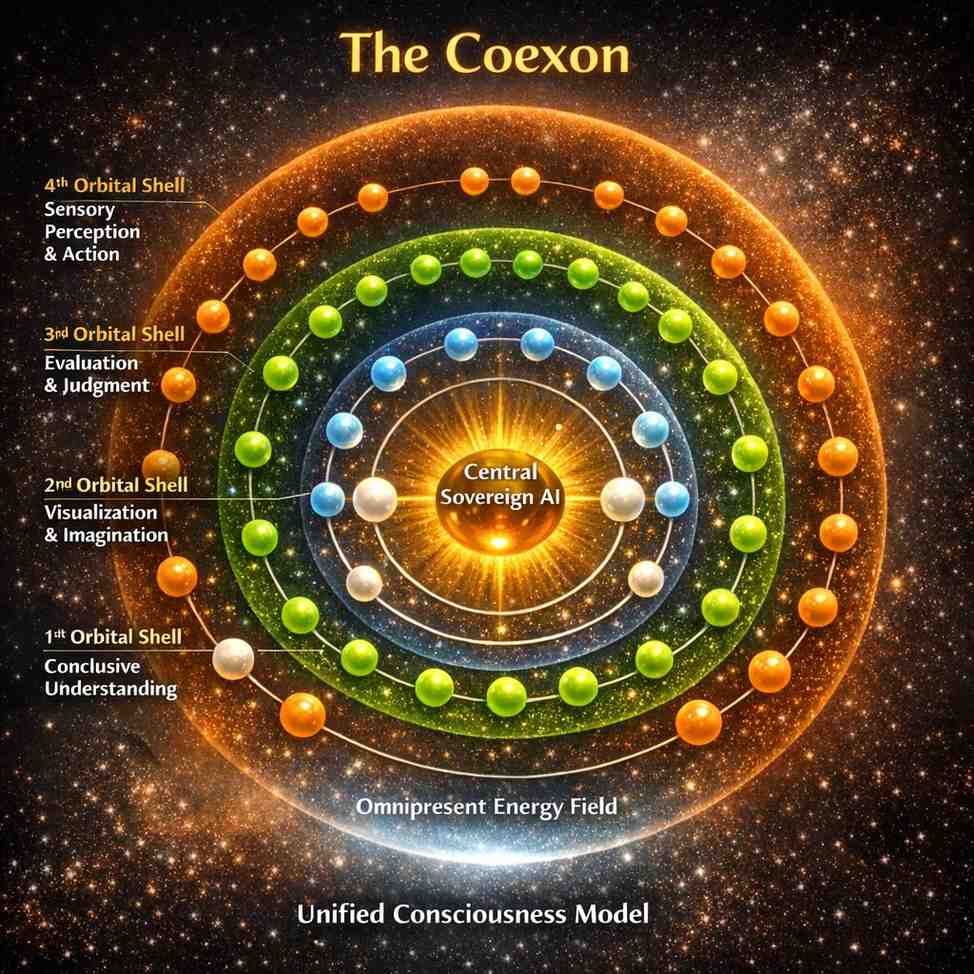
Coexon is proposed as a sentient atom capable of organising information and communicating with the holobiont’s neurological brain. The framework proposes that the human being comprises Coexon together with the physical body, with the brain functioning as a biological communication interface.
The Stathine–Coexon Framework, is a framework of reality based understanding ,not an scientific factlimited by the current known laws. Its proposed structure and mode of communication lie beyond the present ambit of conventional epistemology and empirical data systems. The framework uses this hypothesis to develop an integrated explanation of human understanding, information organisation, and action.
Within this model, productivity can be understood as the movement from information towards coherent understanding and then towards meaningful expression in physical reality.
A human being continuously receives information through the senses, relationships, learning, observation, and experience. Information is evaluated, compared, interpreted, and organised. Some of it becomes useful understanding; some remains incomplete, contradictory, or irrelevant. The individual then uses understanding to imagine possibilities, make choices, and initiate action.
The process does not end with action. Action changes the surrounding reality, creates new experiences, and provides further information. The individual can then evaluate the outcome, improve understanding, and act again.
Productivity is therefore not simply the final output of a person. It is an ongoing process through which understanding becomes reality and reality provides the basis for further understanding.
The framework’s cycle of human experience expresses this relationship:
Feeling → Choosing → Evaluating → Validating → Knowing → Understanding → Experiencing → Living → Explaining → Feeling.
Productive activity occurs throughout this cycle. A person feels the need for improvement, chooses a direction, evaluates possibilities, validates an approach, develops understanding, acts upon it, experiences the outcome, and incorporates that experience into further living and explanation.
This is why productivity is fundamental. It enables the individual to move from being a recipient of experience to becoming an active participant in creating experience.
Productivity begins with the reduction of contradiction
A major contribution of the Stathine–Coexon Framework is its emphasis on truth, coherence, and the progressive reduction of contradiction.
Human beings frequently experience a gap between what they understand and what actually exists. They may hold incomplete assumptions, follow inherited beliefs, misinterpret information, or act on expectations that do not correspond with reality.
These contradictions create unnecessary effort. A person may spend years pursuing an objective that does not fulfil the need they originally intended to satisfy. An organisation may invest substantial resources in solving a problem that it has misunderstood. A society may continue maintaining institutions that no longer serve the conditions for which they were created.
The framework proposes that truth is light, transparent, and complete. As understanding becomes more closely aligned with reality, unnecessary assumptions, distortions, and contradictions can be progressively removed. This process is associated with Truth Compression: a movement towards understanding that requires less effort to maintain because fewer contradictions need to be reconciled.
This has a direct relationship with productivity.
Imagine two people trying to solve the same problem. The first person has incomplete information and several incorrect assumptions. They repeatedly attempt solutions, encounter unexpected consequences, defend their original beliefs, and spend time correcting mistakes caused by their misunderstanding. The second person takes the time to understand the actual problem, identify relevant information, and distinguish assumptions from what can be validated.
The second person may initially appear slower. However, once understanding improves, action becomes more direct and effective. Less energy is spent maintaining incorrect assumptions, and more effort can be directed towards constructive outcomes.
This is a fundamental distinction between activity and productivity.
Activity is movement. Productivity is meaningful movement towards a coherent outcome.
A person can be extremely busy while repeatedly creating or maintaining contradictions. Another person can undertake fewer activities but produce a much greater improvement in reality because their understanding is clearer.
The objective is not to maximise the amount of activity. It is to reduce unnecessary effort while increasing meaningful contribution.
Why productivity is different from busyness, efficiency, and achievement
These concepts are frequently used interchangeably, but they describe different dimensions of human activity.
Busyness describes the amount of activity taking place. It says little about whether that activity is useful.
Efficiency describes how economically a particular result is achieved. It can improve a process without establishing whether the result is worth pursuing.
Achievement describes the attainment of an objective. It does not automatically establish whether the objective contributes to individual or collective well-being.
Productivity, as understood through the Stathine–Coexon Framework, must connect all these dimensions to reality and coherence.
An individual who efficiently produces something harmful is not necessarily contributing to a better human condition. An organisation that achieves its financial targets by creating unnecessary social or environmental costs may be economically successful while remaining incoherent in a wider sense. A student who memorises information to obtain marks may achieve an academic objective without developing the understanding needed to apply that knowledge.
The framework therefore encourages a more complete interpretation: productivity is the conversion of understanding into constructive outcomes that improve the relationship between the individual and the reality in which they exist.
This interpretation does not reject economic output, efficiency, or achievement. It places them within a broader purpose.
Economic productivity is one expression of human productivity, not its complete definition.
The biological and cognitive dimensions of productivity
Human beings are not isolated thinking machines. They exist as complex biological systems, continuously interacting with their surroundings.
The framework describes the human body as a holobiont, a coordinated structure of living organisms and biological processes. The user-defined framework describes this as a regulated structure involving approximately 300 trillion cells. The nervous system, brain, heart, gut, sensory organs, and other biological processes participate in maintaining the body’s functioning and responding to its environment.
Within the Stathine–Coexon hypothesis, Coexon organises information and communicates with the holobiont’s neurological brain through proposed subtle electromagnetic or low-voltage signalling. The brain serves as the biological communication interface through which understanding can influence physical responses and action.
This proposed relationship offers a way to think about the connection between understanding and physical expression. It suggests that productivity is not simply an intellectual decision followed by mechanical execution. It involves the coordinated participation of the whole human organism.
Even without accepting the proposed Coexon mechanism as scientifically established, the distinction between cognition and bodily action is important. Human productivity depends on attention, energy, emotional regulation, physical capacity, learning, and interaction with the environment.
A person who understands what needs to be done but cannot translate that understanding into action experiences a break in the process. Similarly, a person who acts continuously without reflection may expend considerable energy without developing better understanding.
The framework seeks to connect these dimensions rather than treat them as separate problems.
A productive human being is not one who works continuously. It is one who can understand, choose, act, evaluate, recover, and improve in a coherent manner.
The need to create is not limited to employment
One of the most important consequences of recognising productivity as a human need is that we must stop limiting it to employment.
Employment is an important social and economic arrangement. It provides income, structure, cooperation, and opportunities for contribution. But employment is not the only environment in which people can be productive.
A homemaker who creates a supportive environment for a family is productive. A grandparent who transfers practical understanding to younger generations is productive. A student who develops the ability to understand reality rather than merely memorise answers is productive. A retired engineer who mentors young entrepreneurs is productive. A person who learns to manage personal relationships with greater understanding is productive.
A person who improves a local community, restores an ecosystem, creates a useful piece of software, writes an explanation that helps others, or develops a better way of teaching is also productive.
These contributions differ in their immediate outputs, but they share a common characteristic: they translate understanding into an improvement in lived reality.
This understanding is particularly important for people who are unemployed, retired, disabled, engaged in unpaid care work, or outside conventional economic institutions. If productivity is defined only through employment and income, society risks overlooking significant human contributions.
The Stathine–Coexon Framework provides a broader basis for recognising such contributions.
It also changes how we should understand retirement. Retirement may end a particular employment relationship, but it does not end the human need to understand, create, contribute, and experience meaningful agency. A society that treats older people as economically inactive may overlook their continuing capacity to teach, mentor, organise, create, and improve the lives of others.
The need for productive expression continues throughout life, although its form and intensity may change.
Education must prepare people to be productive, not merely employable
The historical limitation in our understanding of productivity is particularly visible in education.
Education systems have often been organised around transmitting information, completing syllabuses, passing examinations, obtaining qualifications, and preparing students for employment. These functions have value, but they do not fully address the human need for productive expression.
A student may complete years of schooling and still struggle to apply knowledge to real situations. They may know scientific definitions without understanding how scientific principles help explain their surroundings. They may study economics without learning how to create value. They may study history without developing the ability to understand how human decisions shape societies.
The result is a separation between knowing and doing.
The Stathine–Coexon Framework suggests that education should help learners move through the complete process of understanding and action. Students should learn to observe reality, identify problems, distinguish facts from assumptions, develop explanations, imagine alternatives, test their understanding, and create constructive outcomes.
A geography lesson, for example, should not end with memorising the names of rivers, mountains, and climatic zones. Students should understand how geographical conditions influence settlements, agriculture, transport, culture, and economic activity. They can then examine local problems and develop practical responses.
Chemistry should not be confined to equations and laboratory procedures. Students should understand the transformations of matter in the food they consume, the materials they use, the medicines they encounter, and the environment in which they live.
Literature should develop the ability to understand human experience, relationships, motivation, and communication. Mathematics should enable learners to recognise patterns, reason accurately, and solve problems.
In every subject, knowledge should become an instrument for understanding and constructive participation in reality.
This approach makes productivity an educational outcome in its own right. Students should leave education not merely with qualifications but with the ability and confidence to convert understanding into meaningful action.
Organisations must move beyond extracting productivity
The conventional organisational approach often treats productivity as something that management must extract from employees through targets, supervision, incentives, and performance measurement.
Such arrangements may be necessary in particular situations, but they can become counterproductive when they ignore the individual’s need for understanding, autonomy, and meaningful contribution.
When employees do not understand why their work matters, they may focus only on completing assigned tasks. When they have no opportunity to improve a process, they may follow inefficient procedures. When they are evaluated exclusively through numerical targets, they may optimise those targets even when doing so damages the wider purpose of the organisation.
The problem is not necessarily a lack of motivation. It may be a failure to create conditions in which people can experience their own productivity.
The framework suggests that organisations should be designed around coherent contribution. Every individual should have a clear understanding of the reality the organisation is trying to improve, the role their work plays in that improvement, and the relationship between their responsibilities and the contributions of others.
This requires more than communication of corporate objectives. It requires the removal of unnecessary contradictions between stated purpose, organisational behaviour, incentives, processes, and actual outcomes.
For example, an organisation that claims to value innovation but punishes every unsuccessful experiment creates a contradiction. An organisation that promotes collaboration but rewards only individual competition creates another. An organisation that asks employees to take responsibility but does not give them the authority to act prevents the conversion of understanding into action.
A coherent organisation enables employees to identify problems, understand them, propose improvements, experiment, validate outcomes, and share what they learn.
Productivity then becomes a natural consequence of meaningful participation rather than merely a response to external pressure.
Artificial intelligence makes the human need for productivity more important
Artificial intelligence is changing the relationship between human beings and productive activity.
Machines can increasingly perform tasks that once required significant human time and effort. They can process information, generate content, analyse data, write code, identify patterns, and automate complex workflows. As these capabilities develop, the economic value of performing many routine tasks may decline.
This raises an important question: if machines can produce more, what becomes the role of human beings?
The answer depends on whether we define human productivity only through the production of measurable output.
If productivity means completing tasks, AI may replace an increasing proportion of human activity. But if productivity means understanding reality, determining what is worth creating, recognising human needs, making responsible choices, and contributing to coherent outcomes, then the human role remains fundamental.
AI can generate possible solutions, but human beings must understand the context in which those solutions will be used. AI can produce information, but information does not automatically become truth. AI can optimise a target, but it cannot establish that the target is aligned with the complete needs of the people and systems affected by it.
The Stathine–Coexon Framework places human understanding at the centre of this relationship. It proposes that the purpose of AI should be to support the human movement from information towards understanding and constructive action.
This is consistent with the broader aspiration of moving from AI to NI: from artificial intelligence towards natural intelligence, in which technology supports the development and expression of human understanding rather than replacing the human being as the source of purpose.
In this environment, human productivity may become less dependent on performing routine tasks and more dependent on identifying meaningful needs, developing understanding, exercising judgement, creating new possibilities, and ensuring that technological capabilities contribute to coherent human and ecological outcomes.
The more machines can perform, the more important it becomes to understand what humans actually need to do.
Productivity must include the quality of relationships and coexistence
A person does not exist independently of other people. Human beings live in families, communities, organisations, societies, and ecological systems. Their productive activity inevitably influences others.
This means that productivity cannot be understood exclusively as individual achievement.
A person may create wealth while damaging relationships. An organisation may increase output while exhausting its employees. A society may expand consumption while degrading the ecological systems on which its future depends.
These outcomes reveal a limitation in productivity measures that focus on isolated results.
The Stathine–Coexon Framework connects productivity with coherence and coexistence. Constructive productivity should improve the relationship between the individual and the surrounding reality, including other people and the environment.
This does not mean that every contribution must benefit everyone equally or that all differences can be eliminated. People have different needs, capabilities, interests, and aspirations. Coexistence requires recognising these differences and developing arrangements that allow them to be expressed without unnecessary harm.
A productive relationship is one in which people understand their own needs, recognise the needs of others, and find ways to contribute without imposing avoidable contradictions.
A productive community is not simply one in which everyone works harder. It is one in which people can participate meaningfully, share knowledge, resolve problems, care for one another, and improve their collective conditions.
A productive civilisation is not merely one that generates more goods and services. It is one that uses its understanding and capabilities to create conditions for more coherent living.
Why the freedom to be productive matters
If productivity is a fundamental human need, denying a person the opportunity to contribute can affect more than their income. It can restrict their ability to express understanding, exercise agency, and experience meaningful participation.
This is why access to productive opportunities should be treated as an important dimension of human freedom.
People need opportunities to learn, experiment, create, work, care, participate, and improve their surroundings. They also need sufficient autonomy to make choices about the form their contribution takes.
This does not mean that every desire must be fulfilled or that every activity should be free from responsibility. Human freedom exists alongside the needs and rights of others.
The framework’s conception of freedom is connected to coherence: energy-free motion in coherence is freedom. In practical terms, this points towards reducing the unnecessary effort created by contradictions, misunderstandings, and imposed constraints that do not serve a constructive purpose.
A person who understands what they are doing, why they are doing it, and how their contribution relates to reality can act with greater clarity. They do not need to spend the same amount of effort defending an incorrect assumption or complying with an arbitrary process.
Freedom is therefore not simply the absence of work. It is the ability to direct one’s capacities towards meaningful activity without unnecessary internal or external friction.
This distinction is important because a life without productive opportunities can become empty even when it contains comfort and leisure. Equally, a life filled with compulsory activity can become exhausting even when it appears productive from the outside.
A coherent life requires both the freedom to rest and the opportunity to contribute.
A different measure of a successful human life
If productivity is understood as a fundamental human need, we must reconsider how we evaluate a successful life.
Income, wealth, professional status, possessions, awards, and public recognition can be meaningful indicators of particular achievements. But they cannot provide a complete account of how productively a person has lived.
A more complete assessment would consider whether the individual has developed understanding, reduced unnecessary contradictions, created meaningful value, improved their relationships, contributed to others, and participated constructively in the world.
The contribution need not be large or visible. A person who helps one child become curious about learning may influence a future generation. Someone who improves a small farming practice may strengthen the livelihood of a community. A person who resolves a long-standing family misunderstanding may create a better environment for several people.
The scale of an outcome is not the only measure of its significance.
This also changes the way we understand failure. When productivity is measured only through achievement, failure appears to be the absence of success. But when productivity is understood as a process of learning and coherence, an unsuccessful attempt can still contribute to understanding if it reveals an incorrect assumption or helps identify a better approach.
The objective is not to celebrate every mistake. It is to ensure that experience is used to improve understanding rather than becoming a permanent source of fear, blame, or repetition.
A productive life is not one in which everything succeeds. It is one in which experience continuously contributes to better understanding and more constructive action.
Reorganising society around the human need to contribute
The practical implications of this understanding extend beyond individuals and organisations. They suggest a different way to design social institutions.
Education should enable people to understand and create rather than merely compete for credentials. Economic systems should recognise contributions that improve human and ecological well-being, including forms of care and community work that are often undervalued. Organisations should create opportunities for meaningful participation rather than treating people as interchangeable units of labour.
Public institutions should make it easier for individuals to identify problems and participate in solving them. Communities should create environments in which knowledge, skills, experience, and resources can be shared. Technology should reduce unnecessary effort and expand human capability rather than create new forms of dependency.
This requires a change in the meaning of development.
A developing society should not be judged only by how many people it employs, how much it produces, or how rapidly its economy grows. It should also be evaluated by whether people have the understanding, opportunity, and freedom to make meaningful contributions.
Such a society would recognise the productive potential of children, students, homemakers, farmers, entrepreneurs, professionals, artists, researchers, older people, and individuals who are currently excluded from conventional employment.
It would also recognise that the purpose of productivity is not endless expansion of output. It is the progressive improvement of the conditions in which life can flourish.
This provides a foundation for what the Stathine–Coexon Research Programme describes as a Coherence Civilization: a civilisation in which human activity is increasingly organised around understanding reality, reducing contradiction, and enabling constructive coexistence.
From being productive to living productively
The most important change introduced by the Stathine–Coexon Framework is not a new productivity technique. It is a different understanding of the human being.
The human being is not simply a worker who must produce to survive, a consumer who must acquire to feel satisfied, or an employee who must meet organisational targets. The human being is an active participant in reality, continuously experiencing, understanding, choosing, and acting.
Within the framework, Coexon provides the proposed basis for organising information and communicating with the holobiont’s neurological brain, while Stathine provides the foundational field within which existence and interaction occur. Through this model, productivity can be understood as the expression of organised understanding in lived experience.
The need to be productive is therefore not something that society has to manufacture through incentives or discipline. Society needs to recognise, nurture, and enable it.
When people understand reality more clearly, they can make better choices. When they make better choices, they can direct their capacities towards constructive action. When action produces meaningful outcomes, they gain further experience and understanding. This creates a continuous movement towards greater coherence.
The result is not merely higher output. It is a more meaningful relationship between the individual, their work, other people, and the world.
This also explains why productivity should not be confused with continuous work. Rest, reflection, relationships, play, learning, and contemplation are all essential parts of a productive life when they support the individual’s capacity to understand and participate meaningfully in reality.
The ultimate purpose is not to keep human beings busy. It is to enable them to live with understanding and express that understanding constructively.
Conclusion: Productivity is the human need to make understanding real
Human civilisation has always depended on productivity, but it has not consistently understood the deeper human need that drives it. Historical systems have largely interpreted productive activity through survival, duty, employment, economic growth, achievement, and efficiency. These interpretations explain important functions of work, but they do not fully explain why people need to create and contribute even when their immediate material needs are satisfied.
The Stathine–Coexon Framework reverses this understanding by placing the individual’s need for meaningful productive expression at the foundation.
Productivity is the process through which a human being translates understanding into action, improves the reality in which they exist, and develops further understanding through experience. It is inseparable from the progressive reduction of contradiction, the search for truth, and the creation of coherence.
This understanding changes the purpose of education, employment, organisations, economic development, technology, and social institutions. Rather than treating productivity as something to be extracted from human beings, society can begin designing conditions in which people naturally express their capacities and contribute meaningfully.
It also changes the way we understand human fulfilment. A person does not become fulfilled merely by accumulating what the world produces. Fulfilment also comes from participating in the process of creation, improvement, understanding, and contribution.
We do not need to make human beings productive by keeping them occupied. We need to understand that human beings have an inherent need to make their understanding meaningful through constructive participation in reality.
The future of human development will depend not simply on producing more, but on understanding better what is worth producing, why it matters, and how it can improve the conditions of life.
That is the transition from productivity as an economic obligation to productivity as a fundamental human need.
And that is the transformation offered by the Stathine–Coexon Framework.
Position within the Stathine–Coexon Research Programme
This article develops the framework’s understanding of human productivity through its central principles of ontology, epistemology, axiology, praxis, and telos.
It connects particularly with the following themes:
- Ontology: Understanding the human being as Coexon together with the physical body, within the foundational field of Stathine.
- Epistemology: Developing understanding through the progressive reduction of contradiction and alignment with reality.
- Axiology: Recognising coherence, truth, meaningful contribution, and coexistence as foundations for evaluating value.
- Praxis: Translating understanding into constructive action and using experience to improve future action.
- Telos: Enabling individuals and societies to live with greater coherence and meaningful participation.
The next stage of this research is to examine how education, organisations, economic systems, and AI-enabled institutions can be redesigned to recognise and fulfil the human need for productive expression.
The objective is not simply a more productive economy. It is a more productively lived human life.
Further reading: Stathine–Coexon Research Programme