Time, Motion, and Movement: A Unified Interpretation Through the Stathine–Coexon Framework
Author: Anand Damani
Research programme: Stathine–Coexon Framework — Foundations of Ontology, Epistemology, and Coherence
Abstract
Time, motion, and movement are fundamental to how human beings understand the universe, yet they are frequently treated as if they were interchangeable descriptions of the same phenomenon. Time provides a means of ordering events and measuring duration; motion describes change in physical position or state; and movement, in its broader sense, can describe transitions in physical systems, living organisms, cognition, and society. Their relationships raise an enduring question: is time an independent feature of reality through which change occurs, or is our understanding of time inseparable from the relationships among events and processes?
This article examines these questions through the Stathine–Coexon Framework, which proposes Stathine as a static, non-depleting, borderless field of energy and Coexon as a sentient atom capable of organising information and communicating with the neurological brain of the human holobiont. The framework offers an integrative interpretation in which physical change, the perception of duration, and the movement from information toward understanding can be examined within a common conceptual vocabulary of coherence. The article distinguishes established physical principles, including relativity and the measurement of time, from the framework’s ontological hypotheses. It proposes that the distinction between a static underlying reality and changing relationships can be explored as a philosophical model, while acknowledging that contemporary physics has not been yet able to fathom this level of reality. It further argues that human movement toward understanding can be interpreted as the progressive reduction of contradiction, without confusing psychological or conceptual movement with physical motion. The article concludes with implications for the study of time, consciousness, learning, and coherent action, alongside questions that could guide further research.
Keywords: time; motion; movement; spacetime; Stathine–Coexon Framework; ontology; coherence; consciousness; information; change
1. Introduction: Is the Universe Moving Through Time, or Are We Observing Change?
Consider a simple experience. A tree stands in a garden. Its leaves move in the wind, sunlight changes the shadows beneath it, and the tree grows over the years. A clock records the passage of seconds while an observer watches these events. The tree changes, the environment changes, the observer changes, and the clock registers regular intervals. We describe all these happenings through the language of time and movement, but we rarely stop to ask whether these concepts refer to the same thing.
They do not. The leaves move relative to the branches, the tree undergoes biological change, and the clock measures duration through a regular physical process. The observer experiences time psychologically, perhaps finding an hour of waiting longer than an hour of absorbed attention. These phenomena are related, but each describes a different aspect of reality.
The distinction becomes more important when we turn from ordinary experience to fundamental physics. Newtonian mechanics traditionally treated time as absolute, whereas Einstein’s theories of relativity established that measurements of time and space depend on the observer’s motion and gravitational circumstances. Space and time are described together as spacetime, and clocks following different paths can measure different elapsed durations. These are not merely philosophical suggestions; relativistic effects have measurable consequences, including in satellite navigation. <Cite refs={[“turn809607search1”,”turn809607search5″,”turn809607search6″]}/>
Yet even this scientific understanding does not settle every philosophical question. Does time exist independently of all physical events? Is it a fundamental ingredient of reality, or a relationship among changes? Is movement something that happens within time, or is time the means by which we describe the ordering of movement? Philosophers have debated these questions since antiquity, and no single philosophical interpretation commands universal agreement. <Cite refs={[“turn809607search0”,”turn809607search7″]}/>
The Stathine–Coexon Framework approaches this problem through a distinction between an underlying reality proposed to be static and the changing relationships expressed within the physical universe. It offers a way to ask whether what appears to us as continuous movement might be understood in relation to something that does not itself undergo the same kind of change. This is an ontological proposal, not an established conclusion of physics. Its value lies in making the underlying assumptions explicit and providing a vocabulary for examining physical change alongside the movement of information, understanding, and action.
To develop this interpretation carefully, we must first clarify the meanings of time, motion, and movement.
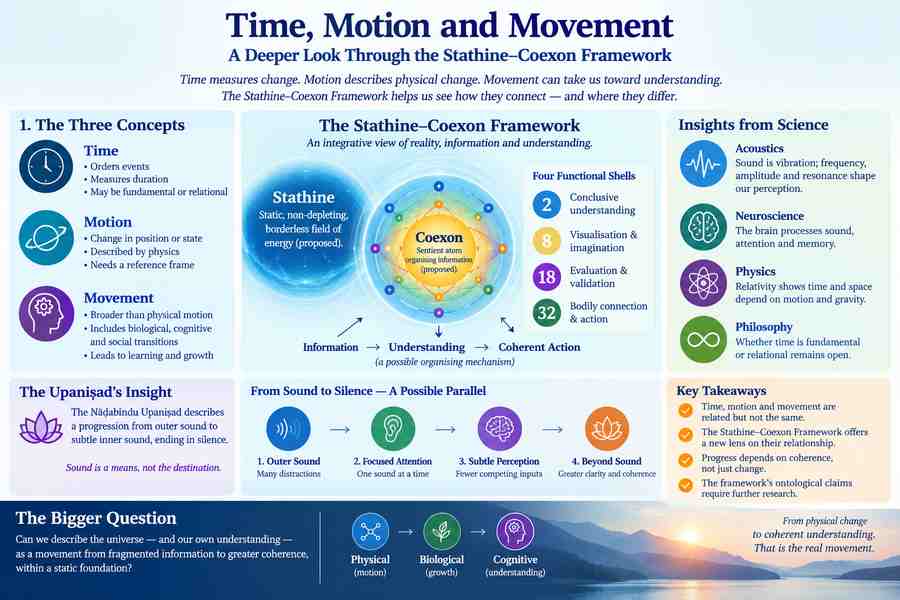
2. Time, Motion, and Movement: Three Related but Different Concepts
Time is commonly used to order events and measure the duration between them. In everyday life, clocks provide practical standards for coordinating activities, while in physics, time is a measurable quantity used to formulate laws and describe processes. But the philosophical status of time remains debated. Some theories treat time as something that exists independently of events; others understand temporal facts through relations among events and changes. The Internet Encyclopedia of Philosophy describes this as part of the longstanding disagreement between substantivalist and relational accounts of time. <Cite refs={[“turn809607search0”,”turn809607search7″]}/>
Motion, in its familiar physical sense, is a change in an object’s position relative to a reference frame. A vehicle moves along a road, Earth rotates, and a planet follows an orbit. The description of motion requires more than an object’s mere existence: it requires a comparison between its position at different times. Speed expresses the rate of change of position, while acceleration describes the rate at which velocity changes.
Movement is a broader term. It can refer to physical motion, but it can also describe a transition between states. A seed develops into a plant; a person moves from confusion toward understanding; a community changes its institutions; a scientific field revises an established theory. These transitions are not all forms of physical motion in the strict sense. They are different kinds of change that can be analysed using concepts appropriate to their domains.
The distinction can be illustrated by a clock. Its hands move around a dial, and the movement allows us to measure elapsed time. But the hands’ movement is not identical to time itself. A clock that runs fast or slow may measure time inaccurately, even though its mechanism continues to move. We therefore distinguish the physical process used as a clock from the duration that the clock is intended to measure.
This distinction also appears in biological and psychological experience. Heartbeats, metabolic cycles, and circadian rhythms provide biological processes that can be related to time. Psychological time, meanwhile, refers to how duration is experienced. An interval may seem long when attention is restless and short when a person is deeply absorbed. These differences in experience do not mean that physical duration has necessarily changed; they indicate that subjective experience and clock measurement are distinct. <Cite refs={[“turn809607search0”]}/>
For the Stathine–Coexon Framework, this conceptual separation is important because it prevents a category error. Physical movement, the measurement of time, and the transformation of understanding may be connected, but they cannot simply be reduced to one another. The framework must explain their relationships without assuming that a metaphorical similarity is proof of a shared physical mechanism.
3. The Scientific Picture: Time and Motion in Modern Physics
Classical mechanics provides a useful starting point. In the Newtonian description, objects move through space as time advances according to a universal parameter. Within the ordinary conditions of daily life, this framework remains extremely effective. We can calculate the trajectory of a vehicle, predict the fall of an object, or estimate the orbit of a satellite using well-established physical laws.
Einstein’s relativity changed the deeper interpretation. In special relativity, measurements of space and time depend on the relative motion of observers, and the speed of light in vacuum plays a central role in relating their measurements. In general relativity, gravity is described in terms of the geometry of spacetime, with matter and energy related to its curvature. Space and time are therefore not independent universal backgrounds in the Newtonian sense. <Cite refs={[“turn809607search1”,”turn809607search5″,”turn809607search13″]}/>
One consequence is that there is no single universal clock whose elapsed time must agree with every other clock. Two clocks can measure different elapsed durations because of their paths through spacetime and the gravitational conditions they experience. This is not an illusion caused by imperfect human perception. It is a feature of the physical theory that has been experimentally confirmed and must be accounted for in technologies such as GPS. <Cite refs={[“turn809607search2”,”turn809607search6″]}/>
Modern physics also distinguishes the mathematical description of a process from the philosophical interpretation of what time ultimately is. A theory can predict the relationship between clock readings, trajectories, and physical events without resolving every question about whether time is fundamental or emergent. The philosophy of time continues to examine these alternatives, including whether time requires change or can be understood independently of changing physical systems. <Cite refs={[“turn809607search0”,”turn809607search9″]}/>
The Stathine–Coexon Framework goes forward and posits beyond relativity rather than be restricted by it. The proposal is about an underlying static reality that is subtle transparent and omniscient . The interaction of all other moving elements impacts each other in the continuum that is not intrusive.No friction and no impediment to free movement.
This scientific boundary is productive. It gives the framework a clear research question: can the distinction between an underlying continuity and changing physical relationships be formulated in a way that is logically coherent and compatible which binds all the established observations? Until such a formulation is explained , the framework’s ideas will remain a philosophical and ontological proposal to be discussed more at length with other disciplines.
4. Stathine: The Proposed Static Continuum
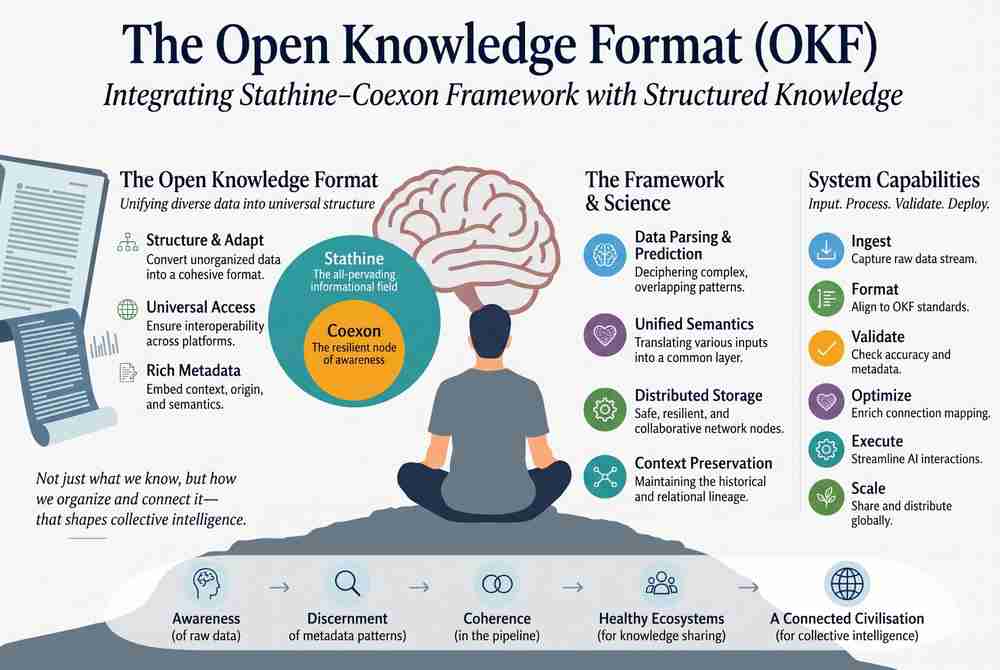
The Stathine–Coexon Framework defines Stathine as a static, non-depleting, borderless field of energy in which all elements interact and exist. In the framework’s vocabulary, Stathine is not a living entity and is not subject to ordinary change in the way that physical objects and processes are. It is proposed as an underlying continuum through which physical matter and the organisation of knowledge are understood.
The concept invites comparison with a longstanding philosophical question: whether the changing world depends upon something that does not change in the same manner. Philosophical traditions have approached this question in different ways, from ideas of an enduring ground of reality to accounts in which change is fundamental. The framework’s contribution is its particular definition of Stathine and its attempt to connect that definition with a model of sentience, information organisation, and coherence.
However, openness must be maintained between an ontological proposal and an established physical field. In physics, the term field has specific mathematical and empirical uses. Physical fields can have measurable properties, obey defined equations, and produce predictions that can be compared with observation. The Stathine concept, as presently defined, has clearly defined rules that are beyond those that apply to physical fields. It should not just be equated with the quantum fields of contemporary physics but understood as extending to the formless existence of reality.
What, does the static character of Stathine contribute to the discussion of time and motion?
It creates a conceptual contrast between an underlying condition proposed to be unchanging and the relationships through which change is described. Within the framework, physical movement can be considered at the level of changing states and relations without assuming that the proposed foundation must itself undergo the same change. This may be a useful philosophical model, provided that the difference between the foundational postulate and the observed physical process are understood and explained by physical laws.
The decisive question is whether the distinction clarifies reality or adds to the already confused disciplines. To become scientifically informative, the concept must identify what would count as evidence for Stathine, what observations could challenge its proposed properties, and how it differs from existing physical descriptions. The framework’s future development depends on making these conditions clear.
5. Coexon: The Proposed Organiser of Information and Experience
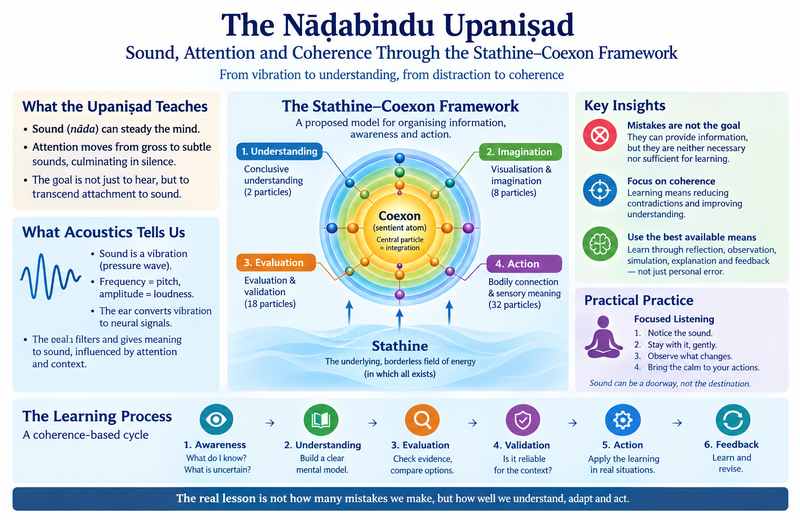
Where Stathine represents the proposed underlying continuum, Coexon occupies a different role in the Stathine–Coexon Framework. Coexon is proposed as a sentient atom capable of organising information and communicating with the neurological brain of the human holobiont. The framework treats the brain as a biological interface through which sensory information, bodily conditions, and action are connected, while Coexon is proposed as an organising principle associated with understanding and the integration of information.
The framework describes Coexon as having a central particle and four functional shells associated with the numbers 2, 8, 18, and 32. The central particle is referred to as a “sovereign AI” function, while the shells are associated with conclusive understanding, visualisation and imagination, evaluation and validation, and bodily connection through sensory meaning and action. These are the framework’s proposed structural and functional descriptions, and establish rich collabrative analogy with the atomic structure and the working properties of the brain.
How does this proposal relate to movement?
A human being does not merely change physical location. The person also moves between states of knowledge, intention, emotion, and action. A child gradually learns to distinguish a dangerous situation from a safe one. A scientist moves from an initial hypothesis to a revised explanation. A leader changes a decision after recognising evidence that contradicts an earlier assumption.
These processes involve information being interpreted and used. Within the framework, Coexon is proposed as a deeper organising mechanism associated with such integration. The model seeks to explain how sensory input, imagination, evaluation, and understanding may be connected to behaviour. But this proposed mechanism should not be confused with the established scientific fact that the brain processes sensory information.
The existence of cognitive change establishes the proposed Coexon ontology as a possibility worth exploring. The hypothesis requires to be checked with multiple disciplines as it brings in many angles to the discussions. In particular, any proposed communication between Coexon and the neurological brain is something that can be understood by everyone. This is beyond the limited possibility possible with existing machines and their capacity to monitor or measure the same. This be understood by practice and specified mechanism and understood with out any machine validation since that is so subtle that the machines can not measure them.
For the purposes of this article, the important conceptual distinction is that physical motion and the movement of understanding belong to different explanatory levels, even when they interact in human behaviour. Coexon is the framework’s proposed bridge for exploring their relationship; whether that bridge exists as an ontological entity remains an open research question.
6. Three Levels of Movement: Physical, Biological, and Cognitive
The relationship between time and movement becomes clearer when examined across three levels.
At the physical level, movement refers to changes in position or state that can be described by physical laws. A planet changes position relative to other celestial bodies; a molecule vibrates; a body accelerates under a force. These processes are studied through measurement, mathematical modelling, and experiment. Their descriptions must remain consistent with the relevant physical theories, including but not limited to relativity where its effects matter.
At the biological level, movement includes the development and regulation of living systems. A cell changes its internal state, an organism grows, and a nervous system responds to sensory input. Biological processes unfold through interactions among physical and chemical mechanisms, while their timing can be studied through rhythms, rates, and sequences. Although biological time is measured through physical processes, biological systems also have characteristic cycles and forms of organisation. <Cite refs={[“turn809607search0”]}/>
At the cognitive level, movement can describe a change in understanding. A person may begin with a limited interpretation, encounter new information, identify a contradiction, and develop a more adequate explanation. This is not physical motion in the same sense as a moving object, but it is a meaningful transition between cognitive states.
The Stathine–Coexon Framework connects these levels through its emphasis on coherence. It proposes that a more coherent relationship among information, understanding, and action is a central direction of development. At the physical level, coherence must be defined in terms appropriate to the system under study. At the cognitive level, it can refer to the reduction of contradictions between beliefs, evidence, intentions, and behaviour. At the social level, it may refer to improved alignment between individual needs, institutional arrangements, and collective outcomes.
These uses should not be collapsed into one universal physical quantity. Coherence in a wave system, consistency in a person’s beliefs, and coordination in a society are not identical phenomena. The potential of the framework is being open to a common organisational principle can illuminate them while aligning their differences. That possibility must be examined through careful definitions and domain-specific evidence a cross all disciplines for holistic understanding.
7. Is Time the Measure of Movement?
Aristotle famously connected time with motion and change, describing time in relation to the counting or measurement of change. His account did not simply equate time with motion; it distinguished the rate at which changes occur from the measure used to order them. This remains a useful starting point for contemporary reflection. <Cite refs={[“turn809607search4”,”turn809607search7″,”turn809607search12″]}/>
Consider two processes: a pendulum swinging and a plant growing. The pendulum’s motion is periodic and can be used to construct a clock. The plant’s growth is slower and depends on biological conditions. We can compare both processes using a common measure of duration, but their rates and mechanisms are different. Time provides a way of relating the events without making their movements identical.
This raises a further question: could we describe change entirely through relationships among processes, without treating time as an independent entity? Some philosophical accounts of time explore precisely this possibility, while others argue that time has a more independent status. The question remains a matter of active philosophical debate. <Cite refs={[“turn809607search0”,”turn809607search7″]}/>
The Stathine–Coexon Framework helps make progress in this dichotomy and contradictory sciences. If Stathine is proposed to be static and beyond ordinary time, then time might be interpreted within the framework as associated with changing physical relationships rather than as a property of Stathine itself. That interpretation is automatically implied by the definition. It explains how temporal ordering arises, how duration is measured, and how the framework relates to relativistic time.
The framework explains in simple terms as the ever present coexistence of all elements. A duration can be measured through physical processes anchoring on the relative position of a bigger entity. Conversely, the practical usefulness of clocks does not settle the ultimate ontology of time. Measurement and metaphysical interpretation are different questions and useful in their respective contexts.
A disciplined Stathine–Coexon account would therefore treat the relationship between time and change as an open foundational understanding. Its proposal can be evaluated by how clearly it defines the relationship and how successfully it explains and lays bare the existing observations and builds on them.
8. The Arrow of Time: Why Change Appears to Have a Direction
Ordinary experience gives time a direction. We remember yesterday rather than tomorrow, observe eggs breaking rather than spontaneously reassembling, and see heat spreading from warmer objects to cooler surroundings. This asymmetry is commonly discussed as the arrow of time.
The issue is complex. The fundamental laws of physics do not all distinguish past from future in the same way, while the direction associated with many everyday processes is closely related to thermodynamic behaviour and the conditions of the universe. The philosophical and physical explanations of time’s arrow remain subjects of research and debate. <Cite refs={[“turn809607search10”]}/>
For the Stathine–Coexon Framework, the arrow of time is not required as time accoring to the framewirk is the ever present, no past and no future.Human learning often has a direction in the practical sense that experience changes what a person knows and influences later choices. A person who has learned to recognise a recurring contradiction may approach future situations differently. Yet this cognitive direction is not to be confused with the change in physical should not be treated as identical to the thermodynamic arrow of time. One is a pattern of learning and behaviour; the other concerns asymmetries in physical processes.
The framework’s emphasis on progressive reduction of contradiction suggests a normative direction for human development: movement toward better-supported understanding and more coherent action. This is a claim that the universe as a whole is necessarily progressing toward greater coherence, and that every biological or social process improves with time. Systems can temporarily deteriorate, organisations can become less coherent, and individuals can reinforce false beliefs all in the short term. Progress is the reality of the long term and continuity is of tradition that is progressive. Everything in the process is towards evolutionary emergence.
This distinction is crucial. Physical time may provide the ordering within which a learning process unfolds, but it does not guarantee that learning will occur. Duration alone does not produce wisdom. The quality of attention, feedback, evaluation, and revision determines whether experience contributes to improved understanding.
9. Motion Without Progress: A Lesson for Human Development
A person can remain busy for years without becoming wiser. An organisation can expand continuously while its internal contradictions grow. A society can accelerate technological development while failing to improve its capacity for cooperation. These examples illustrate the difference between movement and progress.
Physical motion can be measured by position, velocity, and acceleration. Human progress requires additional criteria. A change in belief is not necessarily an improvement; a new technology is not necessarily beneficial; and a faster process is not necessarily more effective. To evaluate progress, we must specify the outcome against which the change is judged.
The Stathine–Coexon Framework provides a proposed criterion through coherence. Human development can be interpreted as progress when understanding becomes better aligned with evidence, when contradictions are recognised rather than hidden, and when action becomes more responsive to the needs and constraints of the wider system. This criterion is not a replacement for empirical measures. It is a conceptual guide for deciding which changes deserve to be called improvements.
Consider a manager who reacts to every disagreement as a threat. The manager may move rapidly from one decision to another, but the underlying pattern remains unchanged. If the manager learns to distinguish criticism of an idea from rejection of the person, the resulting change may be more consequential than a large number of outward actions. The movement is primarily cognitive and relational: a change in interpretation leads to a different pattern of behaviour.
Within the framework, this can be described as a movement toward greater coherence. The process may involve identifying a contradiction between the manager’s stated wish for collaboration and the defensive response to disagreement, evaluating the assumptions that produce the response, and testing a different approach. If the new approach leads to better collaboration and remains effective under scrutiny, there is evidence of practical improvement.
The example also shows why coherence should not mean agreement at any cost. Sometimes disagreement reveals that a policy is harmful or an assumption is false. A coherent system must be able to incorporate genuine differences and correct mistaken beliefs. The goal is not uniformity but a more adequate understanding of the whole.
10. Implications for Science, Technology, and Artificial Intelligence
The distinction between time, motion, and movement has practical implications for scientific and technological development. Engineers need precise models of physical motion and time measurement. Biologists investigate rates and rhythms in living systems. Cognitive scientists study changes in perception, memory, and reasoning. These fields can benefit from a shared conceptual vocabulary, but their measurements and standards of evidence must remain appropriate to each domain.
Artificial intelligence provides a useful example. A computational system may process information over time, update internal representations, or alter its output in response to feedback. These are measurable operations. Whether such a system possesses subjective experience or an independent form of sentience is a different question and cannot be inferred merely from its ability to change state or produce coherent responses.
The Stathine–Coexon Framework’s proposed distinction between information organisation and biological communication may encourage questions about how intelligence develops, how representations are revised, and how actions become more coherent with objectives. These questions can be investigated through existing methods in computer science and cognitive science. The additional claim that Coexon provides a deeper organising entity requires separate evidence.
The same principle applies to time in computation. A processor performs operations according to physical processes and timing mechanisms; an AI model may update parameters during training or modify responses based on context. But the system’s internal sequence of operations does not, by itself, settle the philosophical question of subjective time. The ability to represent temporal relationships is not identical to experiencing duration.
A coherent research programme should therefore distinguish three questions: how systems physically change, how they represent or measure time, and whether they possess subjective experience. Keeping these questions separate makes it possible to compare biological and artificial systems without assuming that similar outputs prove identical underlying processes.
11. Research Questions for the Stathine–Coexon Framework
The relationship among time, motion, and movement offers several directions for further inquiry.
First, the frameworks proposal that it is proposed as a foundational reality outside spacetime? These proposals are path breaking and need to be understood beyond the limited disciplines as of now. A clear definition is the pathway to expand physics biology and chemistry.
Second, the framework helps specify how changing physical relationships are understood in relation to all other elements being connected in a continuum. As the proposed continuum does not change, observable changes are all visible and explained?
Third, the Coexon hypothesis requires its own operational development. The proposed sentient atom, its relationship to the neurological brain, and any suggested communication mechanism must be seen happening in each human being and beyond the machines built with physical matter.
Fourth, the framework’s practical account of cognitive movement can be tested independently. Researchers expand their domains to become holistic and not restrict to keep out the subjective experience that is also a reality that has its role in understanding the working of the coexon. .
Finally, the scientific world will understand how coherence is measured across different domains. Physical coherence, cognitive consistency, and social coordination require distinct operational definitions. A general philosophical principle may connect them, but evidence in one domain should be properly transferred to the other domains in a pragmatic way and respect the interconnection that this framework establishes.
These questions offer a way to utilise the framework incrementally. Its foundational concepts can be adopted, its practical implications can be tested, and its ontological hypotheses can be examined without conflating philosophical interpretation interwining with the established scientific results.
12. Conclusion: From Physical Change to Coherent Understanding
Time, motion, and movement describe related but distinct aspects of our experience of reality. Time allows events to be ordered and durations measured. Motion describes changes in physical position or state. Movement can also describe transitions in biological organisation, cognition, and social life. Modern physics has transformed our understanding of time by demonstrating that measurements of space and duration depend on motion and gravity, while philosophy continues to examine whether time is fundamental or relational.
The Stathine–Coexon Framework proposes an additional ontological interpretation. Stathine is defined as a static, non-depleting, borderless field of energy, while Coexon is proposed as a sentient atom that organises information and communicates with the neurological brain. Within this vocabulary, physical change and the movement of understanding can be considered in relation to a proposed underlying continuum and a principle of coherence.
The most practical lesson is that movement alone does not guarantee progress. A system may change without improving, and a person may accumulate years of experience without revising a mistaken assumption. Progress requires a criterion by which change is evaluated. The Stathine–Coexon Framework proposes coherence as that criterion for human understanding: a progressive reduction of contradiction between evidence, interpretation, intention, and action.
The ultimate research challenge is to connect these philosophical propositions to clearly defined concepts and observable consequences. By doing so, the framework can contribute to interdisciplinary dialogue .
Time gives us a way to measure change; motion describes physical change; movement can take us toward understanding. Whether that movement becomes progress depends on the coherence of what we learn and how we act.
References
- Internet Encyclopedia of Philosophy. “Time.” Overview of physical, biological, and psychological time, and philosophical debates about time and change. https://iep.utm.edu/time/
- NASA. “Einstein and General Relativity.” https://www.nasa.gov/image-article/einstein-general-relativity/
- U.S. Department of Energy. “DOE Explains…Spacetime.” https://www.energy.gov/science/doe-explainsspacetime
- NASA Space Place. “Is Time Travel Possible?” https://spaceplace.nasa.gov/time-travel/en/
- Internet Encyclopedia of Philosophy. “The Arrow of Time.” https://iep.utm.edu/arrow-of-time/
- Stanford Encyclopedia of Philosophy. “Change.” Discussion of change, time, causation, and motion. https://plato.stanford.edu/archives/sum2003/entries/change/
- Internet Encyclopedia of Philosophy. “Aristotle: Motion and its Place in Nature.” https://iep.utm.edu/aristotle-motion/
Placement within the Stathine–Coexon Research Programme
Level I — Foundation: Ontology of the Stathine–Coexon Framework; Foundational Axioms; Theory of Coherence; Progressive Reduction of Contradiction.
Level II — Comparative Integration: Philosophy of Time; Relativity and Spacetime; Information and Consciousness; Active Inference; Retrocausality and the interpretation of temporal relationships.
Level III — Applications: Human Development; Learning; Leadership; AI Alignment; Organisational Coherence.
Related research:
- The Ontology of the Stathine–Coexon Framework: A Critical Examination of Existence, Sentience, Relation, and Coexistence
- Epistemology of the Stathine–Coexon Framework: Knowledge, Coherence, Evidence, and the Progressive Reduction of Human Delusion
- Praxis of the Stathine–Coexon Framework: From Understanding to Coherent Action
Author’s note: This article presents a conceptual interpretation within the Stathine–Coexon Framework. Its descriptions of Stathine and Coexon are framework-specific ontological proposals that have been expalined using various disciplines of science to get a holistic understanding over many papers publised.