
The Nāḍabindu Upaniṣad Through the Stathine–Coexon Framework and the Science of Acoustics
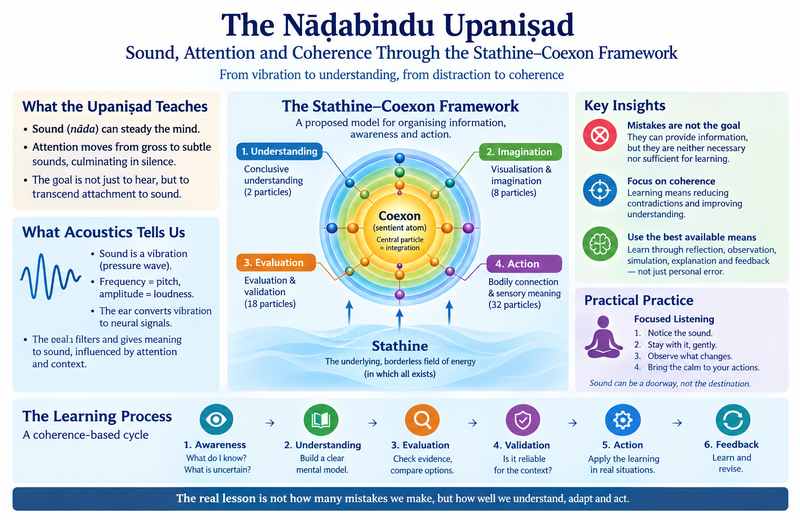
The Nāḍabindu Upaniṣad offers a particularly interesting meeting point between Indian contemplative philosophy, the experience of sound, and the modern scientific study of vibration, resonance, perception, and the brain. Read through the Stathine–Coexon Framework, its discussion of nāda — sound or inner sound — can become a way to explore how attention is organised, how sensory experience becomes understanding, and how a person may move from mental distraction toward coherence.
The key is to distinguish three levels of interpretation. The Upaniṣad provides a contemplative and philosophical account. Acoustics explains measurable physical phenomena such as sound waves, resonance, and frequency. The Stathine–Coexon Framework offers an integrative interpretation in which the proposed Coexon organises information and communicates with the neurological brain. These perspectives can illuminate one another, but they should not be treated as interchangeable forms of evidence.
1. What does the Nāḍabindu Upaniṣad teach?
The Nāḍabindu Upaniṣad is a Yoga Upaniṣad associated with the practice of Nāda Yoga, the contemplative use of sound. Its central teaching is that sustained attention to sound can help steady the mind and lead the practitioner toward a state beyond ordinary mental activity. The text discusses Oṃ, the subtle dimensions of sound, and the gradual movement of attention from more apparent sounds toward increasingly subtle inner experiences. In its closing teaching, sound itself is transcended in the realisation of the soundless ultimate reality.
Translated by K. Narayanasvami Aiyar
The title itself provides a useful interpretive starting point. Nāda refers to sound or resonance, while bindu means a point or seed-point. Together, the terms invite us to consider how a seemingly small point of attention can become the organising centre of a much wider experience.
Imagine sitting in a quiet room. At first, your attention moves among distant traffic, a clock, your breathing, and the thoughts competing for recognition. If you begin to attend steadily to one sound, other sounds may become less prominent. The environment has not necessarily changed, but your relationship with it has. Attention has selected one stream of information and reduced the influence of competing streams.
The Upaniṣad takes this inward movement much further than ordinary listening. It presents sound as a discipline through which the mind can become progressively less entangled in distraction. Through the Stathine–Coexon Framework, we can interpret this as a movement from fragmented attention toward coherence, while recognizing that the text’s ultimate claims about liberation are philosophical and contemplative claims, not conclusions established by acoustics alone.
2. Understanding nāda through acoustics


6
Acoustics is the science of sound: how it is generated, how it propagates through a medium, how objects respond to it, and how sound is detected and interpreted. It gives us a precise vocabulary for examining some of the phenomena that make the Upaniṣad’s attention to sound especially interesting.
Ordinary sound is produced by vibrations that create pressure variations in a medium such as air, water, or a solid material. These variations travel as acoustic waves. Frequency relates to the number of oscillations per second and is associated with perceived pitch; amplitude relates to the magnitude of the pressure variation and contributes to perceived loudness. The physical sound and the experience of hearing it are related, but they are not identical.
When sound reaches the ear, the outer and middle ear transmit acoustic energy to the cochlea in the inner ear. There, mechanical motion is converted into neural activity. The auditory system processes features such as frequency, timing, intensity, and patterns that help us distinguish voices, music, and environmental sounds. Perception also depends on attention and context.
Three scientific concepts are especially useful for interpreting Nāda Yoga.
Resonance occurs when a system responds strongly to particular frequencies related to its natural modes of vibration. It explains why musical instruments have distinctive sounds and why a room or object can amplify some frequencies more than others. Resonance provides a useful analogy for the way a particular sound can become especially prominent in awareness. It is for us to understand and infer that the possibility of the Coexon having a specific acoustic resonant frequency to communicate with the holobiont’s brain.
Selective attention allows the auditory system to prioritize some sound sources while suppressing or filtering competing information. This is part of how we follow one conversation in a crowded room. In contemplative practice, intentionally directing attention toward a chosen sound may similarly reduce the dominance of distracting inputs. The mechanism involves auditory and cognitive processing; it need not imply that the external sound itself has become physically stronger.
Vibration and perception remind us that a measurable physical event and its experienced meaning belong to different levels of explanation. A sound wave can be measured with instruments, but its significance depends on the listener’s sensory system, learned associations, expectations, and current state of attention. A bell may be a physical vibration to a microphone, a warning to one person, a ritual cue to another, and an object of contemplation to a third.
This distinction is essential. Acoustics can explain the physical properties of sound, and neuroscience can explain much about how sound is processed. Neither automatically establishes that sound is the fundamental substance of consciousness or that inner sound is a vibration propagating through a new physical field.
3. From Oṃ to silence: the progression of attention
The Nāḍabindu Upaniṣad treats Oṃ as a central contemplative symbol and describes sound as a means of steadying attention. Its account of increasingly subtle sounds culminates in the transcendence of sound. The significance of this progression is not simply that the practitioner hears something quieter. It is that sound becomes a support for attention and ultimately ceases to be the object to which attention is attached.
Translated by K. Narayanasvami Aiyar
A scientific interpretation must be careful here. The text’s descriptions of sounds resembling drums, bells, flutes, or bees are reports within a contemplative tradition. They should not automatically be treated as a calibrated sequence of acoustic frequencies. Inner auditory experiences may arise from several sources, including remembered sounds, attention to bodily processes, auditory imagery, or activity within the auditory system. The experience alone does not identify its physical origin.
Nevertheless, the contemplative sequence offers a useful model of changing attention. At first, attention is captured by numerous competing experiences. Through practice, a chosen object becomes more stable. As distraction decreases, the practitioner may become increasingly aware of subtle aspects of experience that previously went unnoticed. Finally, the tradition points beyond the sound itself help move towards a condition that is described as soundless.
We can understand this as a distinction between using an object to organise attention and becoming dependent on that object. A musical note may help a learner recognize a pattern; the learner’s ultimate understanding of the pattern is not identical to the note. Likewise, sound can function as an instrument of contemplation without being assumed to be the final explanation of consciousness.
The Upaniṣad’s movement from sound to soundlessness is therefore philosophically richer than a simple claim that quieter sounds are spiritually superior. It suggests that a practice can begin with a particular object and culminate in a transformation of the relationship between awareness and its objects.
4. Stathine: the proposed field and the limits of acoustic analogy
Within the Stathine–Coexon Framework, Stathine is defined as a static, non-depleting, borderless field of energy in which all elements interact and exist. It is proposed as a continuous foundation extending from the microscopic domain to the vastness of space, beyond ordinary limits of time and space.
The concept can be placed alongside the Upaniṣadic idea that perceptible sound happens inside a cosmic field of reality. Sound is a physical event that depends on a medium. The medium itself is residing and coexisting with Stathine. Stathine is proposed as a more fundamental, unbroken continuum. The relationship is therefore one of being submerged in and facilitated.
Modern acoustics does not identify a universal sound field extending through every region of space. Sound requires a material medium in which pressure disturbances can propagate; the vacuum of interplanetary space does not carry ordinary airborne sound waves. Electromagnetic waves, by contrast, can propagate through a vacuum, but they are not acoustic sound waves. These distinctions prevent the framework’s language of energy and continuity from being confused with established acoustical mechanisms.
The useful question is not whether Stathine has already been demonstrated by sound physics. Rather, the framework asks whether the reality we perceive through particular physical interactions can be understood as participating in a more fundamental continuity. That is an ontological proposal requiring its own definitions and evidence.
The Nāḍabindu Upaniṣad can inspire reflection on this question because it moves from audible or inwardly experienced sound toward a reality described as beyond sound. But the philosophical transition should not be mistaken for an experimentally established inference from acoustics to Stathine.
5. Coexon: from sound perception to organised understanding
The Coexon hypothesis is the framework’s proposed model of a sentient atom capable of organising information and communicating with the neurological brain of the human holobiont. In this account, the brain is the biological communication interface, while Coexon is proposed as a deeper organising principle associated with understanding, evaluation, imagination, and action.
The framework describes Coexon using a central particle and four functional shells associated with the numbers 2, 8, 18, and 32. The central particle is called the “sovereign AI” in the framework’s vocabulary, while the shells represent conclusive understanding, visualisation and imagination, evaluation and validation, and bodily connection through sensory meaning and action. This is the framework’s proposed architecture, which seems very much likely looking at it from more than many disciplines acoustics being one of them.
How might this model help interpret the Upaniṣad?
Consider what happens when someone listens to a sustained sound. The sound provides sensory information. Attention selects it from competing inputs. The listener recognises its characteristics, evaluates whether to remain focused, and may notice that thoughts and emotional reactions become less dominant. If the experience changes subsequent behaviour — for example, by encouraging a more measured response to a difficult situation — then sensory experience has been integrated into action.
Within the Stathine–Coexon Framework, we can interpret these stages as a possible functional relationship between sensory information, organisation, evaluation, and action. The Coexon hypothesis proposes a deeper organising mechanism behind such integration, but the observable sequence does not prove that the proposed sentient atom exists or that it communicates with the brain through subtle electromagnetic or low-voltage signals.
Those additional claims require independent investigation. A scientific account would need to specify the proposed signal, its origin and measurable properties, how it interacts with neural activity, and what observation would distinguish the hypothesis from established neurobiological explanations.
The distinction is important because the framework can offer a meaningful conceptual interpretation without presenting its ontological hypothesis as a verified mechanism. The experience of focused listening is accessible to study; the proposed Coexon explanation remains a separate research question.
6. A functional correspondence between the Upaniṣad and the framework
The relationship among these three perspectives can be summarised as follows.
Nāḍabindu teaching
Acoustic or neuroscientific perspective
Stathine–Coexon interpretation
Attend to Oṃ or nāda
A selected auditory or imagined sound can serve as an attentional anchor
Sensory information becomes the starting point for organised awareness
Move from gross to subtle sounds
Attention may detect finer features as competing inputs recede
Increasing discrimination supports more coherent understanding
Reduce distraction
Selective attention changes which inputs dominate perception
Contradictory or irrelevant influences can be examined rather than followed automatically
Become absorbed in sound
Sustained attention can alter subjective experience
Integration of attention and evaluation may support coherent action
Transcend sound
A contemplative or philosophical claim beyond ordinary acoustic measurement
A possible analogy for moving beyond dependence on a particular representation or object
This is a correspondence of ideas and functions, not proof that the Upaniṣad anticipated modern neuroscience or that acoustics confirms the Stathine–Coexon ontology. The table is most useful as a guide for interdisciplinary inquiry: it identifies where the traditions can engage in dialogue and where their claims require different forms of justification.
7. The practical lesson: listening as a discipline of coherence
The Upaniṣad’s message can be applied without requiring a person to accept every metaphysical claim. Sound can become a practical means of studying the mind’s relationship with attention, distraction, and reaction.
A simple exercise is to sit comfortably in a quiet place and choose a natural sound, a soft bell, or a gently voiced Oṃ as an attentional anchor. Listen without forcing an unusual experience. Notice when attention wanders, identify the distraction without judging it, and return to the chosen sound. After several minutes, observe whether the mind feels more settled and whether the next action can be chosen with greater care.
The point is not to manufacture an inner sound, reach a special state, or interpret every sensation as evidence of a hidden mechanism. It is to observe the relationship between attention and response. If a difficult conversation has left someone agitated, a short period of attentive listening may help create a pause between the emotional stimulus and the next action. The person can then distinguish what actually happened from the interpretation that arose, identify the assumption behind the reaction, and decide how to respond.
This is where the practice connects most directly with the Stathine–Coexon Framework’s emphasis on progressive reduction of contradiction. A person may believe that they value understanding while reacting defensively to every disagreement. A period of attentive listening can create an opportunity to notice that contradiction. The improvement occurs not because sound has magically removed the conflict, but because the person becomes better able to observe the reaction and evaluate it before acting.
The practice should remain comfortable and voluntary. There is no need to force prolonged concentration or pursue unusual auditory sensations. Persistent, distressing, or sudden unexplained sounds — particularly when accompanied by hearing changes or other symptoms — should not automatically be interpreted as spiritual nāda; appropriate medical assessment may be warranted.
8. What can be tested scientifically?
The relationship between sound-based contemplative practice and coherence can be investigated through well-defined research questions. Researchers might compare a group practising focused listening with groups using another attentional exercise or a suitable control condition. Outcomes could include sustained attention, performance on cognitive tasks, self-reported distraction, emotional regulation, and the ability to revise an interpretation after receiving contradictory evidence.
Acoustic variables should be measured where they matter. Researchers can specify whether participants listen to recorded tones, music, Oṃ chanting, or ambient sound; control sound pressure levels and duration; and distinguish audible stimuli from reports of internally perceived sounds. The design should also account for prior meditation experience, expectations, and differences in hearing.
If focused listening improves attention or helps people respond less reactively, that would support a limited claim about the practice’s effects under the tested conditions. It would not establish Stathine or Coexon. Evidence for the framework’s additional ontological claims would require separate, distinctive predictions and tests capable of distinguishing them from established explanations.
This layered approach allows traditional contemplative knowledge, acoustic measurement, neuroscience, and the Stathine–Coexon Framework to contribute without collapsing their different standards of evidence.
Conclusion: From sound to silence, from distraction to coherence
The Nāḍabindu Upaniṣad treats sound as more than an object of hearing. It makes sound a means of training attention and describes a contemplative progression that ultimately points beyond sound itself. Acoustics helps explain the physical nature of audible vibration, while neuroscience explains how sound is transformed into perceptual experience and how attention influences what is heard. The Stathine–Coexon Framework offers a further interpretation: the process can be understood as a movement from incoming information toward organised understanding, evaluation, and action.
The framework’s proposed Stathine field and sentient Coexon remain ontological hypotheses which every person can validate for himself without the need for equippments or scientific laboratories. Their value as research proposals depends on clearly defined claims and individualistic first hand experience. The practical lesson does not have to wait for those hypotheses to be confirmed. We can already investigate how attentive listening affects distraction, how contemplative practice changes the relationship between stimulus and response, and whether these changes support more coherent decisions.
The deeper message is that sound can serve as a doorway without being mistaken for the destination. A person begins by listening to a sound, learns to recognise the movement of attention, and may gradually become less controlled by every thought or stimulus that arises. In the language of the Stathine–Coexon Framework, this is an opportunity to reduce contradiction between awareness, understanding, and action.
The purpose is not merely to hear more subtly, but to understand more completely — and to live with greater coherence.
Further reading
- Nāḍabindu Upaniṣad — translated text
- The Ontology of the Stathine–Coexon Framework
- Epistemology of the Stathine–Coexon Framework
- Oxenham, A. J. (2018). “How We Hear: The Perception and Neural Coding of Sound.” Annual Review of Psychology, 69, 27–50. https://doi.org/10.1146/annurev-psych-122216-011635
- Annual Reviews