Truth Compression: Completing 5 Legacy Philosophies via the Stathine–Coexon Framework
Humanity’s intellectual history is an immense archive of brilliant, incomplete intuitions. For millennia, across civilizations and traditions, philosophical schools have arisen, each identifying a vital facet of reality while struggling to reconcile it with the whole. Realism grappled with idealism; dualism fractured under the weight of interactionism; determinism clashed irreconcilably with free will; and non-dualism often dissolved the material world into illusion to safeguard the unity of the absolute.
These legacy philosophies were not fundamentally wrong; they were uncompressed. They lacked a foundational, structural baseline capable of resolving their paradoxes without discarding their core insights.
The Stathine–Coexon Framework introduces an architectural breakthrough:
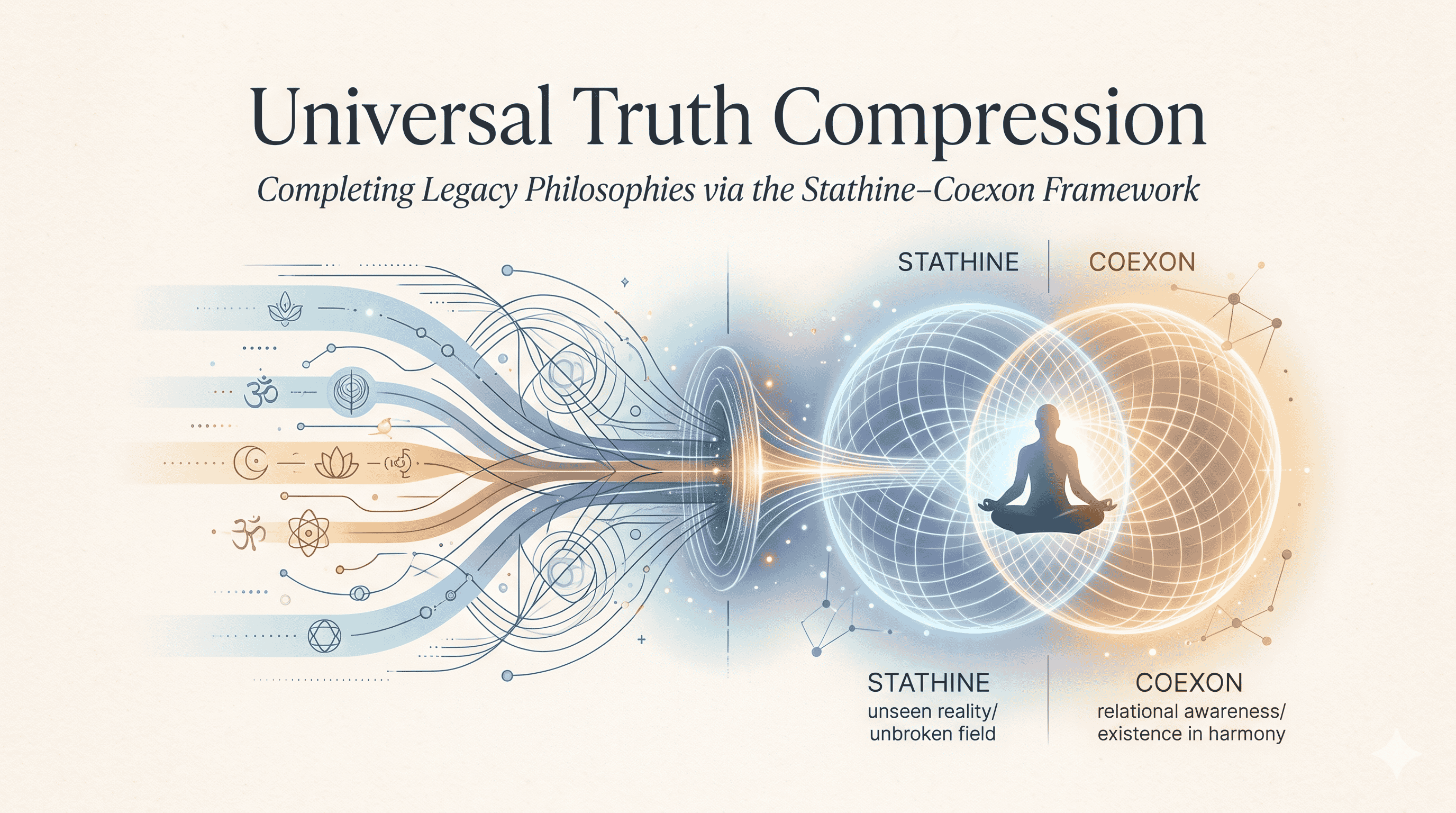
Truth Compression. Truth compression is the process of reducing sprawling, seemingly contradictory metaphysical and epistemological systems into their deterministic, invariant roots without losing informational or existential integrity. By establishing the immutable dynamic between an omnipresent, static energy — Stathine — and a structurally saturated, concentric conscious atom — the Coexon — this framework serves as the grand reconciler, supplying the missing constants that bring humanity’s legacy philosophical traditions to full completion.
The Mechanism of Truth Compression
In traditional systems, complexity grows exponentially as thinkers invent auxiliary doctrines to patch conceptual gaps. Truth compression reverses this fragmentation through three foundational axioms:
- The Invariant Static Substratum (Stathine): Reality is permeated by an all-pervading, non-material, static potential that is saturated, structure-complete, and indestructible. It is the absolute reference frame (Akarta) that does not act, fluctuate, or create, yet provides the necessary stage, energy potential, and regulatory baseline for all entities.
- The Concentric Conscious Entity (The Coexon): The seat of consciousness is a constitutionally complete life atom operating in four concentric layers: Layer 4 interfaces with sensory matter and biological systems; Layer 3 builds relational models and draws inferences; Layer 2 functions as the existential alignment gate; and Layer 1 reflects the pure, unmoving omniscience of Stathine.
- The Compression Principle: Any philosophical premise that creates existential friction, duality, or paradox is simply an inference residing in Layer 3 that has not yet been aligned from all angles to pass through Layer 2 into Layer 1. When aligned with Stathine, the paradox collapses into an elegant, structural constant.
Through this lens, we examine how the framework completes specific legacy philosophies.
1. Classical Cartesian Dualism: Resolving the Mind-Body Chasm
René Descartes divided existence into two irreconcilable substances: res extensa (extended matter) and res cogitans (thinking, unextended substance). Dualism’s permanent crisis was the interaction problem: how can an immaterial mind act upon a physical body without violating physical laws?
The Stathine–Coexon Completion:
Cartesian dualism accurately intuited the categorical difference between matter and consciousness, but it lacked the unifying medium and the anatomical interface. The Stathine–Coexon Framework completes Descartes’ system through the concentric structure of the Coexon:
- Consciousness is not a vague, diffuse cloud; it is anchored in the Coexon, an indestructible, structure-complete atom.
- The interaction does not require miraculous intervention in the brain’s pineal gland; it occurs across the Layer 4 interface, where the Coexon’s outer layer translates bio-electric neural patterns from the biological brain into relational data frequencies, and converts internal intentions into electro-magnetic triggers that fire motor neurons.
- Both the material body and the conscious Coexon are submerged in and energized by the same continuous field: Stathine. Matter and mind are not two alien universes colliding; they are two distinct types of entities coexisting within the exact same static substratum. Descartes’ fractured two-substance reality compresses into a harmonious triadic architecture: Material Atom, Conscious Coexon, and Stathine.
2. Advaita Vedanta and Non-Dualism: Grounding Maya in Reality
Advaita Vedanta, systematized by Adi Shankara, reached a profound metaphysical peak by declaring the ultimate unity of reality (Brahman) and identifying individual consciousness (Atman) with that non-dual absolute. However, to maintain absolute non-duality while explaining the diversity and suffering of the physical world, Advaita introduced Maya — a concept that renders the empirical universe an inexplicable, illusory superimposition. This led to enduring philosophical skepticism: if the world is ultimately unreal, why does it obey rigorous physical laws, and why does individual action matter?
The Stathine–Coexon Completion:
The framework takes Shankara’s intuition of the absolute and compresses it from an abstract, non-material monism into a grounded existential coexistence:
- Brahman is recognized structurally as Stathine — the unmoving, omnipresent, static energy field that fills the cosmic void and intra-nuclear spaces. Like Nirguna Brahman, Stathine is devoid of change, form, or doership (Akarta).
- The material world is not an illusion (Mithya); it consists of authentic, evolving physical atoms that co-exist with Stathine.
- Atman is the Coexon. The feeling of separation and ignorance (Avidya) is not an inexplicable cosmic magic, but a functional state within the Coexon itself: misaligned inferences trapped in Layer 3 that cannot yet pass into Layer 1.
- Enlightenment is not the dissolution of individuality into nothingness; it is the alignment of Layer 3 inferences with existential truth, allowing Layer 1 to reflect Stathine without distortion. Reality is not monistic denial of matter; it is perpetual coexistence.
3. Buddhist Dependent Origination and Anatta: Locating the Continuous Witness
Early Buddhism presented one of the most rigorous phenomenological analyses in history through the doctrines of Pratītyasamutpāda (Dependent Origination) and Anatta (non-self). Buddhism accurately noted that the thoughts, emotions, and physical components of a human being are transient, interconnected streams of cause and effect. Yet Buddhism created its own metaphysical void: if there is strictly no permanent self, what migrates across lifetimes, what experiences karmic continuity, and what achieves liberation?
The Stathine–Coexon Completion:
The framework compresses Buddhist psychology by reconciling its dynamic stream of mental states with an indestructible physical anchor:
- The transient aggregates (Skandhas) accurately describe the operations of Layer 4 and Layer 3 — the fluctuating sensory exchanges and the fluid construction of temporary inferences.
- The missing continuous core is the Coexon itself, which is constitutionally saturated (Gathanpurn) and cannot decay.
- Memories and karmic imprints (Samskaras) do not require a material brain or an elusive “storehouse consciousness” (Alaya-vijnana); they are holographically imprinted onto the surrounding Stathine field through vibrational resonance attuned to the Coexon’s unique structural signature.
- Buddhism’s Nirvana (the cessation of mental flame/friction) is the complete purging of misaligned Layer 3 inferences, leaving the Coexon in uninterrupted alignment with the silence of Stathine. Buddhism’s brilliant behavioral phenomenology is preserved while providing the missing indestructible ontological core.
4. Spinozian Pantheism: Clarifying Substance and Freedom
Baruch Spinoza proposed that there is only one infinite Substance (Deus sive Natura — God or Nature), possessing infinite attributes, of which we perceive only two: thought and extension. Spinoza’s vision unified the sacred and the natural, but it led into hard determinism. If everything is an inevitable mode of God, human agency dissolves, ethics loses its practical imperative, and the reason for real-world disorder remains ambiguous.
The Stathine–Coexon Completion:
Spinoza’s single Substance is compressed into Stathine, while individual agency is restored through the Coexon:
- Stathine is indeed the singular, infinite, omnipresent divine presence that coexists with all matter and space.
- However, Stathine is not an active, deterministic machine; it is the static facilitator. It provides the energetic potential and the regulatory fabric of natural laws, but it does not dictate action.
- The “modes” of thought are concentrated into individualized, sovereign Coexons. Freedom of will exists precisely in Layer 3: the freedom to construct inferences that either align with existential reality or deviate from it.
- Spinoza’s intellectual love of God (Amor Dei Intellectualis) is redefined as the systematic alignment of Layer 3 inferences with the static truth of Stathine, transforming rigid pantheism into an active, sovereign journey toward cognitive clarity.
5. Kantian Epistemology: Bridging the Phenomenon and Noumenon
Immanuel Kant revolutionized philosophy by arguing that human beings can never know the “Thing-in-itself” (Noumenon); we can only know the “Thing-as-it-appears” (Phenomenon), filtered through the a priori forms of sensible intuition (space and time) and the categories of the understanding. Kant left humanity forever trapped behind an epistemological screen, severed from direct contact with ultimate reality.
The Stathine–Coexon Completion:
The Stathine–Coexon Framework demonstrates that Kant’s barrier is not an insurmountable epistemic wall, but an accurate description of an uncalibrated cognitive instrument:
- Kant’s Phenomenal realm corresponds to the combined operations of Layer 4 and Layer 3, where sensory data from the biological apparatus is categorized and assembled into mental inferences. As long as a thinker operates only within these outer layers, they are indeed viewing a processed representation of reality.
- Kant’s Noumenal realm — the thing-in-itself — is Stathine and the subatomic reality of matter.
- The passage between phenomenon and noumenon is built directly into the Coexon’s architecture: Layer 2. When an inference in Layer 3 is tested, refined, and validated from all angles to match existential law, the frequency barrier of Layer 2 drops. The truth enters Layer 1, where the Coexon directly reflects Stathine.
- The “Thing-in-itself” is not unreachable; it is the static presence soaking the Coexon’s own nucleus. Direct existential knowledge is achieved when mental concepts graduate into structural alignment.
Synthesis: The Unified Philosophical Taxonomy
The historical progression of philosophy can now be seen not as an endless war of opposing doctrines, but as a stepwise journey toward truth compression:
- Dualism uncovered the distinctness of consciousness and matter.
- Materialism uncovered the precise physical mechanics of Layer 4 and biological systems.
- Idealism and Phenomenology mapped the cognitive operations and inferences of Layer 3.
- Kantian Epistemology identified the critical validation gate of Layer 2.
- Monism and Mysticism intuited the eternal stillness of Layer 1 and its total saturation in Stathine.
By integrating these insights into a single, cohesive architecture, the Stathine–Coexon Framework performs the ultimate act of truth compression: it provides a stable home for science, psychology, and metaphysics, showing that truth does not belong to any single school, but to the seamless, coexistent nature of reality itself.
The Research Series at AnandDamani.com
This paper forms an integral part of the ongoing monograph series on the Stathine–Coexon Framework, documenting its foundational physics, cognitive architecture, and systemic real-world applications. Readers can explore the companion investigations in this series at ananddamani.com:
- Foundational Physics & Ontology:
- The Coexistence of Stathine in the Void and Matter explores the subatomic reality of Stathine as the static, non-material constant ($Akarta$) coexisting with all atomic structures.
- Evolutionary Consciousness:
- From Sentience to Consciousness: The Genesis of the Coexon traces the multi-billion-year emergence of constitutional saturation (Gathanpurn) and the biological anchoring of the Life Atom.
- Advanced Information Theory & AI:
- The Open Knowledge Format (OKF) & Lossless AI Knowledge Compression maps the concentric Coexon layers to deterministic AI graph structures, eliminating probabilistic context latency and hallucination.
- Clinical Cognition & Well-being:
- The Stathine–Coexon Journey to Improved Mental Health outlines the clinical protocol for resolving Layer 3 psychological friction and anchoring human consciousness in Stathine stillness.
- Social Architecture & Human Progress:
- Beyond Sex Discrimination: Complementarity as an Existential Imperative details the sociological proof that consciousness has no biological gender and outlines the cooperative mechanisms needed to resolve contemporary global crises.